Lode Runner
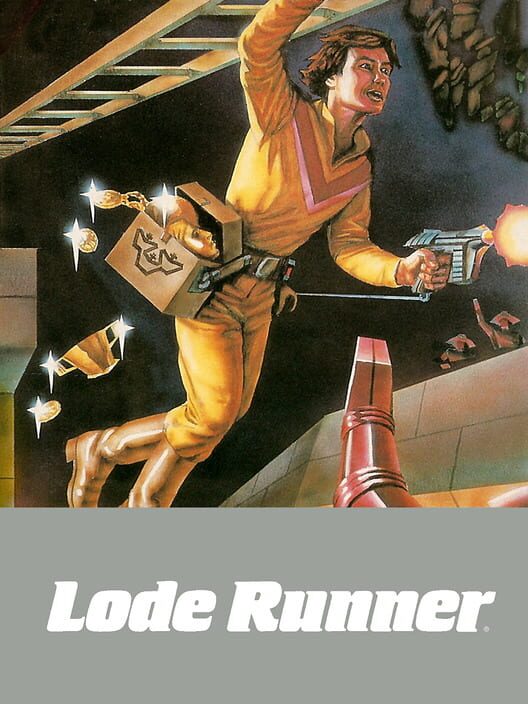
Released in 1983 on Apple II, Mac, and numerous platforms, Lode Runner combines gold collection, platforming, and trapping enemies using holes dug in the levels.
Developer Douglas Smith Publisher Broderbund
When I first touched a computer at the age of five, it was my dear father's Mac Plus, which he had bought for his work.
In addition to the software dedicated to his work, there was a floppy disk (400KB at the time) that was the Holy Grail for me. It contained the first video games with which I started: Chess, Shufflepuck Café, and Lode Runner!
While the first two were extremely frustrating, Lode Runner was relatively easier to get the hang of.
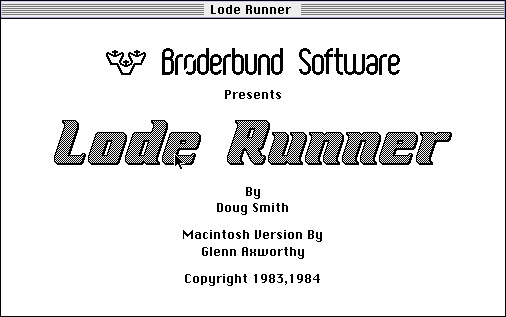
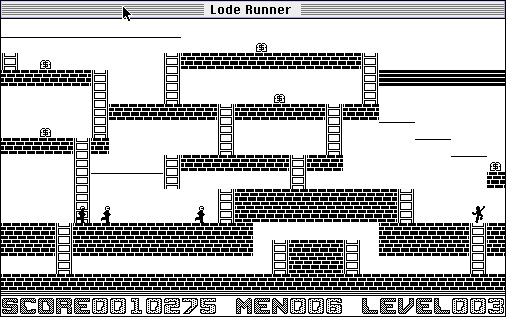
Lode Runner is a game released in 1983, available on several platforms including the Apple II and the Mac. While the Apple II version featured colors, the (first) Mac version was limited to black and white, so don't expect highly advanced graphics. However, the game is very fluid and well-animated for its time, so the lack of colors or grayscale doesn't pose any issues.
The gameplay is simple and intuitive; we control a small character who must collect gold sacks, then exit the level while avoiding enemies that are intent on running into you.
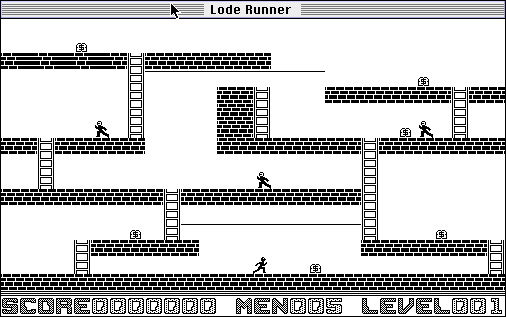
The levels are two-dimensional (of course), with a side view. The levels consist of platforms, walls, ladders, and ropes that must be used wisely to evade enemies while collecting gold.
If that were all, the game would have been just typical for its time, but what set it apart from others was the ability to dig holes in the ground, either to evade opponents (and walk on them to pass) or to dig a path to collect underground gold. To make it not too simple, enemies eventually resurfaced from the holes, and the holes would refill.
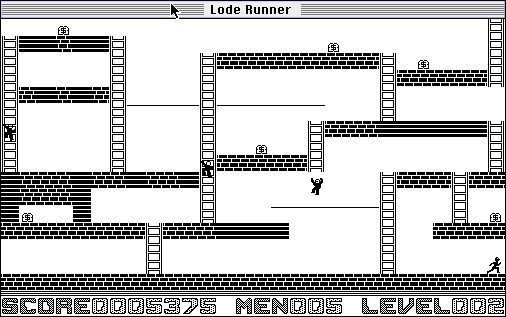
The controls are excellent, fully keyboard-driven, and the game is perfectly responsive. You have 4 keys to indicate the direction to take (I, J, K, and L), and 2 more keys to dig holes, to the left (U) and to the right (O).
The original game contains 150 levels, some of which are really difficult, so you can say the playtime is excellent, especially for a game from that era. They are all very different, and you will sometimes need to think a bit to find the specific mechanics of one level or another.
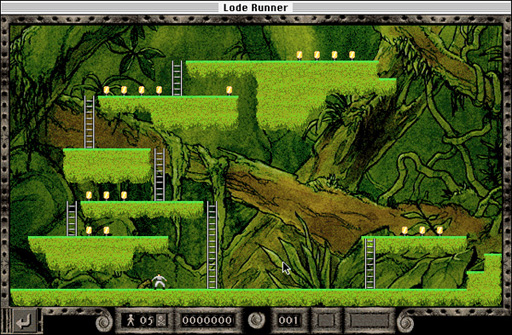
Over the years, many variations and new versions have emerged, including a beautiful 256-color version also available on (old) Mac. This version, in addition to the colors, features music and sound effects.
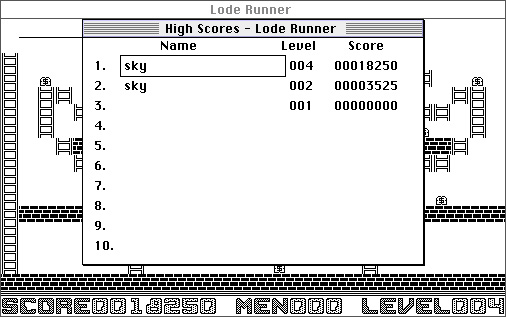
But for me, Lode Runner, the only, the true version, is the first one available for Mac, the one you can see in the screenshots accompanying this article.
Lode Runner works perfectly from System 6 on BasiliskII, to Mac OS 9 on Sheepshaver.
Lode Runner is one of those unforgettable games that have marked the history of video games, and one that you should have played at least once. And when you know that all of this was contained in 84KB, you can say that the developers of the time were a bit like magicians.
Where it fits in time
The whole timelineWhat came out and what happened around 1983.
-
BBC Micro
Computer · Acorn Computers
-
Atari 5200
Console de salon · Atari
-
Dragon 32/64
Computer · Dragon Data
-
The North American video game crash
Too many consoles, too many poor games: the market collapses, and the microcomputer takes over.
-
Amstrad CPC
Computer · Amstrad
-
Steve Jobs leaves Apple
After the power struggle with John Sculley, Steve Jobs leaves the company he co-founded and founds NeXT.
Play it on a Mac
1 Platform emulator
Show the 185 other emulators
An emulator being listed does not mean the game runs: every project keeps its own compatibility list.
Reply on the forum
A question or a hands-on report? Open the discussion on the forum.