Theme Park
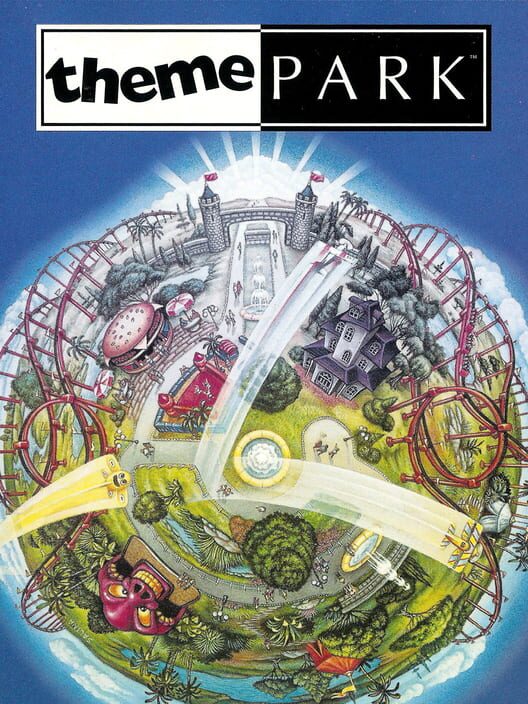
Released in 1994 for Macintosh and numerous platforms, Theme Park simulates the creation and management of an amusement park, covering landscaping, staff, finances, inventory, and visitors.
Developer Bullfrog Productions Publisher Electronic Arts, Bullfrog Productions
Do you love Theme Park?
Theme Park, though not a SIM (even if it shares the pronunciation), attempts a simulation approach on a subject that has inspired all the children we once were and still dreams within us.
For a few moments, we become the director of an amusement park and have the mission of transforming a barren plot of land into a small amusement park, then developing it to become the best amusement park in the world.
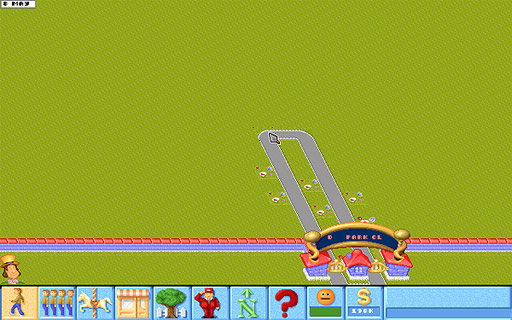
You start with a few attractions, admittedly not the most exciting, but enough to begin, along with some shops that will help empty the wallets of your park visitors a bit more.
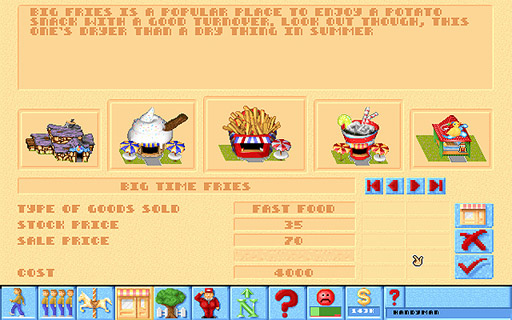
The challenge, but also the pleasure, lies in the placement of attractions, shops, paths, and, since this is a quite advanced simulation, queues, toilets, etc.
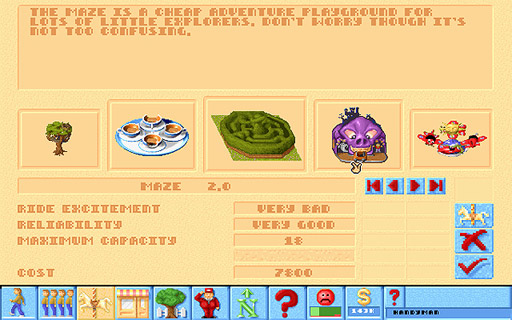
Indeed, this simulation includes a vast number of elements to manage, and while some remain a pleasure and relatively simple, others are extremely complex.
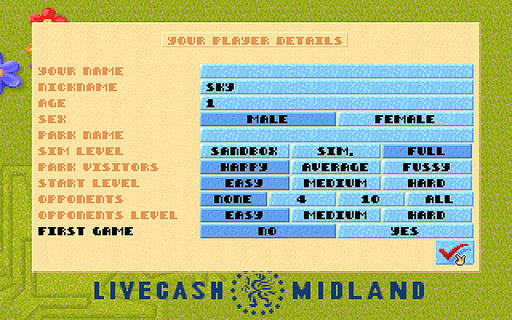
Fortunately, three difficulty levels allow you to bypass some elements, even if the main ones will always be present.
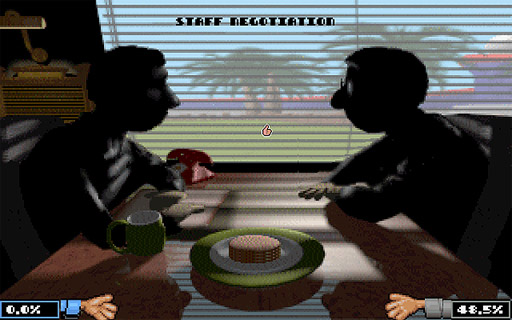
Unlike SimCity, where you can have moments of calm or even waiting, here you must stay at your computer to manage numerous real-time elements: staff placement, salary negotiations or raw material pricing, attractions breaking down, monitoring visitors' needs, you won’t have a minute to spare!
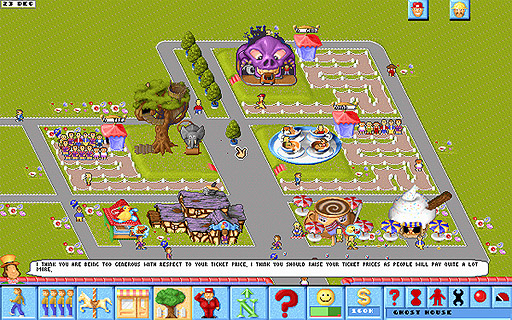
In addition to all this, you will have to manage the stock of consumables in your shops, the various prices, whether it’s the
Ticket prices, as well as shop rates.
Still regarding the shops, you will have to manage caffeine in coffee, salt on fries, sugar in soda, etc. If these parameters seem trivial, they are not at all. More salt on the fries? This will make your customers thirsty, so you need a nearby drink shop. While this could be good news for your profits, it may be bad news for the cleanliness of your park. The more your visitors eat, the more waste you will have, and that's not all—wait for the attractions.
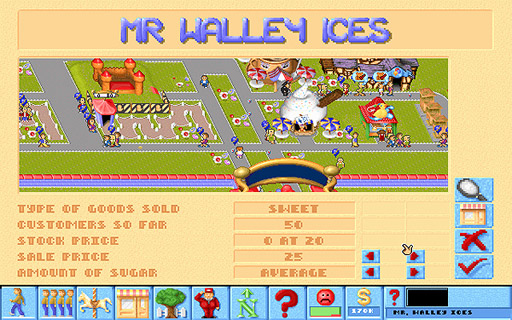
Regarding attractions, you will need to best adapt the number of simultaneous visitors, the duration, and the speed of the ride. Of course, the longer they stay and the faster it goes, the happier they are. However, this can quickly damage your attraction, requiring more frequent repairs and a complete stop of the ride. And speaking of visitors craving sugar, salt, and more, imagine the result when a well-fed and well-drunk visitor takes a fast ride.
All the more so because the simulation is pushed to the limit, as one "mess" can lead to others, even depressing the cleaning supervisor.
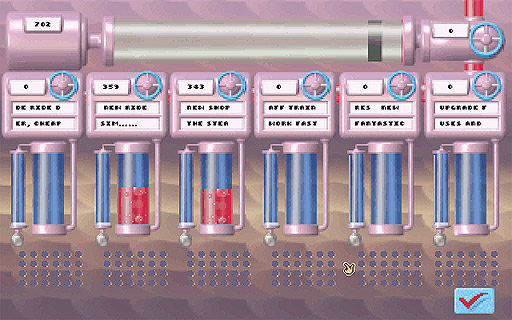
With all this, if you still have some time left, there is also a research management interface, for which you will need to allocate funds and distribute them among the available meters: Attraction improvements, new attractions, shop improvements, new shops, new facilities (toilets, barriers, visual enhancements)...
The ultimate goal of all this is, of course, the satisfaction of your visitors, and on this point, hold on tight to your seat, as they are generally extremely demanding.
Among those who are hungry in front of a burger shop, the annoying tendency for everyone to want to ride the same attraction at the same time (the same moment it breaks down, of course), those who get bored and can't find any attraction... it's enough to pull your hair out.
And I won't even tell you about the frustration of building a new attraction that you find amazing, like a fantastic roller coaster... but with no one going on it, because visitors can't find the way (it's right in front of the entrance).
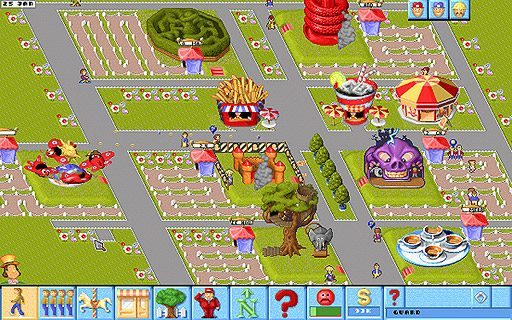
On this point, I think the game has a problem, as it is very difficult to balance all of this. You certainly have to build your park in the way the developer envisioned, but it's a matter of finding it.
Continuing with the flaws, this game suffers from a real ergonomic issue; it can be difficult to locate certain interfaces, as they are scattered throughout the game. Fortunately, on the Mac version, some are accessible from the menu, a small advantage over the DOS version.
Once your park is sufficiently advanced, and if you've managed to keep finances balanced, you can choose to sell it to buy another plot of land and start all over again.
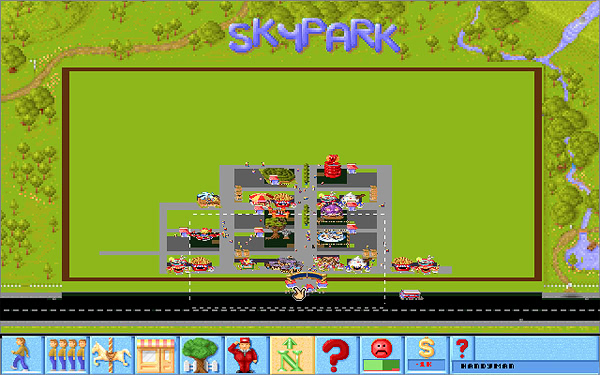
In the end, Theme Park was, and still is, an excellent game, with excellent ideas that provide immense pleasure, though marred by a few flaws, certainly youthful ones, which sometimes limit the enjoyment. The game was followed by two sequels, Theme Park World and Theme Park Inc., of which only the first was released on Mac. These sequels had the advantage of allowing you to take the place of a visitor and test the attractions, which was very fun, especially for roller coasters.
A little tip at the end of the article for those who embark on this adventure: I looked for a while, so I share this— to remove an element (because you missed a queue, for example), just do a Cmd+click.
Where it fits in time
The whole timelineWhat came out and what happened around 1994.
-
Amstrad NC
Computer · Amstrad
-
Executor, the Mac on a PC
ARDI releases Executor 1.0: a 68k emulator that reimplements the Macintosh Toolbox rather than the hardware.
-
CPS Changer
Console de salon · Capcom
-
Basilisk II opens up the 68k Mac
Christian Bauer’s free emulator brings 68000 Macintoshes back to life on other machines, ROMs and System 7 included.
Play it on a Mac
2 Platform emulator
Show the 84 other emulators
An emulator being listed does not mean the game runs: every project keeps its own compatibility list.
Reply on the forum
A question or a hands-on report? Open the discussion on the forum.