Mortal Kombat
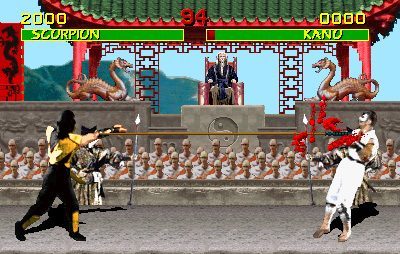
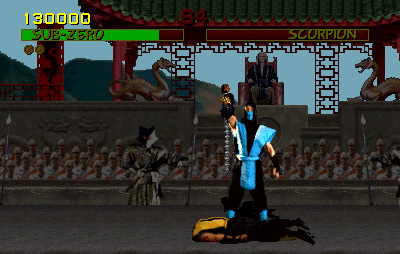
Released in 1992 for arcades before being ported to numerous platforms, Mortal Kombat established its digitized fighters, brutal combat sequences, and fatalities—sometimes censored on consoles.
Developer Midway, Probe Software, Sculptured Software Publisher Midway, Acclaim, Virgin Interactive Entertainment
Do you love one-on-one combat? Brutal, no-holds-barred fighting? Not against a bit of gore? This Mortal Kombat is made for you!
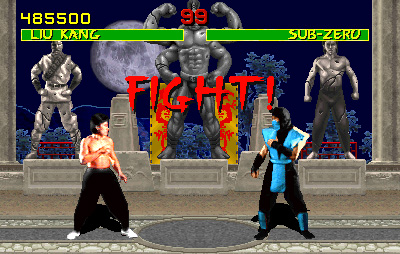
Here’s another game that revolutionized the (then) small world of video games. The integration of digitized images in a fighting game was unprecedented, giving it a unique charm. Each character’s movements are performed by an actor, and the footage is then digitally integrated.
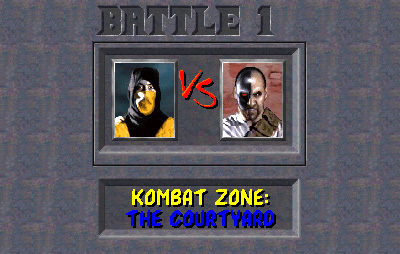
It’s also quite successful, of excellent quality for an era when digital video was still in its infancy. The cuts in character animations were limited, preserving the superior fluidity provided by video.
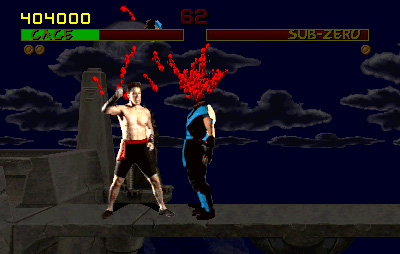
Beyond this video rendering, Mortal Kombat innovates by introducing a level of violence never seen in video games before. Blood raining with every hit! The possibility of "throwing" your opponent into a pit filled with sharp iron spikes ready to tear apart the adversary (The Pit).
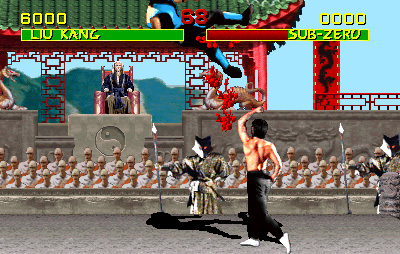
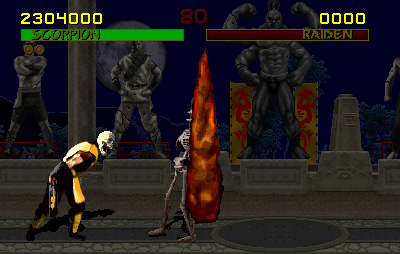
The development team didn’t stop there—they went even further with the fatalities. Special moves that had to be chained after the blood-curdling announcement of "Finish Him" to finish off your opponent.
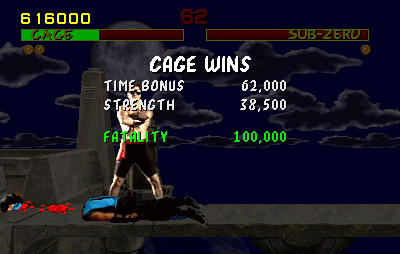
Each character has its own fatality, covering a wide range of gore—from decapitation to immolation, including spinal column removal! Pure bliss for fans.
This violence was censored in console versions, primarily the SuperNES version. Blood, overly gory fatalities, and human body parts in the background were limited or removed. The code a-b-a-c-a-b-b allows bypassing the censorship on the MegaDrive version. Console and computer versions were released one year after the arcade version.
There are some minor variations among these versions.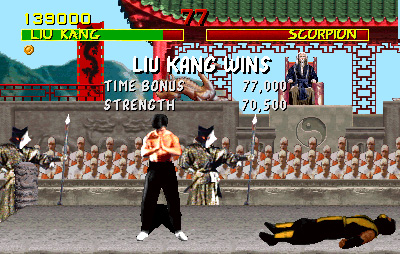
Despite the technical limitations due to video importation, the number of playable characters is correct. There are 7 characters available, each with their own unique abilities.
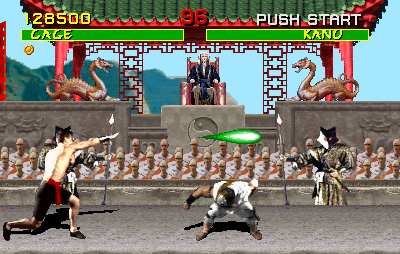
The gameplay is distinctive. It doesn’t use 6 buttons (like in Street Fighter) or 4 buttons (like in SNK's fighting games), but 5 buttons are available: High Kick, Low Kick, High Punch, Low Punch, and a dedicated block button, which is quite unusual for fighting games.
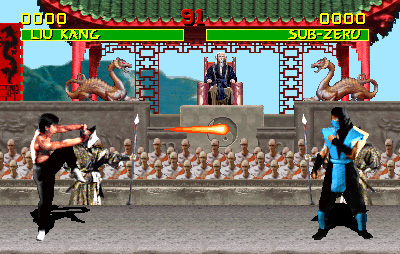
The moves come out easily, but the corresponding button combinations are not necessarily "logical," unlike those in Street Fighter, for example. The game is therefore a bit more challenging to master compared to other fighting games from the same era. Once you get used to it through gameplay and learn the combos, the game becomes a true pleasure.

Mastery of these mechanics will be necessary to face the game’s two non-playable bosses. These bosses are not controllable and add a narrative touch. Five hundred years ago, during the Shaolin World Tournament, Shang Tsung and Goro interrupted the fights, killing the reigning champion Kung Lao. According to Shang Tsung’s plans, Goro—a half-man, half-dragon monster with four arms—became the undisputed champion, bringing chaos to the Earth Kingdoms. A new tournament is organized, and many fighters embark on this adventure, hoping to defeat the demon and restore peace.
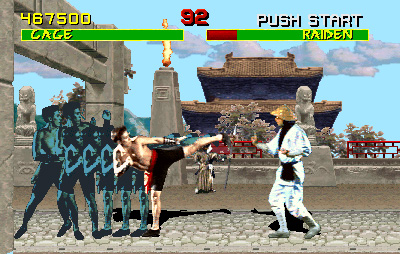
Two hidden, non-playable characters are available in the game. The first is Reptile, a ninja with a design similar to Sub-Zero and Scorpion (in green, a fusion of yellow and blue). You can fight him if you achieve a "Double flawless victory," meaning a double perfect win, on the arena The Pit.
This character will be available by default in the subsequent game releases, featuring a different design.
The second character, according to legend, is a design bug whose name is derived from ERror MACro. Ermac also adopts the design of the two ninjas, this time in red. He will be available as a playable character starting with Mortal Kombat 3.
Midway took advantage of the ambiguity surrounding its existence at the release of the second installment in this series.Are you ready to take on the challenge of Shang Tsung?
Here are the available moves for each character:
Legend
Movement:
U = Up
D = Down
F = Forward
B = Back
Moves:
HP = High Punch
LP = Low Punch
HK = High Kick
LK = Low Kick
DEF = Defense
Johnny Cage:
Fireball: B, F, LP
Shadow Kick: B, F, LK
Ball Breaker: DEF+LP
Fatality: F, F, F, HP (Close to the opponent)
Kano:
Knife Throw: Hold DEF (B, F) or B, F+DEF
Roll: F-D-B-U (Full circle near your opponent starting with Forward)
Ball Breaker: DEF+LP
Fatality: F, D, F, LP (Close to the opponent)
Liu Kang:
Fireball: F, F, HP
Concorde Kick: F, F, HK
Fatality: F-D-B-U (Full circle near your opponent starting with Forward)
Raiden:
Lightning: D, F, LP
Torpedo: B, B, F
Teleport: D, U
Fatality: F, B, B, B, HP
Scorpion:
Spear: B, B, LP
Teleport Punch: D, B, HP
Fatality: U, U (Jump distance)
Sonya:
Sonic Ring: B, B, LP
Leg Grab: LP+DEF+LK
Air Sweep: F, B, HP
Fatality: F, F, B, B, DEF
Sub-Zero:
Freeze: D, F, LP
Slide: LP+DEF+LK
Fatality: F, D, F, HP (Close to the opponent)
Where it fits in time
The whole timelineWhat came out and what happened around 1992.
-
System 7 modernises the Mac
Virtual memory, file sharing, AppleScript: System 7 is the first major overhaul of the Macintosh system.
-
Amstrad NC
Computer · Amstrad
-
Executor, the Mac on a PC
ARDI releases Executor 1.0: a 68k emulator that reimplements the Macintosh Toolbox rather than the hardware.
Play it on a Mac
1 Platform emulator
Show the 100 other emulators
An emulator being listed does not mean the game runs: every project keeps its own compatibility list.
Reply on the forum
A question or a hands-on report? Open the discussion on the forum.