F-Zero
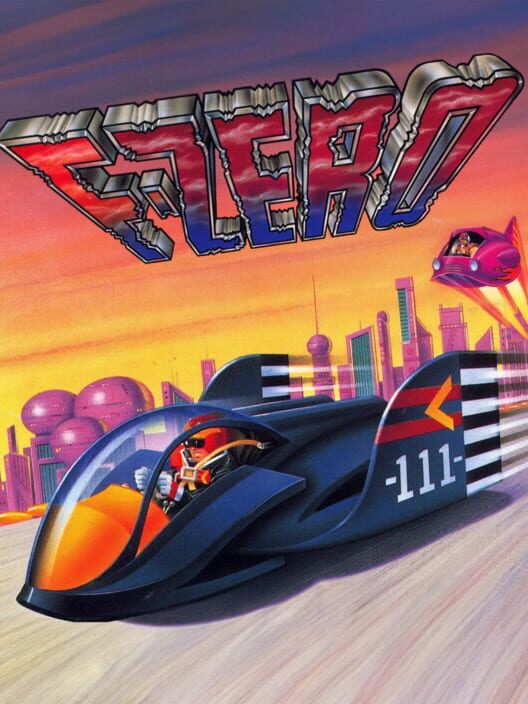
Released in 1990 on Super Nintendo, F-Zero pioneered Mode 7 with high-speed futuristic races, four distinct ships, and fifteen tracks spread across three cups.
Developer Nintendo EAD (R&D4) Publisher Nintendo
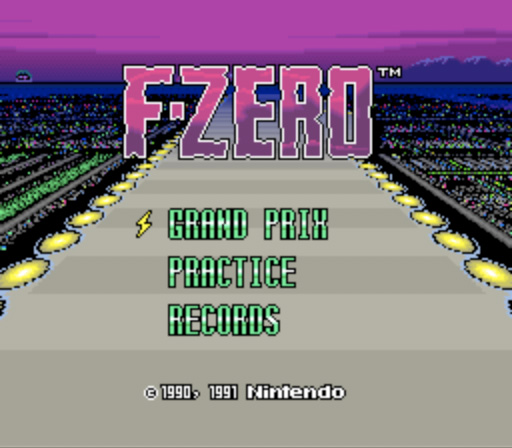
Among futuristic racing games, two series have particularly marked video game history. The first is the WipeOut series, which we had the chance to briefly see an episode on Mac and which still performs well in HD on PS3. The other, much older, began during the era of 16-bit consoles. The first F-Zero episode was released on Super Nintendo, bringing a fresh breath to this console. Indeed, it was the first game to use the famous Mode 7, which can also be found in many other hits of Big N's console, with Mario Kart certainly being the best example.
Ships
The attributes of each ship are: acceleration, handling, durability, and top speed. They determine the potential of each of the four available ships.
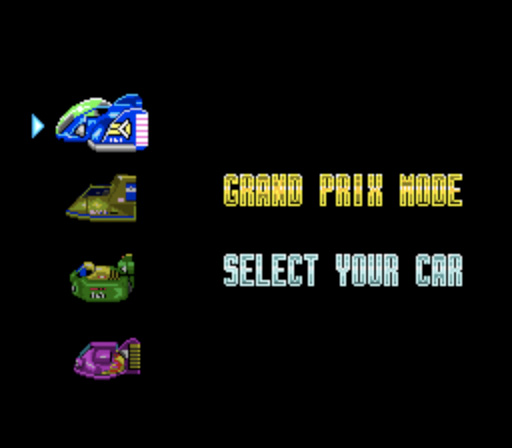
- The Golden Fox, piloted by Dr. Stewart, has the best acceleration but sacrifices top speed and durability.
- The Fire Stingray, piloted by Samurai Goroh, is the fastest ship and has the weakest acceleration.
- The Wild Goose, piloted by Pico, is an intermediate between the two previous ones.
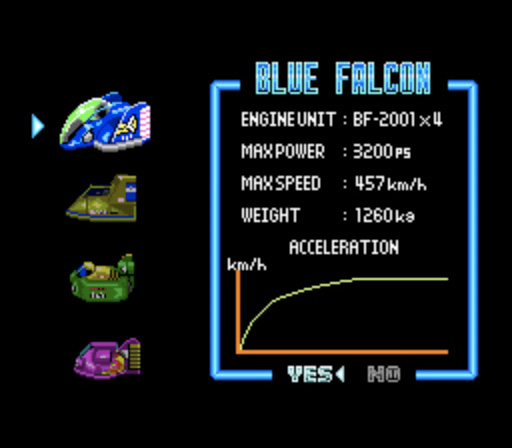
- The Blue Falcon, piloted by the now famous Captain Falcon, who also appears in the Smash Bros. series, is a balanced ship, ideal for beginners in the game.
The Environments
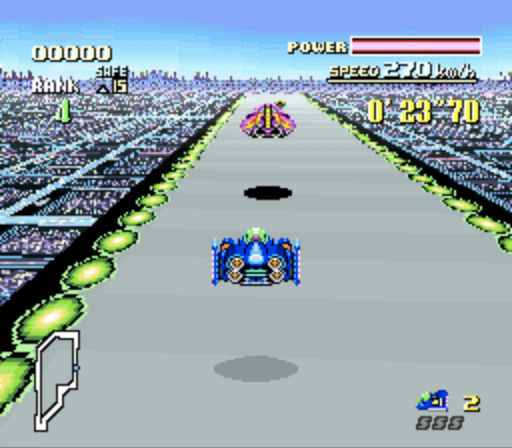
The game features 9 environments, on which 15 races are held, divided into 3 cups. Although the graphics may seem ultra-simple, it should not be forgotten that this is the first game to use the famous Mode 7. The minimalist design of the backgrounds enhances the futuristic aspect of the game, allowing the player to focus on the race, which speeds by at over 400 km/h.
The Races
As with any futuristic racing game, the matches take place at an incredible pace.
You need to weave between slower opponents while avoiding hitting the track edges too often. Each ship has an energy charge that keeps it in place and decreases with every collision. The tracks have areas where you can recharge your ship's shield to continue the race without taking too many risks.
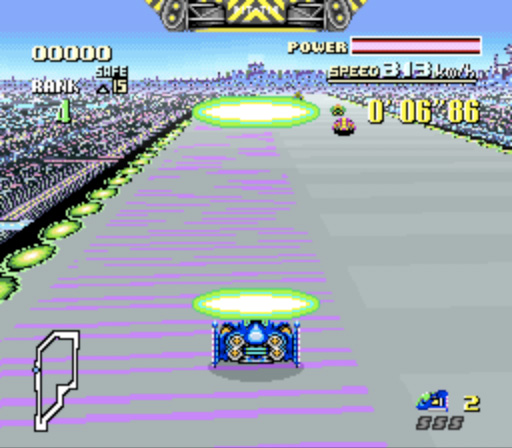
The narrow tracks and extreme speeds require players to have excellent reflexes. The need to finish in the top 3 to continue the championship forces the player to take risks. Good technique will be necessary to overcome the later championships.
Its flaws
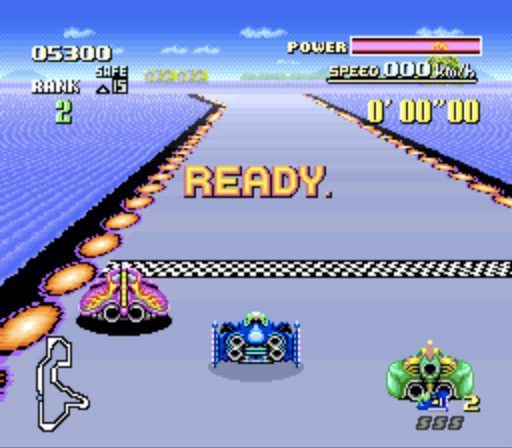
Its main fans will say this game has no flaws. However, it lacks a two-player mode to truly make the game "ultimate".
Conclusion
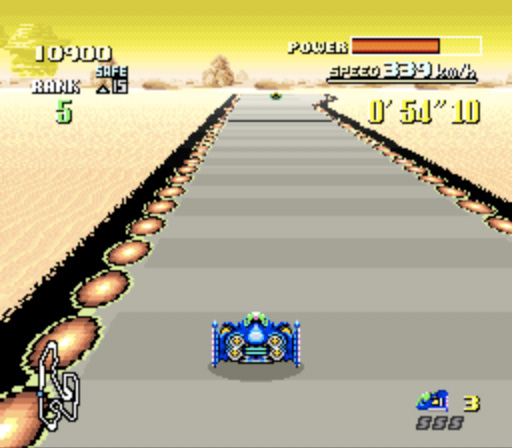
While the game may make you smile today, it remains one of the pioneers of its genre. It is still just as enjoyable to play. Connoisseurs from that era will quickly regain their old reflexes, while young players will be surprised to see that even the fastest games back then never suffered from a lack of frame rate.
Where it fits in time
The whole timelineWhat came out and what happened around 1990.
-
SoftPC runs the PC on the Macintosh
Insignia Solutions brings its x86 emulator to the Mac: DOS and Windows reach Apple machines through software emulation.
-
NeXTcube
Computer · NeXT
-
Mega-Tech
Arcade · Sega
-
System 7 modernises the Mac
Virtual memory, file sharing, AppleScript: System 7 is the first major overhaul of the Macintosh system.
Play it on a Mac
2 Platform emulator
Show the 12 other emulators
An emulator being listed does not mean the game runs: every project keeps its own compatibility list.
Reply on the forum
A question or a hands-on report? Open the discussion on the forum.