The Duel - Test Drive II
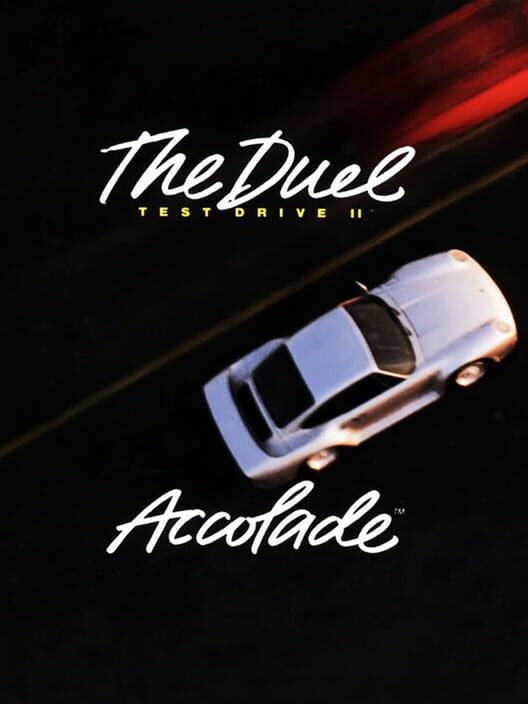
In 1989, The Duel: Test Drive II expanded automotive racing on microcomputers and consoles with two high-performance sports cars, a computer-controlled opponent, and diverse open roads.
Developer Distinctive Software Publisher Accolade
The Duel: Test Drive II is a racing game from 1989, the direct sequel to Test Drive and the second installment in a long series that continued until 2012. It takes its name from the fact that you race against another driver controlled by the computer, unlike the first Test Drive (released on Apple II), where you only raced against the clock.
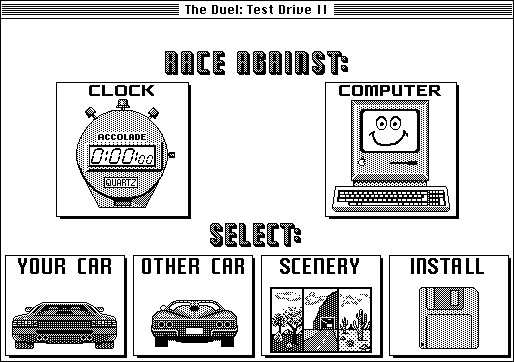
This is not the only advanced feature that this game offers. Indeed, it is packed with original elements for its time, all wrapped in a production using all the technologies of the late 1980s.
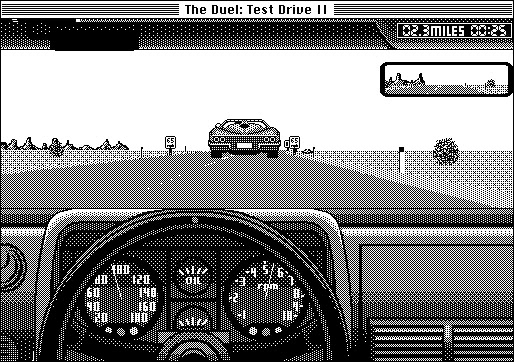
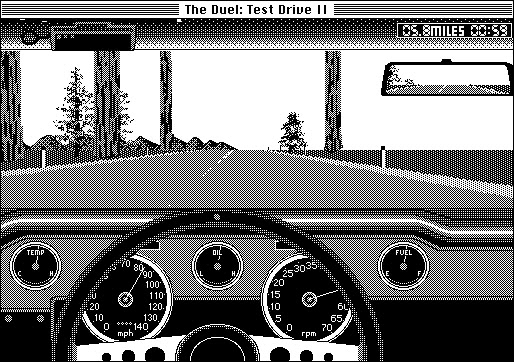
The most impressive aspect is certainly the view the game offers, like its predecessor, you drive the car from its steering wheel, in a pseudo-3D view very well executed for 1989.
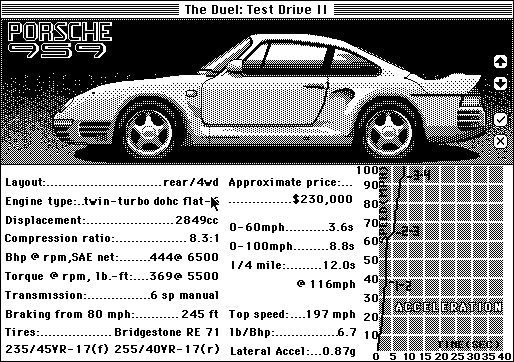
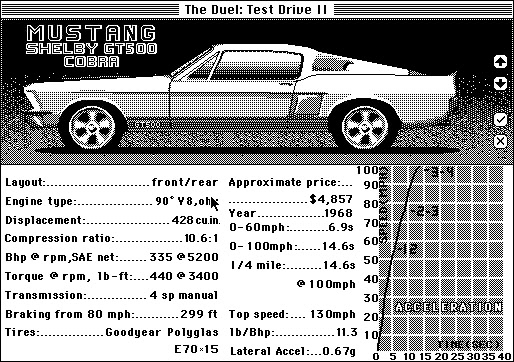
The game allows you to choose, in its original version, 2 cars to drive: a Ferrari F40 and a Porsche 959, both iconic supercars of the era. By selecting your vehicle, you can see its technical specifications.
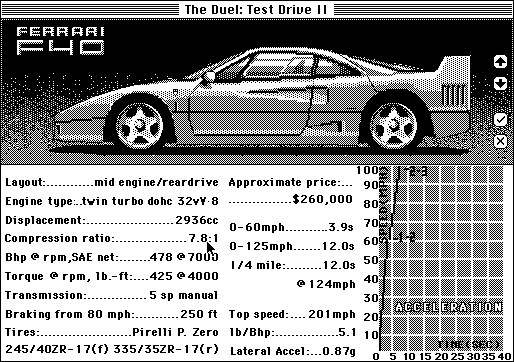
The two vehicles have different handling, as we can see in much more modern games, even if it is limited here to different acceleration and top speeds. Additionally, each vehicle has its own dashboard, modeled after the real one. The gauges are functional and show you the RPM and speed in real time. You can also use the functional rearview mirror to monitor your opponent.
The game features a multi-level scenario with varied environments. The races take place on open roads, amidst traffic. While the first level takes place on plains with some trees, the second throws you directly on a mountainside, between rocks and cliffs, and passing under tunnels.
In addition to having to defeat your opponent, you will also have to rely on the police who will push you not to (too much) slow down despite the poor visibility range. However, you can also reduce your speed when approaching the patrol, thanks to the radar detector.
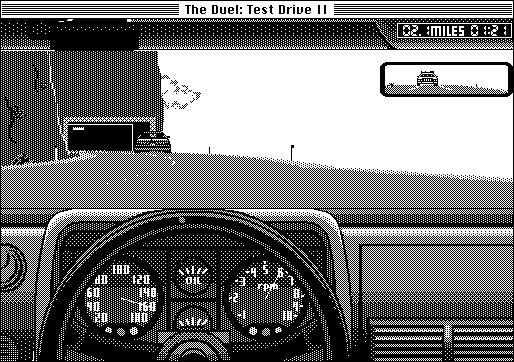
This game features a wide range of difficulty levels, corresponding to the speed of your opponent, as well as the need to manually shift gears. This forces us to keep an eye on the gauges while watching the road.
Failing to shift up a gear will cause your engine to explode, and you will see thick black smoke in your rearview mirror, losing a life in the process. If the concept of "lives" may seem amusing today, and even more so for a car game, it was, at the time, a necessity for most games. If the game seems easy to you, think again, as there are many ways to lose lives. Indeed, as soon as you hit something, you will lose a life; driving is not as precise as in Gran Turismo, forcing you to remain attentive at all times, and may feel frustrating at times. You think you pass, but in the end, you don’t. You can also lose lives if you are caught by the police or if you miss the gas station to refuel.
Finishing the entire scenario is not an easy task.
The tested version is the Macintosh version in Black & White, while other platforms feature colors. It runs on System 7, using Basilisk II. This version allowed you to control the car with a joystick or mouse (unfortunately, not recommended on the emulator).
Something I was unaware of at the time, four DLCs were released (yes, add-ons, in 1989).
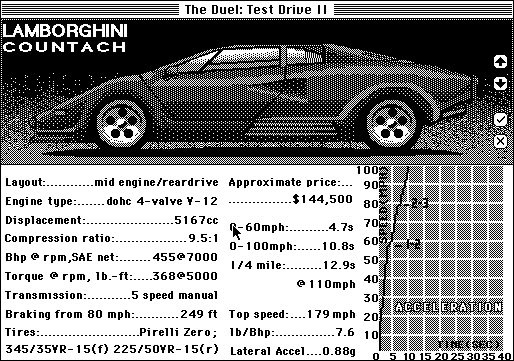
2 vehicle packs, one with additional Supercars (Lotus Turbo Esprit, Ferrari Testarossa, Ruf Twin Turbo, Lamborghini Countach, and Corvette ZR1), and another with American Muscle Cars (1963 Corvette Stingray, 1969 Camaro ZL-1 COPO, 1968 Mustang Shelby GT500, 1967 Pontiac GTO, and 1969 Dodge Charger Daytona), all with their own features and dashboards.
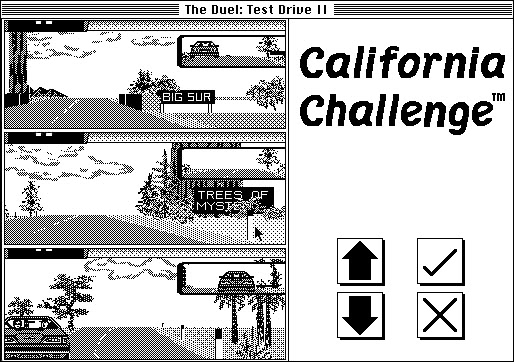
There are also 2 new scenarios named California Challenge and European Challenge to refresh the available routes.
The console versions (SNES, MegaDrive) will arrive later, in 1992, with a third vehicle, a new must-have supercar of the time, the Lamborghini Diablo. However, these versions will not have access to the additional packs.
Small tip: If you find the add-ons in .dsk format, change the extension to .dmg, open the disk image on your Mac OS X, then copy the contents into your The Duel folder on your emulated old Mac.
Where it fits in time
The whole timelineWhat came out and what happened around 1989.
-
SoftPC runs the PC on the Macintosh
Insignia Solutions brings its x86 emulator to the Mac: DOS and Windows reach Apple machines through software emulation.
-
Sharp X68000
Computer · Sharp
-
NeXTcube
Computer · NeXT
-
System 7 modernises the Mac
Virtual memory, file sharing, AppleScript: System 7 is the first major overhaul of the Macintosh system.
Play it on a Mac
1 Platform emulator
Show the 73 other emulators
An emulator being listed does not mean the game runs: every project keeps its own compatibility list.
Reply on the forum
A question or a hands-on report? Open the discussion on the forum.