Ninja Spirit
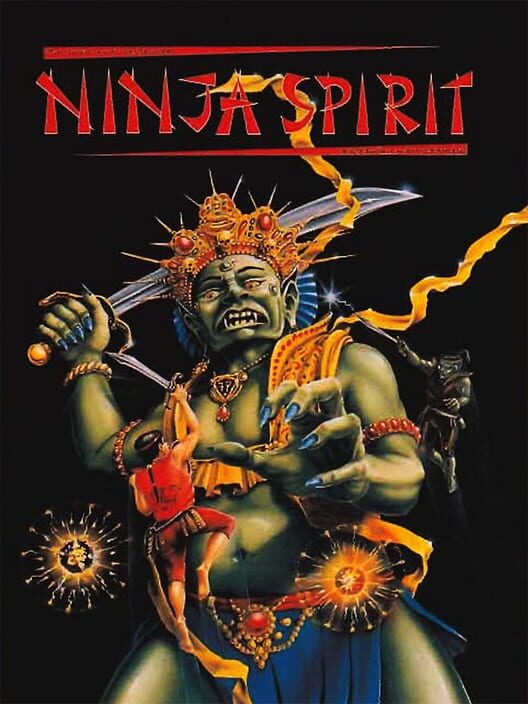
In 1988, Ninja Spirit offered a demanding arcade-style action set in a medieval Japan, where Tsukikage switches between four weapons, performs variable jumps, and uses clones to navigate through seven stages.
Developer Irem Publisher Irem, NEC
Irem will remain for many players the developer of the legendary shoot-'em-up R-Type and its sequels. Yet limiting this Japanese developer to this series would be reductive when considering that on arcades alone, the company is also responsible for other major titles like Moon Patrol and Kung Fu Master, and especially for some lesser-known gems like Ninja Spirit.
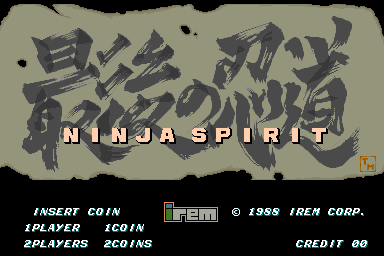
Ninja Spirit is a 1988 action game set in medieval Japan. The player takes on the role of Tsukikage, a ninja dispatched to free the world from the malevolent grip of a demon, and must traverse 7 stages and face as many bosses to complete his mission.
During his journey, Tsukikage has at his disposal 4 weapons that he can switch freely between:
-the katana: a melee weapon with a sweeping arc
-the shurikens: fast but weak projectiles
-the bombs: powerful but slow-to-recharge projectiles
-the sickle: a weapon that pierces enemies along a straight line
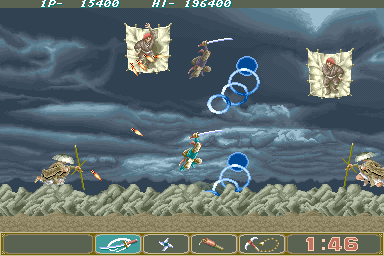
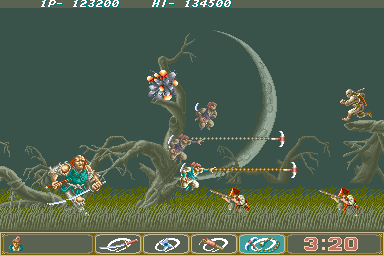
The real interest of this weapon system lies in the fact that these weapons are quite different, requiring the player to use them wisely depending on the situation. Focusing solely on one weapon and neglecting the others will not get you far. It should be noted that weapons can be fired in any of the 8 directions, even while jumping.
Tsukikage is a highly skilled ninja who can walk on ceilings. However, the originality of Ninja Spirit lies elsewhere: the ninja can perform variable-height jumps up to extreme heights and has the ability to be assisted by clones (up to two), which follow his movements and replicate his attacks. These abilities combined with the weapon system make up the true strength of the game's gameplay.
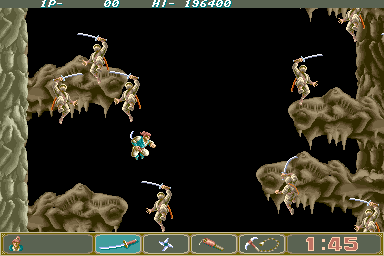
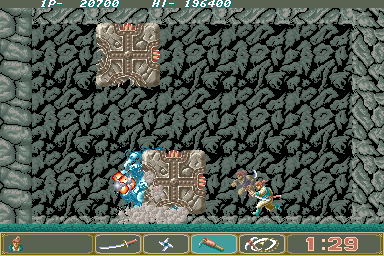
Some ninjas encountered leave behind a bonus after being defeated.
These bonuses come in four forms: a temporary fire shield, a bonus that kills all on-screen enemies, and especially the clone bonus, as well as one that upgrades the current weapon in use. Thus, the katana becomes more powerful and leaves a blue trail behind it, shurikens are launched in sets of three, bombs recharge instantly, and the scythe can spin.
Ninja Spirit is an action-packed game. Based on the same hardware as R-Type, the M72, the game displays masses of enemies without any stutter, along with their projectiles, which rarely give the player a moment of respite. Since upgrades and clones are lost upon Tsukikage's death (who has no health bar and dies at the first hit), knowing how to obtain and retain them for as long as possible is crucial to smoothly passing certain sections. Indeed, Ninja Spirit does not disappoint Irem's reputation and is a difficult game. While the first two levels are relatively easy, things quickly become tough starting from the third, becoming very hard in the last two levels (though not impossible, regular checkpoints are placed in most stages).
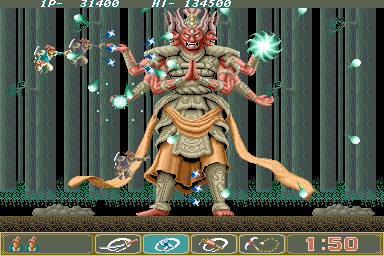
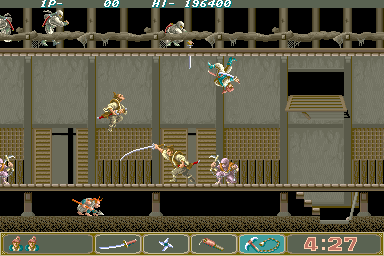
Graphically very successful, Ninja Spirit draws on Japanese folklore, which is perfectly rendered in both enemies (soldiers, ninjas, samurais, ghosts, monks, ...) and backgrounds (temple, forest, cliff, cave, ...), contributing to a tense atmosphere throughout the game, heightened by a rhythmic, slightly oppressive soundtrack.
Ninja Spirit has seen several ports to consoles and computers, all inferior to the arcade version. The PC-Engine port is likely the most recognized. This port is fairly faithful to the original, though some scenes experience slowdowns, fewer enemies, and a soundtrack that falls short compared to the arcade version.
This version also adds a new mode where the hero has 5 health points, making the game easier, even though some enemies still kill in one hit.
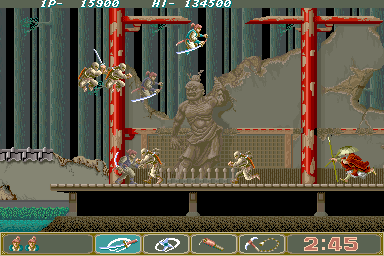
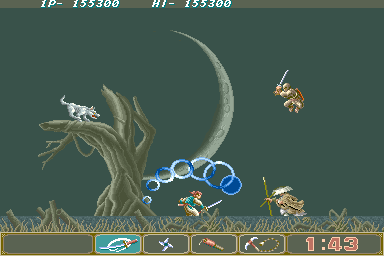
At the time, the excellent gameplay of Ninja Spirit was not overlooked, as evidenced by the idea of clones being reused two years later in Ninja Gaiden 2 on NES. Yet, Irem never deemed it necessary to give it a sequel. The game ultimately remains a rather atypical title within the company's catalog, and over time, it has somewhat fallen into obscurity. But so what, Ninja Spirit remains one of Irem's greatest successes, and among the dozens of titles based on the "ninja" universe developed at the time, Ninja Spirit remains today one of the best representatives of the arcade genre.
Where it fits in time
The whole timelineWhat came out and what happened around 1988.
-
Steve Jobs leaves Apple
After the power struggle with John Sculley, Steve Jobs leaves the company he co-founded and founds NeXT.
-
Atari 7800
Console de salon · Atari
-
SoftPC runs the PC on the Macintosh
Insignia Solutions brings its x86 emulator to the Mac: DOS and Windows reach Apple machines through software emulation.
-
Sharp X68000
Computer · Sharp
-
NeXTcube
Computer · NeXT
-
Mega-Tech
Arcade · Sega
Play it on a Mac
1 Platform emulator
Show the 86 other emulators
An emulator being listed does not mean the game runs: every project keeps its own compatibility list.
Reply on the forum
A question or a hands-on report? Open the discussion on the forum.