Street Fighter Alpha
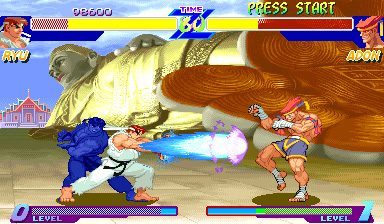
Released in 1995 for arcades and consoles, Street Fighter Alpha revitalized the series in 2D with detailed sprites, smooth animations, dynamic backgrounds, and some gameplay refinements.
Developer Capcom Publisher Capcom, Virgin Interactive Entertainment
Released in June 1995, as many began developing 3D fighting games, Capcom revitalized its flagship fighting game series with a 2D-enhanced version.
But how does Street Fighter Alpha compare to games like Tekken, SoulEdge, or Virtua Fighter? This question has certainly been asked thousands of times!
The game's visuals were completely redesigned from the Street Fighter 2 classics, as developers eventually exhausted the possibilities given the number of versions available. Capcom, having retained this 2D display that it masters perfectly, offers a very visually appealing versus fighting game that retains the core gameplay mechanics.
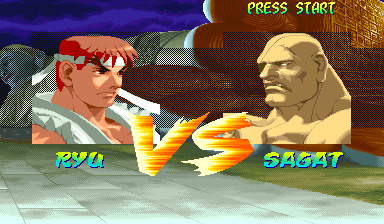
Graphically, the first thing that stands out is the rendering of the characters, which are more detailed and better integrated into the backgrounds. The impression of sprites overlaid on a background has faded. Despite the 2D space, a sense of depth is present to demonstrate that the game has nothing to envy to its 3D competitors.
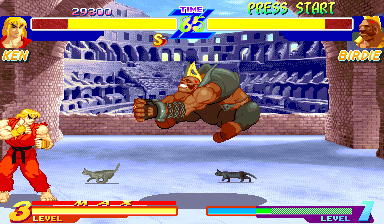
The character animations are smoothed to the maximum. Actions are no longer visible on two frames but are fully decomposed, making the game much smoother. All of this combined with advanced graphical effects.
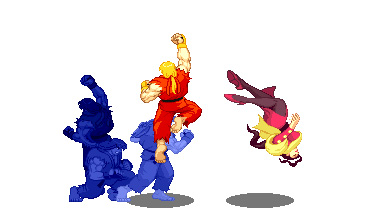
The six (only) backgrounds now feature multiple layers of sprites, allowing the backgrounds to come alive with many independent animations. The game is a masterpiece in terms of aesthetic realization.
The sound atmosphere has also undergone a similar upgrade, goodbye 16-bit console sounds, we now have clean, well-rendered sounds, and above all, perfectly integrated with the rest of the game.
The gameplay barely changes, but how can you improve a system already so complete and which has been the main strength of the game? Among the few new features, you can now block aerial attacks, adding an extra layer of technique.
There are also the super combos, more powerful special moves that require charging an energy bar. Placing them at the right moment during combat adds an extra layer of strategy. They are often close to the original moves of the fighters, both in terms of button sequence and the action performed.

Inherited from Street Fighter II Turbo, the mode of the same name is still available with character selection. It allows the game to be sped up, reserved for players who find the game too easy at normal speed.
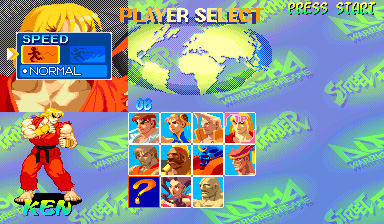
A small regret regarding the number of fighters available, 10 plus 3 hidden, totaling 13. This number seems low, especially after getting used to a constant overabundance of characters. You'll find the classics Ken and Ryu, as well as some other iconic figures from the series like Sagat or Chun Li. You'll also find a few characters from Street Fighter I who disappeared with the release of The World Warriors.
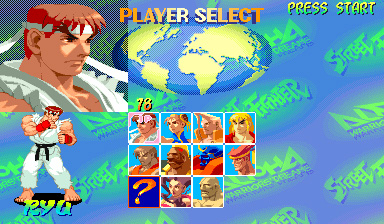
Among these familiar characters, there are a few new ones who are not afraid to challenge the regular street fighters. These characters are quite different from all the ones we already know. This forces Street Fighter II specialists to adapt their gameplay to face new moves.
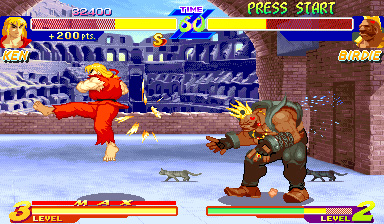
The difficulty has been lowered in this episode, allowing beginners (like me! :D) to practice and win a few matches. However, it remains challenging, as the final will require a more solid technique to be won.
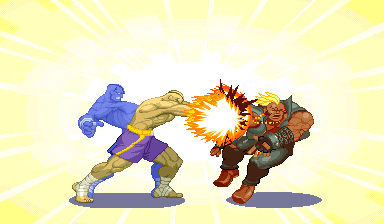
This episode, sometimes criticized for its "simple" 2D, marked the revival of the series in a very successful way. Two more installments of this Alpha series were released in 1996 and 1999, featuring many more characters to compensate for the lack in Street Fighter Alpha. A successful transition to a new generation was achieved.
You have a perfectly balanced, fast, and smooth game... Everything you loved about the Street Fighter II series... but better.
Some tips for this game:
Playing with hidden characters:
- Akuma: Place the character selection on the ? (random). Press and hold the start button. Type: down, down, down, left, left, left, then strong punch and light punch simultaneously. Release start.
By using kicks instead of punches, you'll get a different costume color for the character. If you're Player 2, you'll need to use the right movement instead of left. - M. Bison: Place the character selection on the ? (random). Press and hold the start button. Type: down, down, left, left, down, left, left, then strong punches and light punch simultaneously. Release start.
Like Akuma, using kicks instead of punches will give you a different costume color for the character. If you're Player 2, you'll need to use the right movement instead of left. - Dan: While holding start, place the character selection on the ? (random). Then type light punch, light kick, mid kick, strong kick, strong punch, mid punch. Release start.
To get the green costume, the sequence is strong punch, strong kick, mid punch, light kick, light punch, mid punch.
Playing in Dramatic Battle mode (2 players):
The Player 1 must be on Ryu, hold start, and press up twice. Then release start and press up twice followed by light punch. Then Player 2 must be on Ken, hold start, and press up twice. Then release start and press up twice followed by strong punch.
The Dramatic Battle mode starts, with Ryu and Ken fighting M. Bison together.
Where it fits in time
The whole timelineWhat came out and what happened around 1995.
-
CPS Changer
Console de salon · Capcom
-
Basilisk II opens up the 68k Mac
Christian Bauer’s free emulator brings 68000 Macintoshes back to life on other machines, ROMs and System 7 included.
-
CP System III (CPS3)
Arcade · Capcom
-
Apple buys NeXT
Apple acquires NeXT for $429 million. NeXTSTEP becomes the basis of Mac OS X, and Steve Jobs returns.
Play it on a Mac
1 Platform emulator
Show the 67 other emulators
An emulator being listed does not mean the game runs: every project keeps its own compatibility list.
Reply on the forum
A question or a hands-on report? Open the discussion on the forum.