Diablo
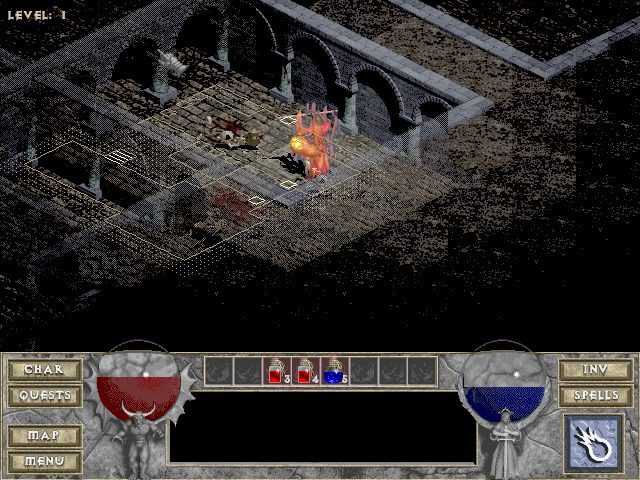
1997, Windows, Macintosh, and PlayStation: Diablo blends random dungeon exploration, real-time combat, hero progression, and loot gathering in Tristram.
Developer Blizzard North, Climax Group (PlayStation) Publisher Blizzard Entertainment, Electronic Arts (PlayStation)
Back in Tristram, you, finally your hero, realize that an evil is corrupting this village in the kingdom of Khanduras. To solve the mystery haunting the city, you will have to enter the cathedral and clean, or rather clear, the successive levels that will open up to you.
Behind this seemingly simple synopsis lies a video game masterpiece, the inventor of a genre that has always remained popular: the Hack'n slash.
Like Warcraft a few years earlier, Diablo revolutionized role-playing games by introducing real-time gameplay! Goodbye turn-based systems, hello direct action responding instantly to mouse clicks!
You click to move your character, you click to attack, you click to cast a spell, you click to drink a potion, you click to pick up an item, you click to open a door or a chest, in short, the mouse is your best weapon against the horde of enemies you will face. Fortunately, a few keyboard shortcuts are there to help you manage everything at once, especially for potions that sometimes need to be taken quickly in the heat of battle. This game and its sequels have often been described, rightly so, as "mouse killers," you click so much that it's not surprising for a mouse to fail mid-game.
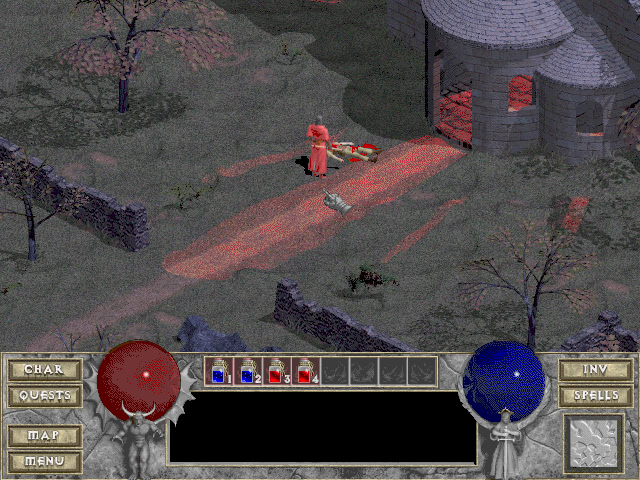
Whether it's attacking enemies or fleeing a complicated situation, action is truly omnipresent. And you can't really rest until the level is "cleaned," the action is continuous! The dungeon exploration is done level by level, randomly generated, which was already a revolution for its time, and it is therefore impossible to memorize them to make the game easier.
Diablo also includes what makes role-playing games successful, namely a detailed character sheet with experience points, statistics that can be improved by leveling up or with items found on the corpses of defeated enemies.
If "loot" or the act of gathering items is an important part of the game, it will become predominant in its sequels, Diablo 2 and Diablo 3, which are both playable on macOS without the need for emulation, despite their age and especially the 18 years of Diablo 2.
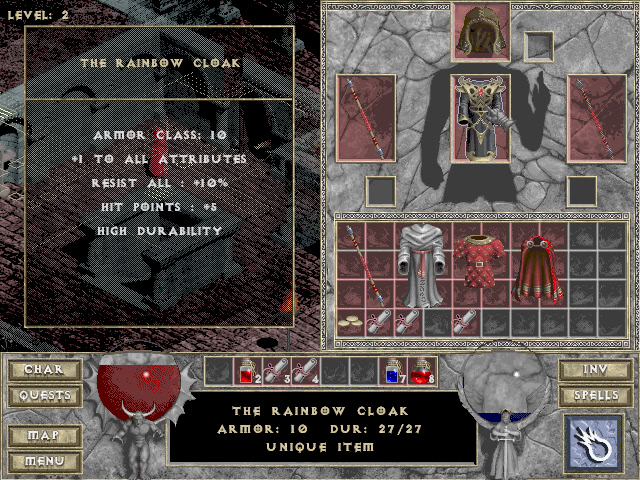
Leveling up and gathering weapons, armors, and jewelry are therefore necessary to improve your character and make it capable of defeating more and more enemies, as well as stronger enemies. From this version on, there are several types of items: "white" items are standard or non-magical objects, then there are "blue" items which are magical and provide an additional characteristic to your character, such as improving a statistic or a spell, and finally, there are "yellow" or unique items, which are predefined objects improving multiple characteristics.
When it comes to spells, there isn't much originality; you'll find the usual electric arcs or fireballs, but real-time gameplay adds a new dimension, as in addition to rolling a die to determine if your spell hits the enemy, you'll also have to aim at that enemy, risking wasting all your mana without any result.
You can also rely on the help of the inhabitants of Tristram, who are delighted to have you with them to fight evil, but will charge you an arm and a leg for their services, weapons, armors, or potions. They will still give you some nice items when you complete a quest. Also, they will buy back anything you find that you ultimately don't need. Don't forget to identify magical items before selling them; they often bring in much more than the 100 gold pieces Cain will ask you for identification.
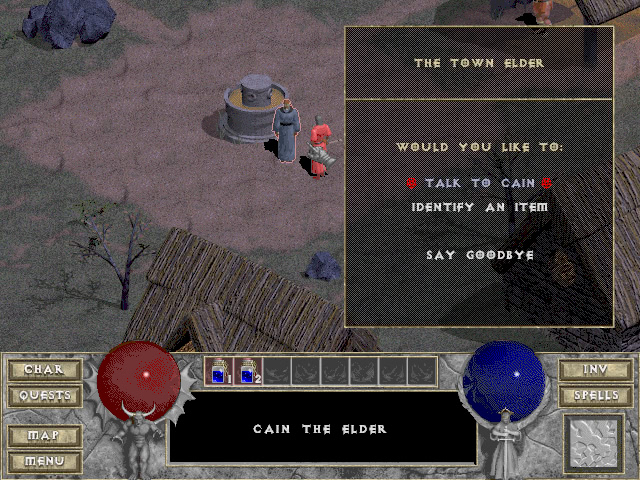
Some of these inhabitants have become iconic figures in the series, starting with Deckard Cain, but also Griswold the blacksmith, or Adria, who plays a key role in the story of Diablo III.
If you're looking for this witch in Tristram, you'll have to leave the village and head southeast to find her!
The analogy with Warcraft doesn't stop at this simple notion of time; each pioneer of their genre, they introduced numerous mechanics that became standards for all subsequent games.
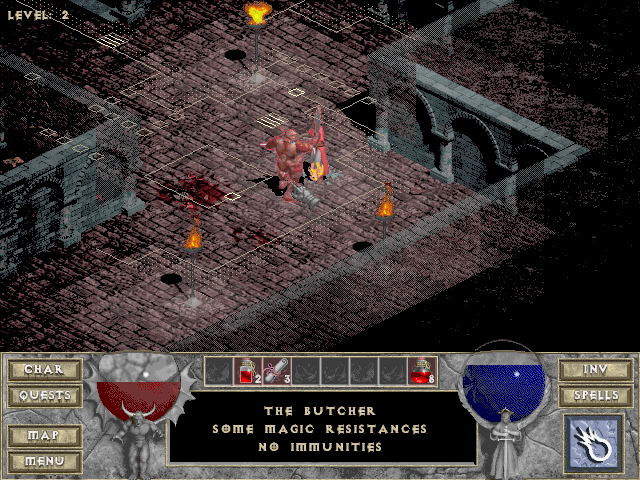
Thus, in addition to the monsters encountered throughout the game, it is possible to come across unique enemies, or even bosses for whom the fight will be a bit more challenging. The most obvious example is the Butcher, found as early as level 2, and it is preferable to leave him alone until you have leveled up a bit and found sufficiently powerful equipment to attempt facing him.
You will have to manage your inventory, as you cannot carry everything, so you'll have to choose which items to keep or make multiple trips back to town, meaning retracing the entire path in reverse. Fortunately, town portal scrolls are there to save us some of these trips. However, it is not uncommon to stumble upon an item you forgot about or didn't see dropped, despite several passes. Picking up and managing items becomes quite an art.
Well thought out, it is possible to display a highlighted map, allowing you to navigate the labyrinths of the levels more easily. You quickly get used to having it constantly with you to save some time on sometimes tedious trips or to find an unexplored area of the level.
Although Diablo is today a game largely surpassed, both graphically and technically, by its sequels, as well as by the numerous clones that have emerged in this niche, it can also be frustrating in some respects because it is the first of its kind, it remains nevertheless very enjoyable to play and reminds us of the immense success of this game, which entered history now 20 years ago.
The best-of was achieved on the Mac version of the game, released one year after the PC version and running perfectly on SheepShaver (with the latest patch, bringing the game up to version 1.09).
It unfortunately doesn’t work on QEMU due to the unavailability of 256-color mode. It is possible to force this mode with some tweaks, but in that case, the game won’t display the correct colors. You might want to try with an older system like 8.6 or even 8.1, which was the latest version at the time of the game’s release.

Where it fits in time
The whole timelineWhat came out and what happened around 1997.
-
Basilisk II opens up the 68k Mac
Christian Bauer’s free emulator brings 68000 Macintoshes back to life on other machines, ROMs and System 7 included.
-
CP System III (CPS3)
Arcade · Capcom
-
MAME documents arcade cabinets
The Multiple Arcade Machine Emulator project sets out to preserve arcade hardware, game by game.
-
Connectix Virtual PC virtualises the PC on Mac
Virtual PC puts a complete PC in a Mac window, BIOS and disk included: emulation becomes a consumer product.
Play it on a Mac
3 Platform emulator
Show the 39 other emulators
An emulator being listed does not mean the game runs: every project keeps its own compatibility list.
Reply on the forum
A question or a hands-on report? Open the discussion on the forum.