Worms

Amiga, 1995: Worms pits teams of worms against each other in tactical 2D battles on randomly generated maps, featuring a diverse arsenal.
Developer Team17 Publisher Ocean Software
We knew about ultra-violent war games, now it's time for "cute" war games. And Worms is one of the rare ones to belong to this category. This game, which brought fame to Team17, and which, thanks to its success, spawned numerous sequels. Unfortunately, these sequels never matched the quality of the first installment, which we will explore here.
The game's principle is simple: four worms per team try to destroy their opponents. All of this takes place on a terrain strewn with mines and completely chaotic, with themed backgrounds. To achieve their goals, players must use the most cunning techniques and all available weapons. The game's style heavily depends on the number of teams in play. In a duel, the match will be calm, thoughtful, and deliberate, whereas with four teams on the field, it quickly turns into organized slaughter.
Before starting to play, you need to create a team for each player. The game allows creating a sufficient number of teams. Each player can create their own team and save it for later use in other matches. The advantage is that the game keeps track of some statistics for the teams. You will thus know the number of matches played, the number of matches won, and whether you kill more worms than you lose.
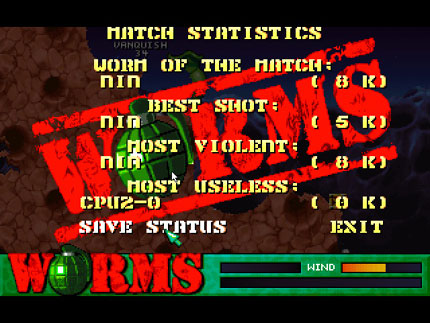
Once the teams are created, you just need to enter the game. On a randomly generated terrain, all the worms and mines are placed randomly. The themes are numerous and help avoid monotony, including Hell, snowy mountains with snowmen, the lunar surface where gravity is less intense, and the list is far from complete. The terrain is displayed in 2D side view, so all the worms are on the same virtual line. Over time, the terrain will erode or even deepen due to the intensive use of weapons.
Controlling the worms is easy; you quickly get the hang of it (no pun intended). They can move, jump, and position themselves optimally to annihilate enemies while staying out of the way of opposing projectiles.
There are additional movement options available.
Indeed, you can use certain tools provided.
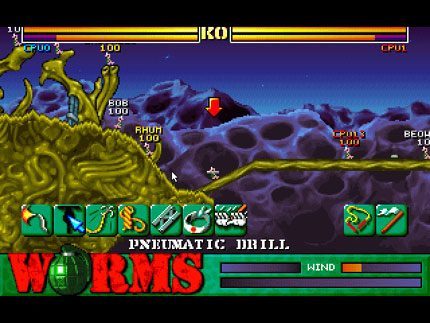
Among these, you will find the bungee jump to descend some too steep slopes, the ninja rope to cross certain dangerous precipices, or even a teleportation device, but be careful, this one makes the player worm skip their turn.
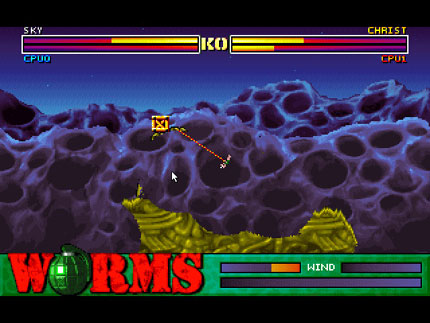
A substantial arsenal allows you to vent your frustrations on your enemies as much as you like. There's a simple bazooka where you'll need to adjust the power and firing angle (a bit like the old Mac games like Canon Fodder or Artillery). You'll also need to account for wind strength in your firing settings. There are grenades, unaffected by wind, where you'll additionally need to set the explosion timing. There are also their smaller counterparts, cluster grenades, which, upon explosion, scatter several small explosives.
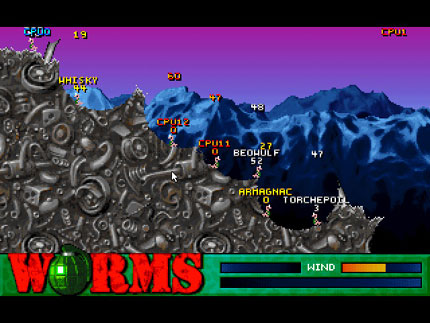
Moving on to firearms, which include the shotgun, allowing you to fire two blasts, and the Uzi, a mini machine gun quite effective if you're precise enough. The following weapons are directly inspired by Street Fighter: the Dragon Ball and Fire Punch allow you to send your enemy flying. For those not satisfied with the previously described weapons, there's the option to place additional mines or dynamite. Powerful, you'll need to hide well after placing them.
You'll need to carefully manage your weapons as some are limited in quantity.
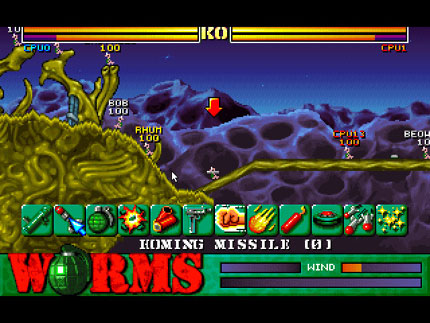
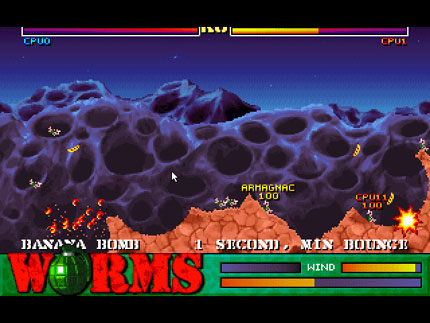
The game occasionally offers random gifts on the battlefield during a match. Among these gifts, you'll find extra ammunition for limited-quantity weapons or much less conventional weapons than those you start with. For example, one of the most devastating weapons, and certainly the one that made the game famous: the Banana Bomb. It is essentially a cluster grenade, whose small explosives release have the power of dynamite.
In general, with this weapon in play, the battlefield shrinks significantly and matches end quickly.
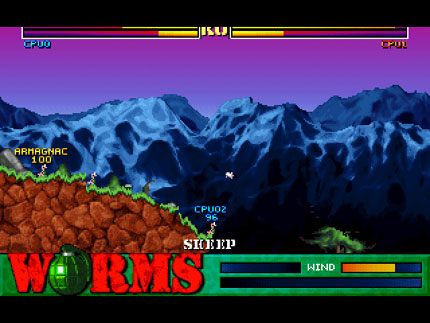
There is also the Sheep, a small bouncing lamb that you can control to explode at a specific time. It can cause havoc too, as it has the power of dynamite but requires relatively flat terrain to be effective.
Despite the game's childish side, each match requires advanced and varied strategies to eliminate the opposing worms while losing as few of your own as possible. You need to know how to use the ninja rope to place a bomb as close as possible to the enemy worms. Don’t hesitate to sacrifice one of your own worms if it is severely weakened, and send it on a suicide mission that will cause losses among the opposing teams. Thus, teleportation, which seems unable to deal damage, can become a formidable weapon by throwing your worm onto one or more mines near your adversaries.
It’s up to you to imagine the most cunning technique to emerge victorious from this merciless battle.
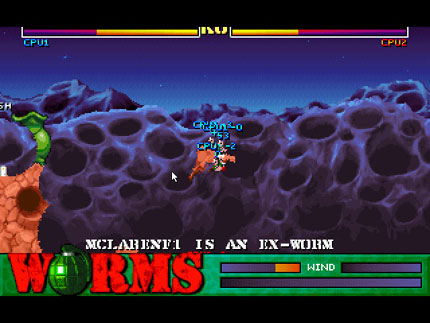
If you’re lacking human players, an artificial intelligence allows you to train while waiting for your friends. However, it has the unfortunate tendency to be excessively skilled. At the easiest level, enemy worms will be somewhat limited: either with a completely missed shot—firing into the air, into the water, etc.—or with a completely foolish shot by killing their own worms for nothing, or with a stroke of genius, a move you’d dream of executing. Increasing the difficulty of the artificial intelligence will reduce the percentage of missed or foolish shots. It should be noted that you can manage the AI of the teams controlled by the computer independently, allowing you to progressively increase your own level.
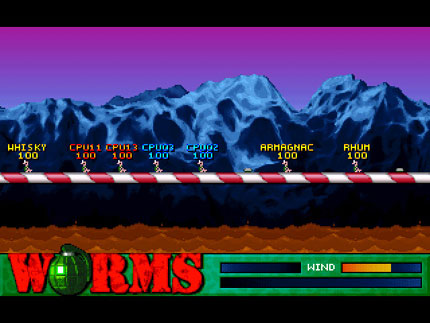
Despite its strong pixelation, the design is pleasant, even superb, for its time. Combined with extremely smooth animations, it’s a real pleasure to play.
The wriggling worm moving forward, each weapon featuring a mini-animation for shooting, and the water or flames of the terrain coming to life, with a multi-layered background to create a sense of depth—nothing is left to chance.
Even though Worms has a few minor flaws, they are easily forgiven when you see the sheer enjoyment this game brings, as it remains rare even today to find a game so "fun" and that can be played by up to four players on a single machine (PC or console).
Where it fits in time
The whole timelineWhat came out and what happened around 1995.
-
CPS Changer
Console de salon · Capcom
-
Basilisk II opens up the 68k Mac
Christian Bauer’s free emulator brings 68000 Macintoshes back to life on other machines, ROMs and System 7 included.
-
CP System III (CPS3)
Arcade · Capcom
-
Apple buys NeXT
Apple acquires NeXT for $429 million. NeXTSTEP becomes the basis of Mac OS X, and Steve Jobs returns.
Play it on a Mac
1 Platform emulator
Show the 57 other emulators
An emulator being listed does not mean the game runs: every project keeps its own compatibility list.
Reply on the forum
A question or a hands-on report? Open the discussion on the forum.