The Revenge Of Shinobi
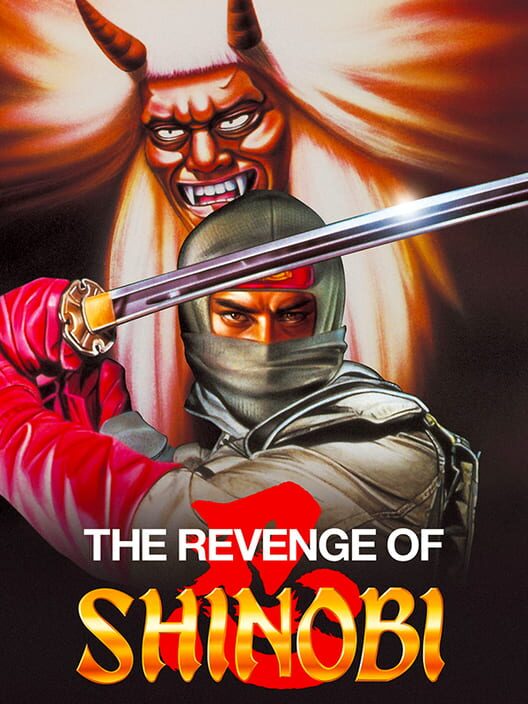
In 1989 on Mega Drive, The Revenge of Shinobi follows Joe Musashi against Neo Zeed across eight levels featuring shurikens, double jumps, health bars, and boss fights.
Developer Sega Publisher Sega
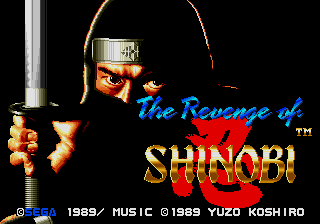
In 1987, Sega made a hit in the arcade halls with Shinobi, the first adventure of its famous ninja Joe Musashi. This action game borrowed many mechanics from Namco's Rolling Thunder, released the previous year, and adapted the setting to ride the wave of the popular ninja theme of the time. Following this success, Sega decided to continue the franchise, and in 1989, the newly arrived Mega Drive in the USA—having landed a year earlier in Japan—featured the excellent The Revenge Of Shinobi.
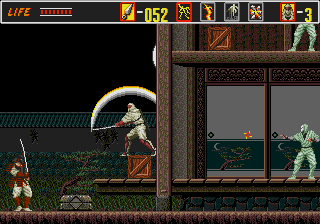
This sequel picks up several years after the events of the first episode. The criminal organization Zeed, thought eliminated, rises again in the form of Neo Zeed, kills Joe Musashi's master, and captures his fiancée Naoko. Setting out to rescue her, Joe Musashi begins his adventure in Japan, in the province of Ibaraki, before flying to the United States a few levels later, and finally concluding his quest on Neo Zeed's naval base, where Naoko is being held.
You'll find the famous ninja still armed with his shurikens but now dressed in white and red. Several notable changes differentiate the gameplay of The Revenge Of Shinobi from the original arcade version. First, there is no longer a need to rescue hostages to complete the levels. The game spans 8 levels, following a consistent pattern: the first two segments where Joe Musashi must progress toward the exit by eliminating enemies, and the final segment where he must face the level's boss. Additionally, the Sega ninja now has a health bar, which is very welcome.
In return, his shurikens are now limited in quantity.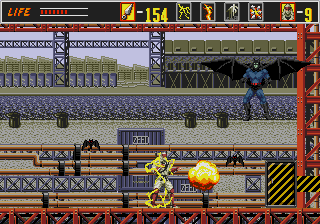
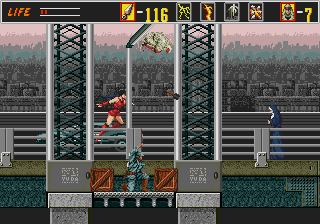
Joe Musashi is granted a new key move, the double jump, which allows him to reach greater heights and also to transition from the foreground to the background in levels that feature this ability. Combined with the action button, this double jump lets Joe Musashi fire 8 shurikens in a curved arc beneath him, effectively clearing the screen area he faces of any immediate threats. However, the double jump requires precise timing to execute correctly, and mastering it is essential as this technique is highly useful in the game.
To escape dangerous situations, Joe Musashi can occasionally use magic; 4 jintsu are now available to the ninja: one jintsu to amplify jumps (Fushin), one to summon a fire dragon (Kariu), one to self-destruct in an explosion and damage anything on screen (Mijin), and finally the most useful jintsu, to surround himself with an electric armor capable of absorbing 4 hits before disappearing (Ikazuchi). Throughout the levels, numerous wooden crates contain various collectible items: extra lives, power-ups, jintsu, and shurikens. The gameplay, while retaining the same core mechanics and remaining action-oriented, stands out significantly from its predecessor and ultimately proves more enjoyable (as it is less punishing) and more varied.
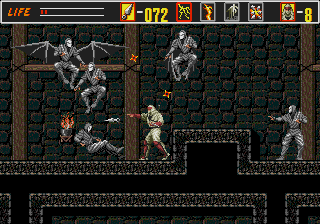
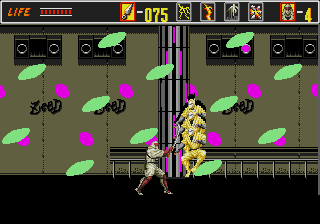
The Revenge Of Shinobi was, upon its release, a true technological showcase of the young Mega Drive in a market dominated by the NES. Even though other Mega Drive games have since surpassed it, the production remains highly commendable to this day, with large sprites, stunning music by Yuzo Koshiro (who would later showcase the same talent in the Streets of Rage series), and above all an undeniable charm throughout, thanks to an excellent atmosphere, constantly renewed environments and situations, and unforgettable boss fights.
The Revenge Of Shinobi also impressed greatly at the time for its difficulty. Indeed, the game is far from easy, leaving little room for approximation. Many sections require memorization and anticipation to be completed correctly. However, while The Revenge Of Shinobi demands a certain investment to hope for its ending, it is far from being as difficult as its reputation suggests, and for several reasons: the player is rewarded with an extra life every 100,000 points, numerous bonuses are hidden in the scenery as invisible crates that reveal themselves under Joe Musashi’s attacks, and finally, the game features an "easy" mode, identical in every way to the normal mode except that you start with 10 lives per continue instead of 3, making it ideal for practicing difficult sections.
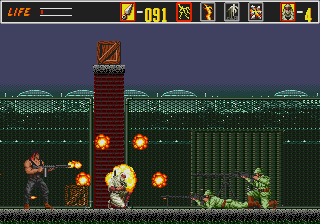
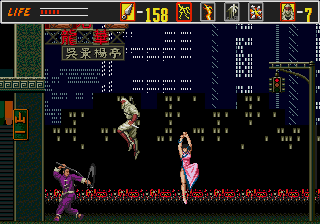
It is amusing to note that The Revenge Of Shinobi underwent several revisions due to blatant copyright violations. Thus, in the original version, you will face characters with varying degrees of recognizable appearances, such as Rambo, Hulk, Terminator, Spiderman, Batman, and Godzilla—nothing less. Unfortunately, the subsequent revisions removed almost all of these references.
Sega waited a few years before releasing a direct sequel, Shinobi 3: Return Of The Ninja Master, in 1993, featuring an overpowered, faster gameplay, an extended and brilliant movement set, reduced difficulty, and sublime graphics.
After these 16-bit episodes, the Shinobi series will continue on other platforms, the Saturn, the PlayStation 2, and the Game Boy Advance, but that’s another story, and not as glorious…
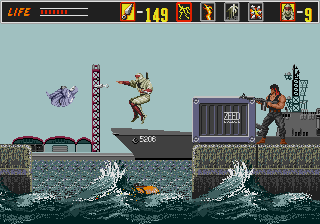
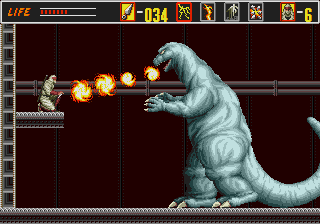
Today, The Revenge Of Shinobi has not lost any of its brilliance and is often regarded as the best entry in the series by those who made the effort to complete it. One of the most refined ninja games that demands the qualities of the role: precision, perseverance, and patience. Don’t delay, your fiancée is counting on you and waiting… Neo Zeed is too…
Where it fits in time
The whole timelineWhat came out and what happened around 1989.
-
SoftPC runs the PC on the Macintosh
Insignia Solutions brings its x86 emulator to the Mac: DOS and Windows reach Apple machines through software emulation.
-
Sharp X68000
Computer · Sharp
-
NeXTcube
Computer · NeXT
-
System 7 modernises the Mac
Virtual memory, file sharing, AppleScript: System 7 is the first major overhaul of the Macintosh system.
Play it on a Mac
1 Platform emulator
Show the 27 other emulators
An emulator being listed does not mean the game runs: every project keeps its own compatibility list.
Reply on the forum
A question or a hands-on report? Open the discussion on the forum.