Virtua Racing
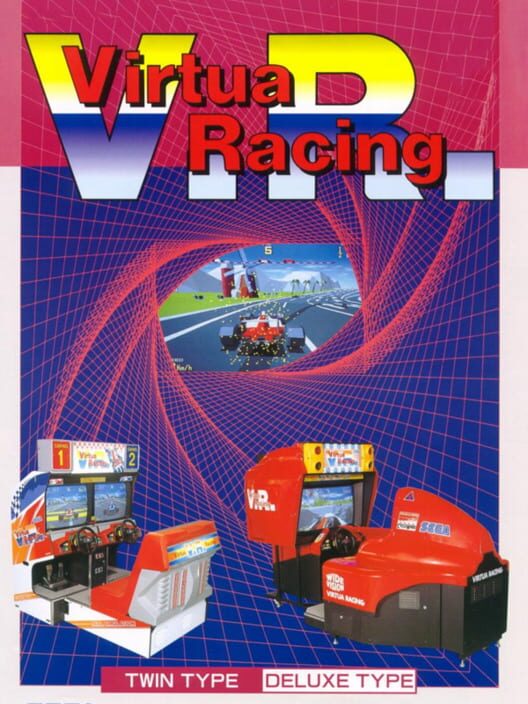
Released in 1992 on the Model 1 arcade cabinet, then ported to Mega Drive, 32X, and Saturn, Virtua Racing popularized real-time 3D racing with three tracks and a single-seater car.
Developer Sega-AM2 Publisher Sega
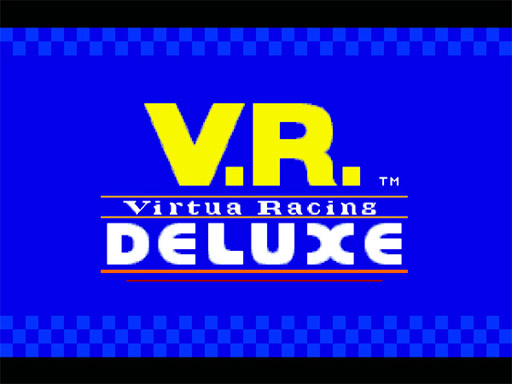
Virtua Racing is a unique, standout game because it is the first 3D racing video game with real-time rendering.
The game was originally available on four platforms: Mega Drive, Sega 32X, Saturn, and Arcade. A PlayStation 2 version would appear much later in a remake titled Virtua Racing: FlatOut.
The game first released on Arcade, with a single-player version followed by a two-player version allowing you to challenge a friend. This release was revolutionary and set a new vision for racing games. With 3D becoming a standard in all subsequent games that went on to shape video game history. Developed on the Model-1 platform, this game laid the foundation for future SEGA titles; Daytona USA would arrive two years later, followed by SEGA Rally Championship a year after that, both benefiting from the power of the Model-2.
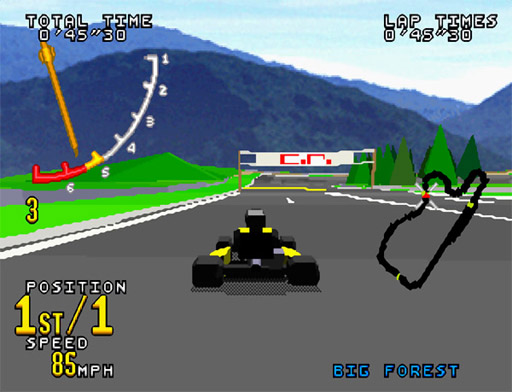
As usual with SEGA, the Mega Drive version followed the arcade version by a year. This version is very close to the arcade version, but less visually appealing. The console, already four years old when the game was released, lacked the power to run the game properly. That’s why the cartridge itself includes an additional chip, the SEGA Virtua Processor (SVP), which helps the central processor with 3D calculations. This version allows SEGA to counter Nintendo, which has just released StarFox, also featuring a 3D rendering co-processor in its cartridge called SuperFX, a direct competitor to the SVP.  Menu of the Megadrive version These two versions offer a single car, similar to a Formula 1 vehicle, along with three tracks that increase in difficulty. They also include multiple camera angles, including an advanced first-person perspective. With the release of the 32X, a new version of the game becomes available. Named Deluxe, it takes advantage of the 32X’s power to improve graphics compared to the arcade version, but most notably, it adds two new tracks, as well as two new cars: a stock car that is less performant and slightly easier to drive, and a prototype with weaker acceleration but higher top speed.  Menu of the 32X version This Deluxe version later becomes part of the launch lineup for SEGA’s next console, the Saturn. This is an even more advanced version, featuring a go-kart, a GT car, and a second single-seater. It also includes the ability to customize vehicle design and up to 11 tracks in total. This version is, by far, the most polished, offering more challenges and greater replayability. Unfortunately, the graphical rendering appears to be filtered to soften the angular edges of the polygons, ultimately losing some of the spirit of Virtua Racing.
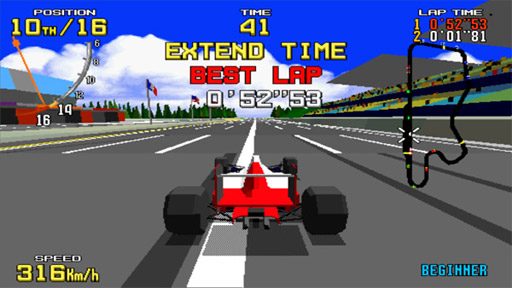
Graphically, outside of the Saturn version, the game is obviously very limited, but many efforts were made to make it highly playable and even, let’s say, visually pleasant.
The vehicle and object modeling is simplistic, but it is detailed enough to recognize them. Special mention to the vehicles, which have an extremely low polygon count but whose rendering was very appealing at the time.
SEGA achieves a true technical feat and demonstration by integrating tracks with elevation changes and mountainous or hilly scenery. It even uses an amusement park as a backdrop for the last turn of the first circuit, providing a stunning visual experience for an era where games were limited to side-scrolling.
The developer did not limit themselves to simple modeling; they also added some effects to enhance the realism of the simulation.
You get sparks when the car comes too close to the track, flame kickbacks during gear shifts, or smoke from tires when a car is skidding hard.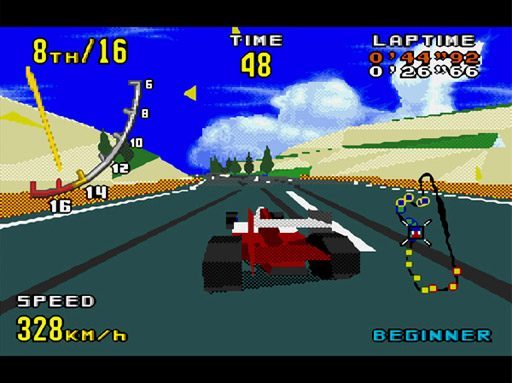
To top it all off, it’s not just a few cars on the track—there are a total of 16 vehicles, a score that some games still struggle to achieve today.
Driving isn’t refined—it’s raw and far from modern simulation standards—but it works perfectly for what it is. It remains an honest arcade-style game, dynamic and reflex-driven, much like the 90s used to make them.
If you want to play the game, I recommend launching the 32X Deluxe version, which is the most polished, most playable, and closest to the original. The Arcade version works well on MAME but is meant to be played as it existed—with a steering wheel and pedals. Meanwhile, the Saturn version tries too hard to smooth out the polygons that originally made the game a success, unless you’re already very familiar with the original and looking for new challenges.
Where it fits in time
The whole timelineWhat came out and what happened around 1992.
-
System 7 modernises the Mac
Virtual memory, file sharing, AppleScript: System 7 is the first major overhaul of the Macintosh system.
-
Amstrad NC
Computer · Amstrad
-
Executor, the Mac on a PC
ARDI releases Executor 1.0: a 68k emulator that reimplements the Macintosh Toolbox rather than the hardware.
Play it on a Mac
1 Platform emulator
Show the 34 other emulators
An emulator being listed does not mean the game runs: every project keeps its own compatibility list.
Reply on the forum
A question or a hands-on report? Open the discussion on the forum.