Sid Meier's Railroad Tycoon
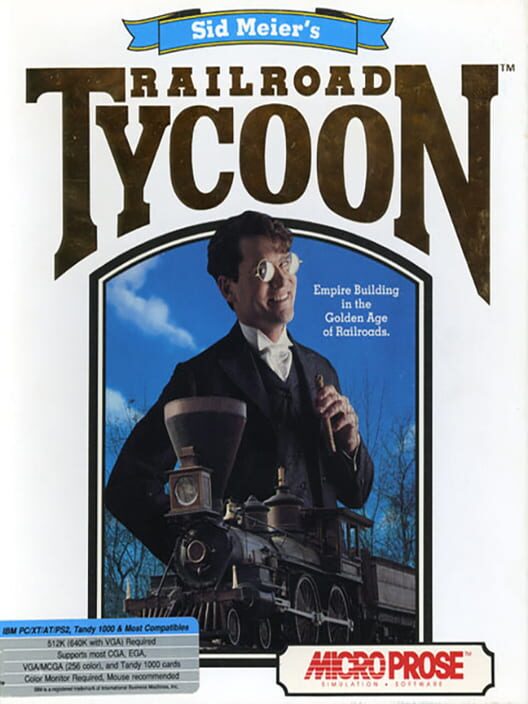
Released in 1990 and later adapted for the Macintosh, Sid Meier’s Railroad Tycoon offers the challenge of building a railway company across multiple maps, at the cost of a five-floppy-disk installation.
Developer Microprose Publisher Microprose
A little trip back in time. Here is Sid Meier's Railroad Tycoon, the first one! Praised by critics at its release in 1990, it was a management game that clearly revolutionized its world.
One year later, the game was released on Macintosh, and this is the version used in this best-of, which works correctly on BasiliskII with a 7.6 system in 16 colors.
Playing it in this version is already, in itself, a small challenge! Because the installation is not the simplest thing in the world. But it is not overly complex either. You need to load the 5 floppy disks to copy their contents onto the virtual disk in a single folder.
A little anecdote for the older ones, the first floppy disk even includes a minimal operating system allowing you to launch the game on a Mac without a hard drive (yes, back then not everyone had one), like the Mac 128k or the Mac Plus. This also allows you to run the game on an operating system that uses the least memory possible, leaving as much as possible to the game. In short, we really go back 30 years!
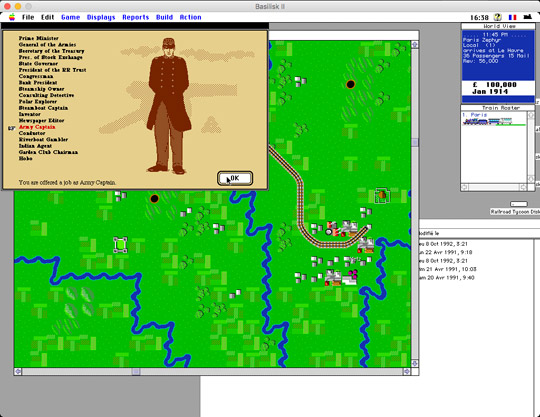
A quick reminder, Railroad Tycoon is a management game. You are in charge of a railway company that you must grow to establish yourself on one of the few available maps: the United States, Great Britain, or Continental Europe.
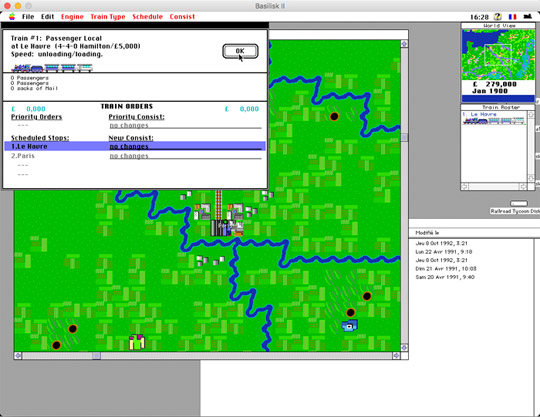
If you are familiar with BasiliskII, you won't be shocked by the graphics, even though they were really good for their time. Nowadays, they are more than outdated, and while playing the second episode still works, this first episode feels like a dinosaur.
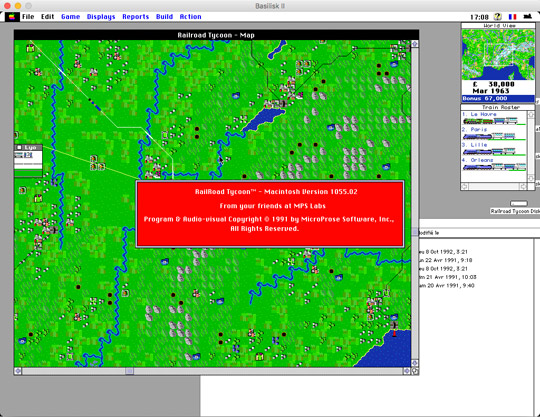
The maps have been carefully crafted, you can recognize the different places you visit, and with some geographical knowledge, you can spot the cities that will become the most important. But it remains a top-down view as simple as it gets, just like the first Sim City.
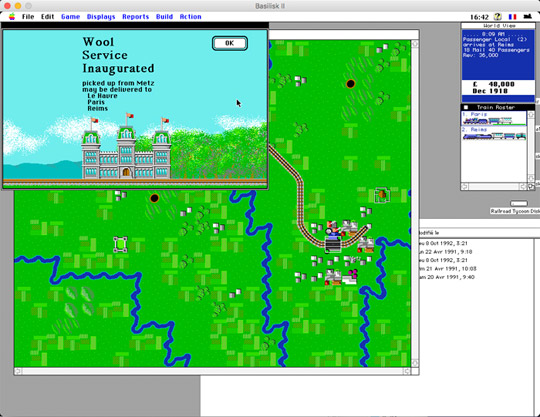
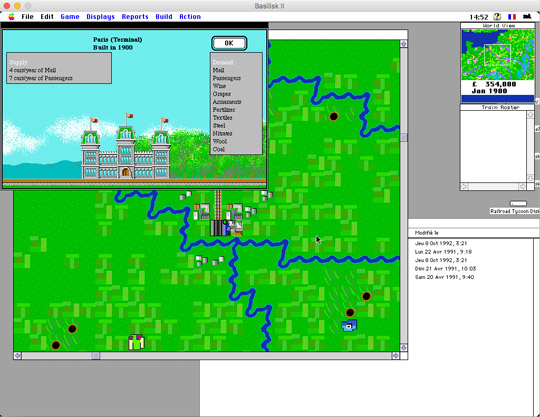
The display of rails, cities, and all scenery is crude, just like the display of trains, but they have the merit of being animated, allowing you to follow their progress.
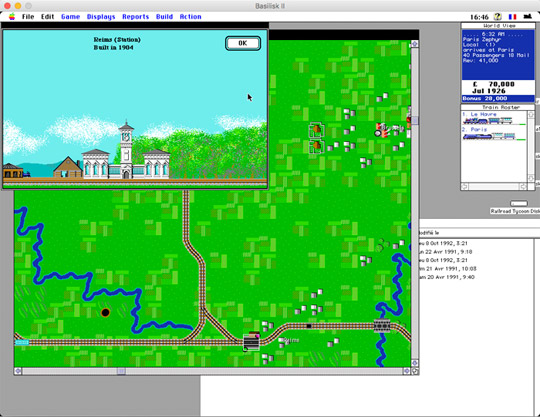
Note that this is the 16-color version, the most visually appealing one, except for the Deluxe version released slightly later, which was not available for Macintosh. The 16 colors give the game a flashy, very old-school look.
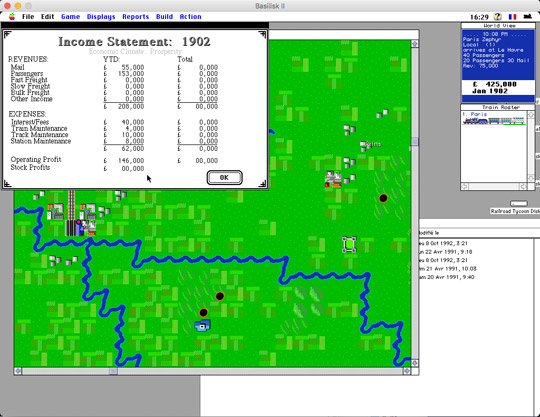
Beyond the 1990s-style graphics, this first entry in the series remains impressive for the many elements it manages.
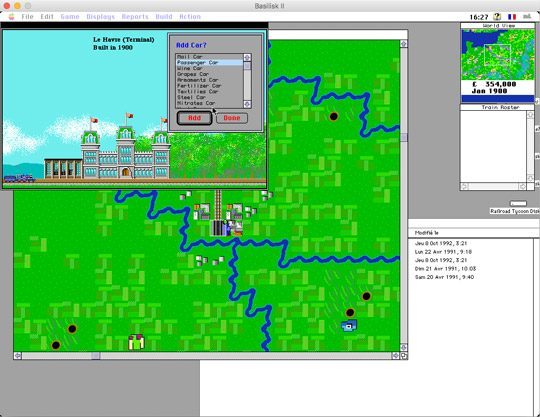
You'll find complete management of stations, with the ability to add add-ons to increase the profitability of routes or that are necessary for proper train operation. Speaking of trains, their management is also complete. You can define your routes and the wagons used for each journey.
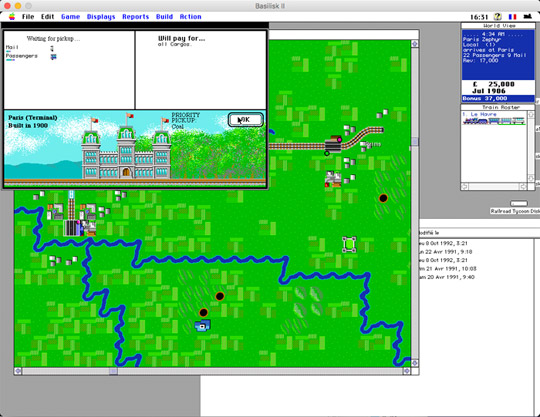
But that's not all, the game already features an AI that is extremely competitive. Moreover, the management of your portfolio and that of your competitors is also present.
Compared to the second or third episode, there are ultimately very few differences on the simulation side.
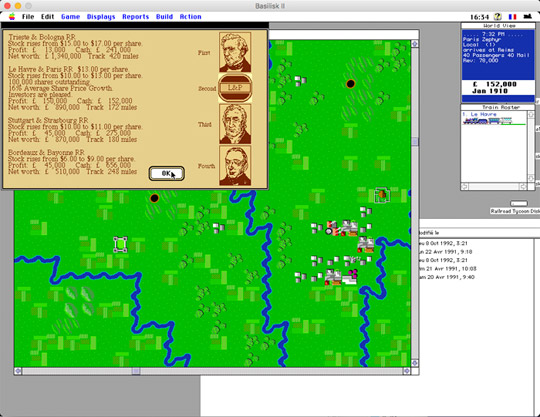
Still, there are many limitations, such as the number of stations, the number of trains, and the number of routes a train can record, but everything the game can handle is surprising, especially considering the memory limitations of the time, just a few megabytes at most.
Last point, the ergonomics. Most actions are performed via keyboard, particularly movement and construction. You move the cursor with the directional keys, and to build a rail, you simply hold down the Shift key while moving. All other actions can be done via keyboard but also have a place in the menus.
Where it fits in time
The whole timelineWhat came out and what happened around 1990.
-
SoftPC runs the PC on the Macintosh
Insignia Solutions brings its x86 emulator to the Mac: DOS and Windows reach Apple machines through software emulation.
-
NeXTcube
Computer · NeXT
-
Mega-Tech
Arcade · Sega
-
System 7 modernises the Mac
Virtual memory, file sharing, AppleScript: System 7 is the first major overhaul of the Macintosh system.
Play it on a Mac
1 Platform emulator
Show the 36 other emulators
An emulator being listed does not mean the game runs: every project keeps its own compatibility list.
Reply on the forum
A question or a hands-on report? Open the discussion on the forum.