Hagane - The Final Conflict
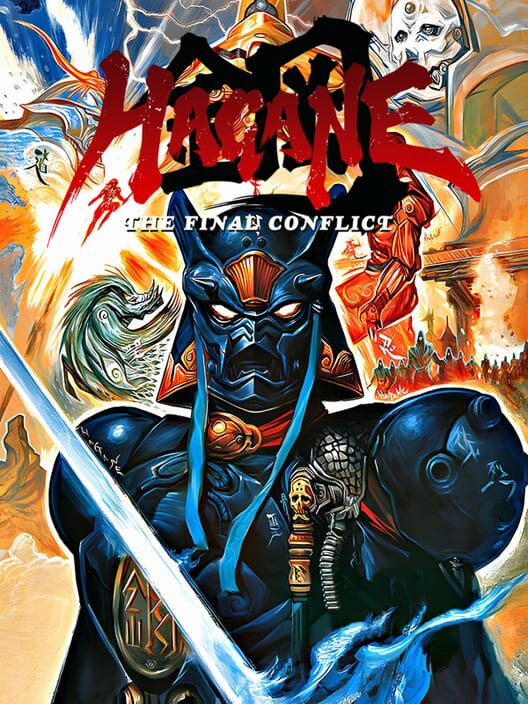
Released in 1994 for Super Nintendo, Hagane: The Final Conflict blends fast-paced action-platforming, diverse weaponry, and a dark setting where cybertechnology and feudal Japan intertwine to fuel the revenge of a ninja.
Developer CAProduction Publisher Red Entertainment, Hudson Soft
Emerging unexpectedly in Japan at the end of 1994 on a Super NES already in its second half of its lifespan (the looming threat of the PlayStation was growing closer), it was later hindered in 1995 by a limited American distribution. Hagane - The Final Conflict, like a shadow warrior, vanished as quickly as it appeared. A fate one could ironically describe as predestined for what remains a still excellent 16-bit ninja game!
As soon as the cartridge is inserted, a cinematic briefly explains the game's setting. The Koma clan has attacked the Fuma clan, leaving one last warrior, Hagane, seemingly dead, who is brought back to life through cyber-technologies and sets out to take revenge and destroy the Koma clan. This quickly makes it clear that Hagane will stand out with its unique universe...
Once the game is launched, the first observation is that the gameplay is smooth and very fast, making it a rather unique action-platform title for the Super NES, where the pace of such games is generally more relaxed compared to their equivalents on the Megadrive (the Super NES's central processor being less powerful than its competitor's). Movements follow one another quickly, the action unfolds rapidly, and soon one of Hagane's specific features becomes apparent, hinted at by the introduction: it is indeed a ninja game, but set in a completely original universe where futuristic elements and medieval Japan intertwine to create an unexpectedly successful blend.
The game features an absolutely grandioses, mature, and dark universe and character design that contrasts sharply with most of the Super NES catalog.
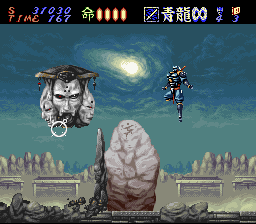
Hagane features a weapon system reminiscent of Ninja Spirit, with four weapons that can be freely switched between:
the sword, its preferred weapon, excellent for melee combat, which will be the most used weapon by far throughout the game
the kunai, fast knives allowing for long-range attacks
the bombs, launched in an arc and exploding on first contact
the grappling hook, weak but allowing you to climb ceilings, generally the least used weapon in the game
Finally, Hagane has a devastating attack to clear the screen, very limited but very useful, especially since it makes the player invulnerable during its short duration.
Hagane offers an enormous range of movements and abilities.
The ninja is thus able, in addition to basic movements (movement and frontal attack), to grab ceilings and various platforms, to slide, to curl up and bounce off walls, to finish a fall with a kick.
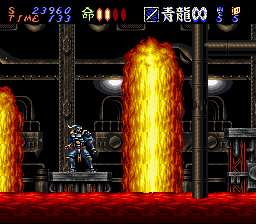
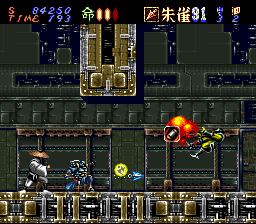
However, too much of a good thing and this abundance can be both an advantage and a hindrance. Indeed, although the gameplay becomes more varied and the progression curve even more engaging for the player, Hagane also features optional attack moves. All moves based on the L and R triggers of the controller (which begin with a spinning motion) are thus reserved for the most experienced players, as they are as devastating as they are difficult to execute correctly. This last category of moves is in no way necessary to complete the adventure, and this abundance ultimately proves quite disorienting for the player at first. It is therefore essential not to be overwhelmed by such a wealth of movements and to learn how to prioritize them, in order to approach Hagane with the best possible mindset.
For once mastered, the gaming experience is truly exhilarating. The levels are few in number (5 in total), but they are very large, divided into 3, 4, or 5 sections each, with at least one mini-boss (or more) in one of these sections, the last section leading to the level's boss fight. Some of these levels are truly grand, especially the second and the last one, which never ends, and the sequences offer beautiful variations throughout the game, to take advantage of Hagane's different movements in certain tricky platforming phases.
The game even includes two short vehicle-based sequences to add variety to the experience.
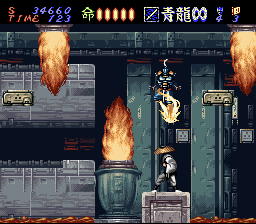
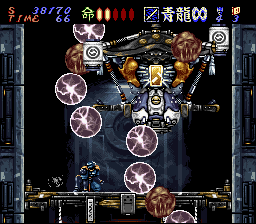
Faced with such a graphical overload, the music could be considered the weak point of the game, but that is not the case in the end. While they are not particularly memorable and cannot compete with the legendary soundtracks of the Super Nintendo, they perfectly fit the game's atmosphere and remain of good to very good quality throughout.
The difficulty of Hagane is praised as in any good action game, initially requiring a lot of learning to progress. However, this difficulty is never discouraging when approached correctly, as the game knows how to be engaging. It is even possible to finish Hagane without using continues if you know it well. And if you master the final level (which is generally the true peak of difficulty in its last sequences), it is even possible to imagine completing it in one life.
Hagane is often described as the Super Nintendo Shinobi, which is perfectly justified. Of the three Mega Drive episodes of the famous Sega series, the one it is closest to, in terms of rhythm and setting, is Shinobi 3.
Even if it may not quite reach the excellence of Sega's work (a ninja producer with far more experience), it certainly has nothing to be ashamed of and truly deserves not to have been overlooked given its qualities.
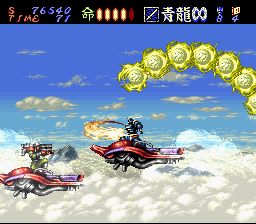
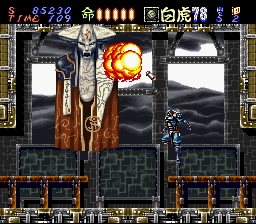
Hagane was the first game by C.A.Production, and, judging by the quality of their recent titles, it now stands out as an oddity in their recent catalog. Once the abundance of movements is disregarded, there is little to criticize about Hagane, especially for a debut title, as its mastery of the 16-bit era of Nintendo's console is impressive (especially considering the cartridge contains no additional chips like some of the latest Super NES games). A unique foray into the ninja universe, and a true masterstroke that C.A.Production will never manage to replicate. A small consolation, Hagane will remain one of the last great action games for the Super NES!
Where it fits in time
The whole timelineWhat came out and what happened around 1994.
-
Amstrad NC
Computer · Amstrad
-
Executor, the Mac on a PC
ARDI releases Executor 1.0: a 68k emulator that reimplements the Macintosh Toolbox rather than the hardware.
-
CPS Changer
Console de salon · Capcom
-
Basilisk II opens up the 68k Mac
Christian Bauer’s free emulator brings 68000 Macintoshes back to life on other machines, ROMs and System 7 included.
Play it on a Mac
2 Platform emulator
Show the 12 other emulators
An emulator being listed does not mean the game runs: every project keeps its own compatibility list.
Reply on the forum
A question or a hands-on report? Open the discussion on the forum.