Dungeon Keeper
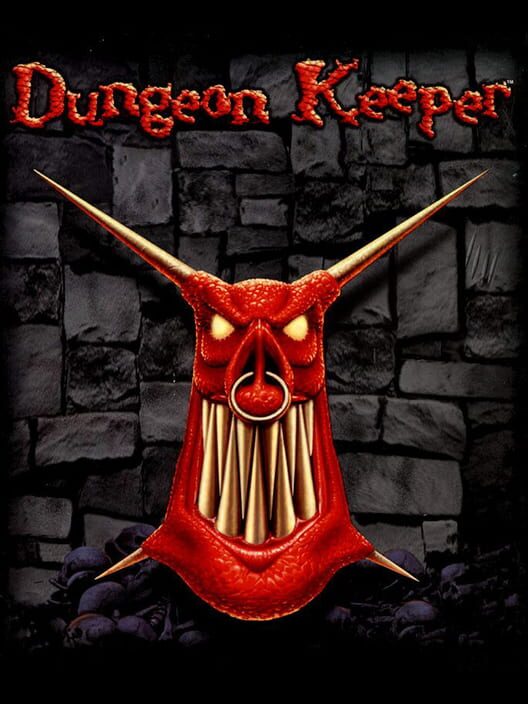
Dungeon Keeper (1997) blends god game and real-time strategy on Windows and MS-DOS, placing the player in charge of a dungeon tasked with invading kingdoms and facing their heroes.
Developer Bullfrog, Bullfrog Productions Publisher Electronic Arts
After years and years of playing only the good guy saving the widow and the orphan, or rather queens, princesses, and kingdoms in peril, the highly creative team from Bullfrog, led by Peter Molyneux—whom we’ve already discussed here with the retro-test of Theme Park—now offers us the chance to play the villains. The game, blending God game and real-time strategy, thus presents a completely different perspective from all the other games we had known up to that point.
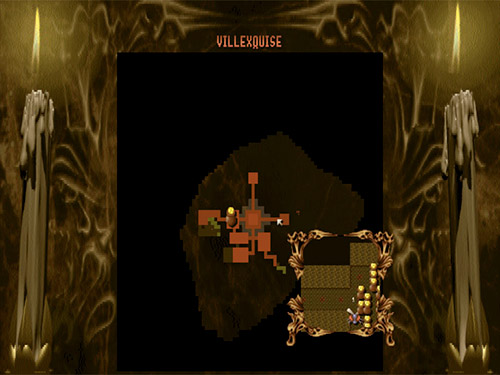
As the dungeon master, you have the daunting task of bringing down a kingdom by infesting every plot of land represented by the different levels of the game. Heroes will come to defend their territory against the darkness of your malevolence! You may also have to displace other dungeon masters, less inclined toward the mass slaughter of humans, elves, and fairies.
Highly innovative at its release in 1997, playing the villain still brings just as much pleasure. The game’s strengths are many, and it doesn’t rely solely on its excellent starting concept. Starting with the tone of the voice-over and the comments on the various game elements. Both sarcastic and humorous, they reinforce our role as the ultimate villain.
The game’s objective is ultimately quite simple. In the undergrounds of kingdoms, you must dig into the earth to build your dungeon, find resources, and then carve a path toward the enemies to annihilate them.
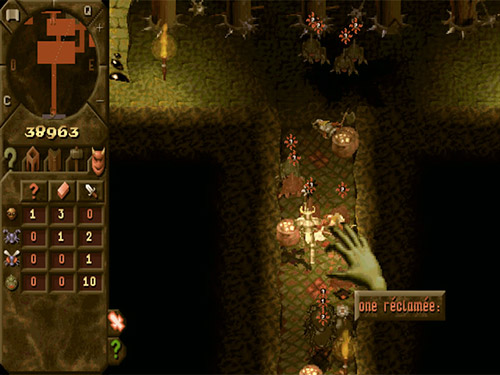
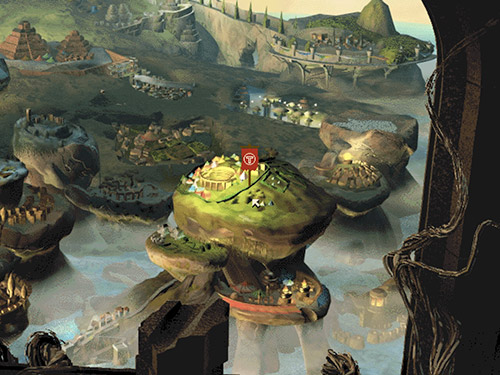
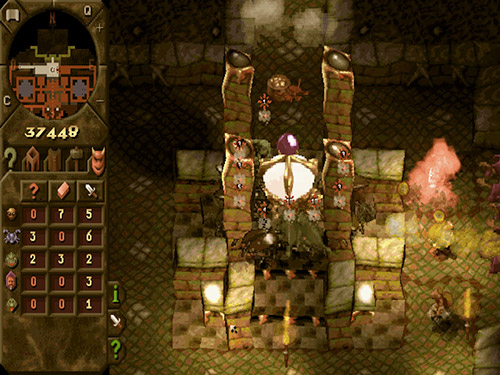
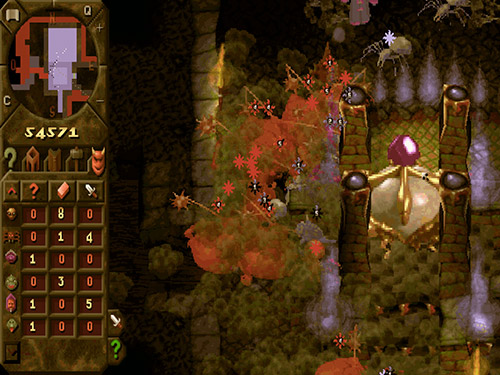
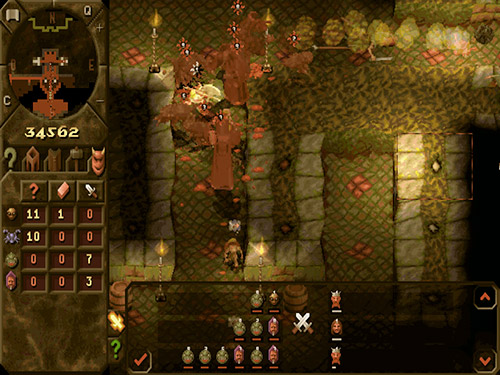
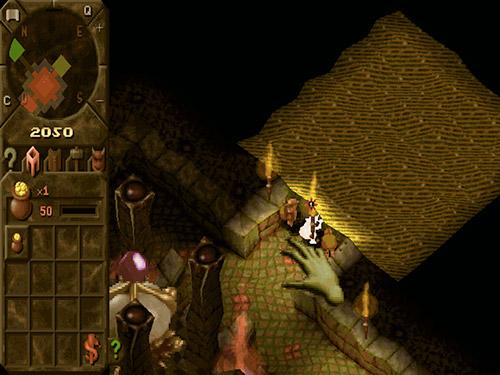
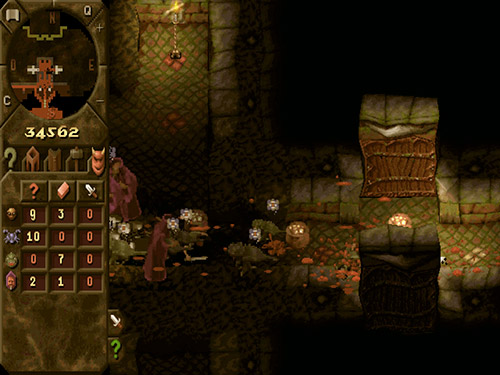
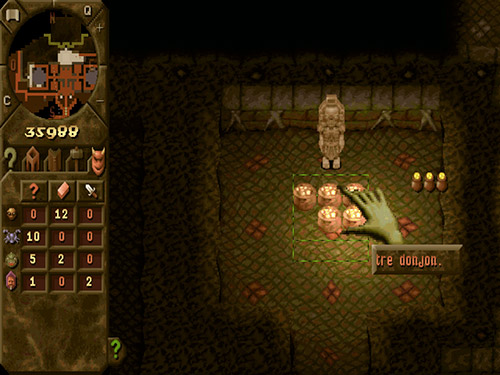
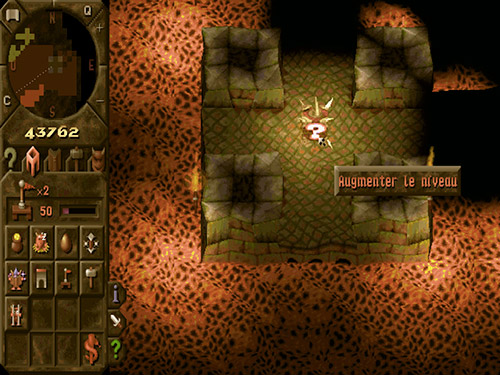
The game is graphically very successful, released at a time when the first 3D maps were appearing, it fully takes advantage of their power while keeping many elements in 2D sprites to maintain sufficient fluidity for gameplay. The game handles shadows and lighting (the cursor allows real-time illumination of the targeted area), and characters are properly animated. The blend of 2D and 3D is not jarring—instead, the integration is astonishing.
The overall visual quality is astonishing for a game of its era, only the very low resolution (640x480) might shock younger players who have never experienced cathode-ray tube screens.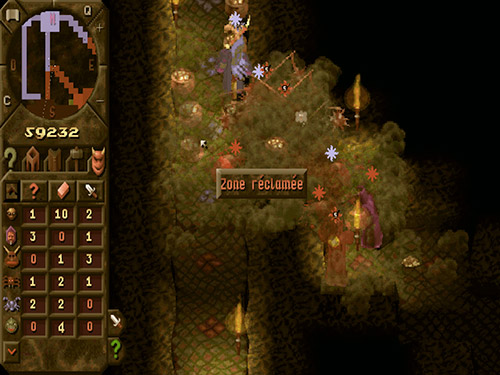
Once inside the game and after completing the very first introductory levels, what impresses the most is the sheer amount of content the game offers.
In addition to the numerous levels, all of which are quite large, the game provides a substantial bestiary. The monsters you can possess are numerous, each with unique abilities and even personalities. This is the case with the Reaper, the largest creature in the game with an extremely bad temper, which can start destroying everything in your dungeon if you don't take care of it. Monsters arrive through the portal connected to your dungeon, lured by the gain if you are rich or by the presence and size of one of the many rooms your dungeon can have. For example, installing a library will attract sorcerers, who will excel at working there. The same goes for trolls in workshops. You must constantly pay attention to these troops, as if they are not satisfied, they will not hesitate to leave your dungeon. Boredom can also drive them to wander the terrain and attract enemies to your dungeon.
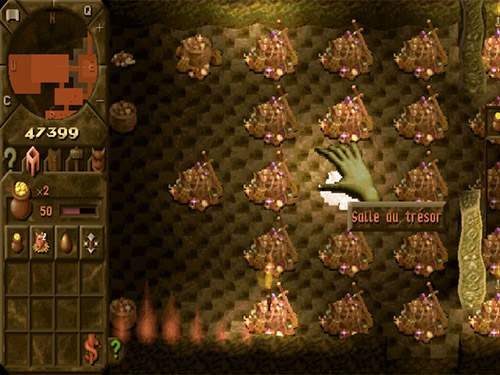
Your dungeon will quickly expand, with each available room dedicated to a specific task, and it is often necessary to use most of them. When arranging these rooms, you must consider that some will need to grow in size to meet the increasing demands of the creatures that have joined you. The first is the treasure room, which will allow you to store your gold until you need it. A beautiful treasure room from the start of the game can be expensive, but it is a good investment. On one hand, it will be necessary at some point or another, and on the other, it will quickly attract the most avid monsters.
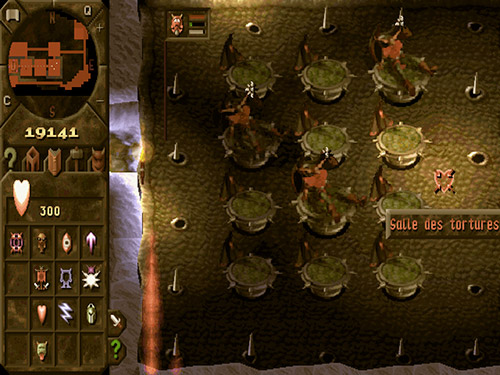
The nest and the hatchery are also essential, serving as a resting and feeding place for your creatures, which will grow as new troops arrive. This gives you access to 14 types of rooms, in addition to the portal and the heart, for building the most beautiful dungeon. Spoiler alert: it's impossible, as your enemies' attacks through galleries connecting to your dungeon will constantly damage your most perfect creations. A special mention goes to the prison, which allows you to recover fallen enemy heroes or creatures in battle. Combined with the torture chamber, it lets you switch their allegiance and benefit from their power (don't forget to heal them, so they don't die in the hands of the torturers).
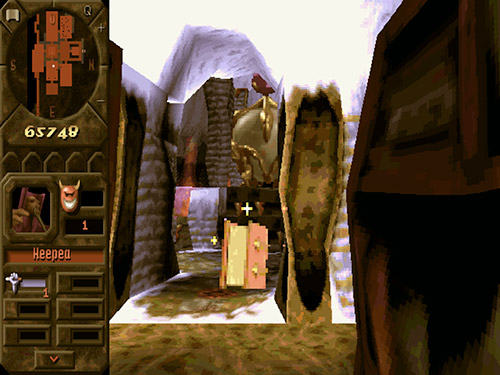
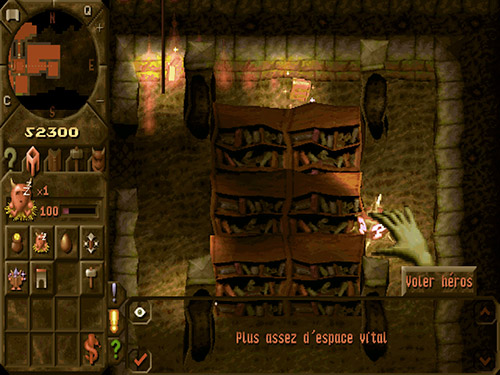
The next feature is spells... Available in the library, spells can give you an advantage in combat, whether offensive or defensive. We start each game with 2 spells: the first is the control of a character, a brilliant idea that lets you explore their dungeon in an isometric 3D view. The game then becomes a FPS where you can directly interact. While the concept is fun or useful in some cases, it only lasts as long as you control a character, and the rest of the dungeon lives its own life, which can work against you. For even more detail, some creatures have a special view: for instance, the fly will have a view divided into multiple facets, while the vampire will see everything in red.
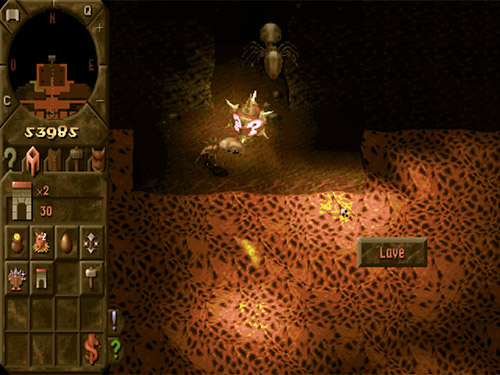
The second spell is the creation of a minion. Minions are the most basic creatures in the game, weak in attack and health, but they can dig through rock, gather minerals, and reinforce your walls. Be careful: the more minions you have, the more expensive it will be to create a new one. The other spells must be discovered by your workers in the library, after which you can use them at will, for a bit of your gold. Invisibility, healing, lightning, recruitment—here, quantity matches quality in its own way.
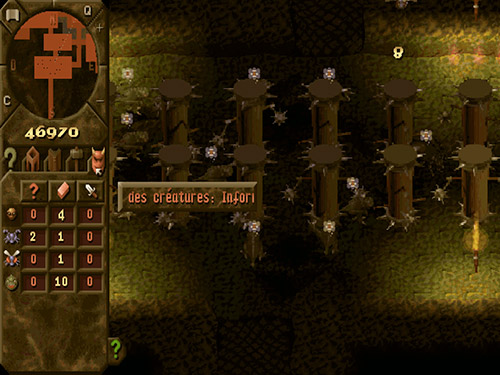
Since we haven’t finished exploring everything yet, let’s move on to workshop pieces. There are two types: doors or traps. Once developed, you can place these elements on the terrain, a door representing an additional obstacle between your enemies and you, but also a way to block your monsters to avoid random encounters during walks on the terrain. Traps will allow you to weaken your enemies during an assault on your base, a good solution to ensure a slightly easier victory in defense. Still, be careful—your opponents can do the same.
And for the cherry on top of this huge cake, the terrains feature surprises. Special spells that will give you an additional advantage. Once again, great ideas abound, and the variety of spells is impressive.
-* Security: strengthens all walls of the dungeon, saving you time from your minions.
-* Increase Level: raises all creatures by one additional level.
-* Resurrect Creature: allows you to recover a deceased creature.
-* Reveal Map: reveals the entire map, useful for spotting hidden rooms and infinite resources.
-* Steal Hero: steals a hero from the enemy.
-* Transfer Creature: sends your chosen creature to the next world, to be used at the end of the game and very useful for starting the next level well.
-* Locate Hidden World: allows you to enter a secret level once the current level is completed.
-* Multiplication: duplicates each of your creatures, the rarest surprise.
The only small drawback of the game is the combat phase, where ultimately, the player with the most creatures and the highest levels will quickly gain the upper hand. Spells, when well used, become a powerful weapon in battles, but you must be fast and precise to make the most of them. But in the end, that’s what combat is all about—whoever has the most power wins.
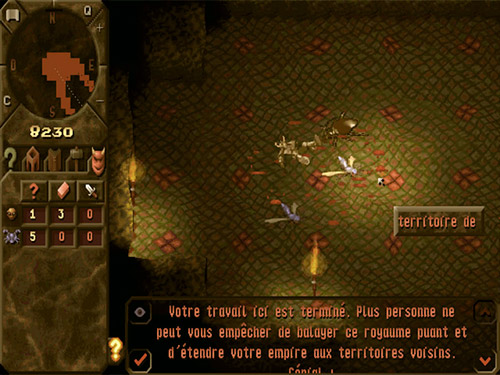
Historically, this was a bit of a breakthrough game for Bullfrog.
This is one of Peter Molyneux's last projects before he left, and unfortunately, it is one of the first Bullfrog games never to have been released on Mac. Today, the game runs perfectly on DosBox, though the Windows version, while prettier, is harder to run. Good old games offers the game in its Gold version (DosBox-based) in a nice ready-to-use package for less than €5, with screenshots taken from this version. (Note: Dungeon Keeper 2 is also available on the platform, but is not Mac-compatible.)
Dungeon Keeper is certainly one of the best games of its generation, nearly perfect in many respects.
The originality, the wealth of ideas, and every little detail make us think this is a game that must have matured over many years in the minds of its creators before coming to light.

Where it fits in time
The whole timelineWhat came out and what happened around 1997.
-
Basilisk II opens up the 68k Mac
Christian Bauer’s free emulator brings 68000 Macintoshes back to life on other machines, ROMs and System 7 included.
-
CP System III (CPS3)
Arcade · Capcom
-
MAME documents arcade cabinets
The Multiple Arcade Machine Emulator project sets out to preserve arcade hardware, game by game.
-
Connectix Virtual PC virtualises the PC on Mac
Virtual PC puts a complete PC in a Mac window, BIOS and disk included: emulation becomes a consumer product.
Play it on a Mac
2 Platform emulator
Show the 29 other emulators
An emulator being listed does not mean the game runs: every project keeps its own compatibility list.
Reply on the forum
A question or a hands-on report? Open the discussion on the forum.