Clock Signal (CLK)
Clock Signal is an open-source emulator for macOS 10.13 and later, compatible with Apple Silicon, supporting multiple classic microcomputers and consoles, including the Apple II, the VIC-20, and the ZX Spectrum.
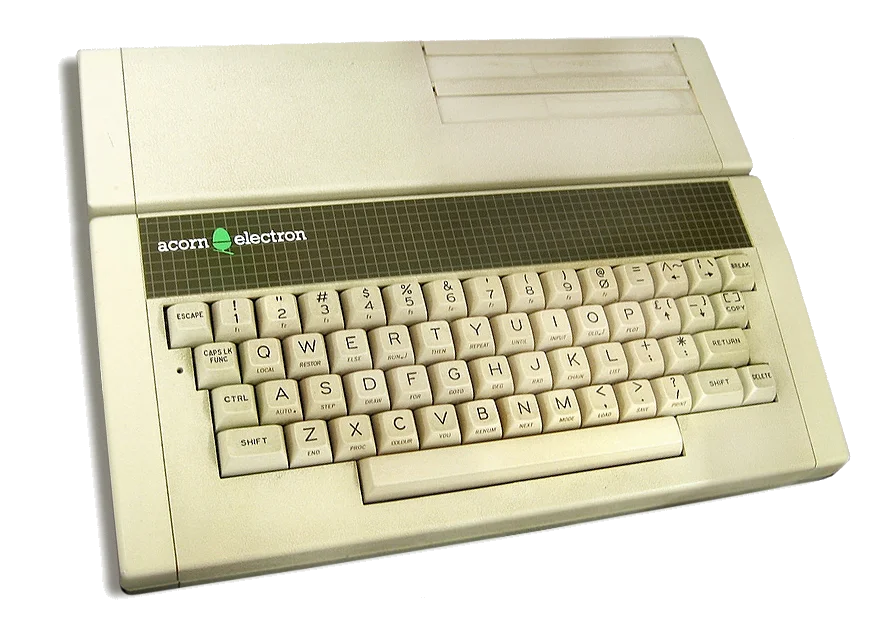
L'Acorn Electron est une version entrée de gamme du BBC Micro et fabriqué par Acorn Computers Ltd. Il intègre 32 kilooctets de RAM, et sa mémoire ROM inclus le langage BBC BASIC ainsi qu'un système d'exploitation.
L'Electron est capable de sauvegarder et charger des programmes sur cassette audio via un câble convertisseur fournis et pouvant être branché sur un magnétophone à la place du microphone. L'ordinateur est capable d'afficher des graphismes basiques soit sur un téléviseur, soit sur un moniteur.
What came out and what happened around 1983.
Computer · Acorn Computers
Console de salon · Atari
Computer · Dragon Data
Too many consoles, too many poor games: the market collapses, and the microcomputer takes over.
Computer · Acorn Computers
Computer · Amstrad
After the power struggle with John Sculley, Steve Jobs leaves the company he co-founded and founds NeXT.
Clock Signal is an open-source emulator for macOS 10.13 and later, compatible with Apple Silicon, supporting multiple classic microcomputers and consoles, including the Apple II, the VIC-20, and the ZX Spectrum.
ElectrEm Future 0.6c, developed by Thomas Harte, emulates the Acorn Electron, a lightweight version of the BBC B, and follows ElectrEm, an emulator that is now discontinued.