Teenage Mutant Ninja Turtles III : The Manatthan Project
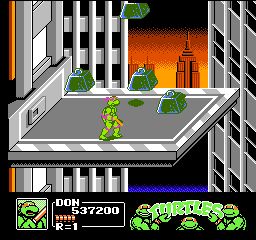
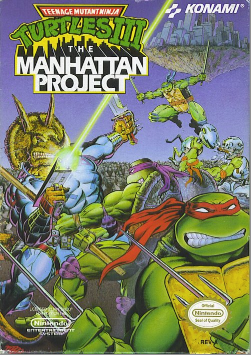
Released in 1992 for the NES, Teenage Mutant Ninja Turtles III: The Manhattan Project offers a beat 'em up game inspired by the animated series, featuring four playable turtles facing off against Shredder and his allies.
Developer Konami Publisher Nintendo
Cowabunga! Four teenage turtles who blend ninjutsu and humor like never before in an unrelenting stealth struggle against New York's criminal threat.
These turtles were, especially in the 90s, a massive entertainment phenomenon. They were everywhere. So much so that they became legends and cult symbols of adolescence. Their success began first in comic books, television series, and then in the world of cinema, video games, and of course, also commercialized in the form of numerous action figures and toys for children. In short, these reptiles achieved enormous international success.
DEVELOPMENT
During this hot period for our four heroes, Konami, a Japanese studio already well-established in the video game industry for nearly 10 years, took advantage of this popular wave to reinterpret the TMNT series on NES, which had already been started by Ultra Games since 1989. Here it is, in 1992, Konami released under our fingertips the third installment, TMNT3: The Manatthan Project. Polished, refined, programmed, and thought out by talented young developers at Konami, this third installment was bound to impress.
However, it did not achieve the expected impact and was entirely overshadowed by its successor released on SNES the same year. (Turtles in Time)
Nevertheless, TMNT3 remains a quality beat-'em-up and here's why.
Firstly, it is inspired by the comic books and the children's animated series that were popular at the time. You'll find many of the same characters and environments.
Where Konami comes into play, it’s the plot, the music, and of course the gameplay.The story.
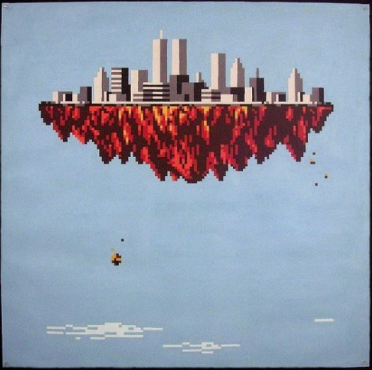
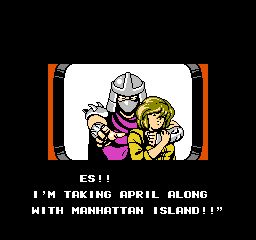
Our four heroes are on vacation and get in trouble when Shredder kidnaps April, the news anchor, during her daily broadcast. She is taken and imprisoned in the Technodrome, a kind of secret bionic base. The situation is now precarious, especially since Manhattan has been transformed into a floating island. Fortunately, the four turtles were watching the broadcast when the incident occurred.
GRAPHICS
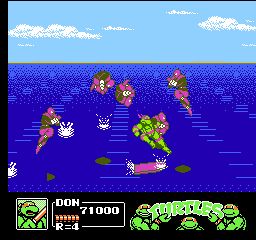
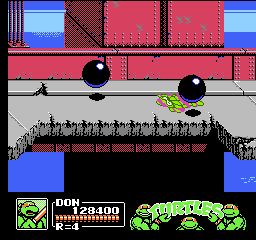
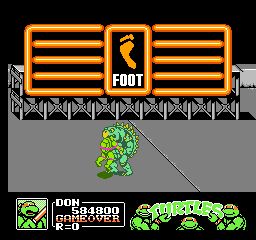
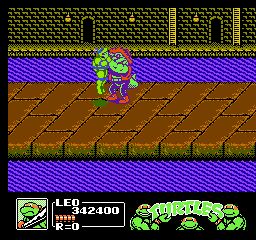
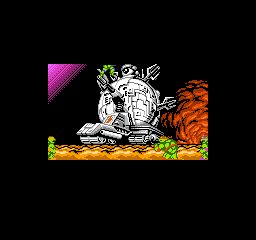
The turtles will have to go through twelve levels of progressively increasing difficulty, packed with enemies from the Foot Clan. Each level is very well designed, filled with details. At least, that’s what the NES can offer. Enemies emerge from everywhere: posters, trucks, water, holes, sewer grates, spaceships—you name it. Additionally, short cinematic scenes have been carefully crafted and inserted between levels. They serve as a way to highlight key moments in the plot’s progression. However, it sometimes happens, and unfortunately often, that the console struggles and loses frame rate (frames per second). The cause: too many enemies displayed simultaneously on screen.

GAMEPLAY
The gameplay is flawless. Simple and complete. Each turtle is controlled in the same way. A is for jumping, B is for attacking, and pressing both buttons simultaneously triggers the super move. The resulting action is extremely powerful and unique to each player, but costs one hit point per execution.
MUSIC
TMNT3 features the MMC3 chip, a part of the MMC (Multi-Memory Controllers) series that Nintendo refined and integrated into its cartridges over time. In short, there are MMC1 through MMC6. Each has its own characteristics while being slightly more expensive to produce at the end of the line. I can't really give you an idea of the price, but regarding their particularities, for example, the MMC3 chip, which is found in TMNT3, has the feature of adding an extra audio channel (sound effects or instruments at the composer's choice) in addition to allocating more RAM, making it possible to execute a moving object layered over an animated background. Check out the second level, the surfing one, and you'll see what I mean.
The sound chip Konami worked on sounds like a positively terrifying affair. Konami has always had a better audio quality compared to its competitors on Nintendo. Proof of this is that today, nostalgic fans of 8-bit music paying homage to this music (also called chiptune) like Virt or Norrin Radd still prefer to use Konami's sound palettes. There is only one other game that benefited from this sound palette, and it's Crisis Force, a shoot 'em up from the same era also developed by Konami. It's worth checking out by the way.
Indeed, the sound reproduction is quite surprising to me, from the sound effects to the 8-bit instruments, not to mention the unforgettable HEY synthesizer at the start of the first level.
CONCLUSION
In short, it's an excellent beat 'em up, colorful and lucky enough to benefit from the latest technologies of its console. Very refined and worthy of Konami's exemplary work. Teenage Mutant Ninja Turtles III: The Manatthan Project. Try it out!
Where it fits in time
The whole timelineWhat came out and what happened around 1992.
-
System 7 modernises the Mac
Virtual memory, file sharing, AppleScript: System 7 is the first major overhaul of the Macintosh system.
-
Amstrad NC
Computer · Amstrad
-
Executor, the Mac on a PC
ARDI releases Executor 1.0: a 68k emulator that reimplements the Macintosh Toolbox rather than the hardware.
Play it on a Mac
1 Platform emulator
Show the 32 other emulators
An emulator being listed does not mean the game runs: every project keeps its own compatibility list.
Reply on the forum
A question or a hands-on report? Open the discussion on the forum.