System Shock
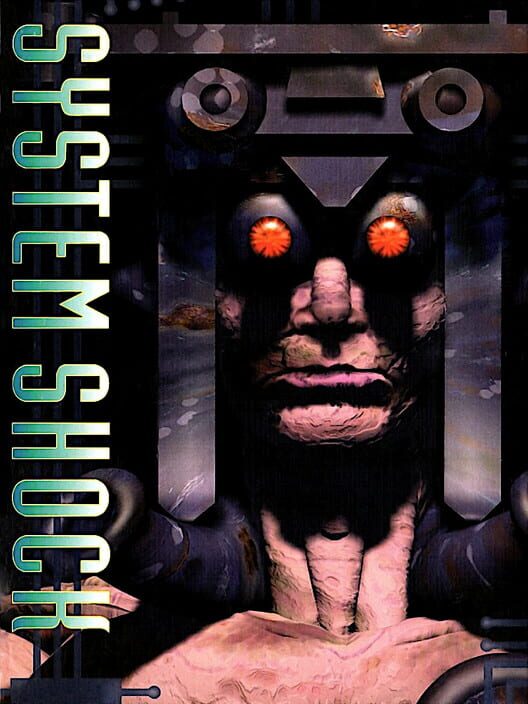
System Shock (1994) blends exploration, combat, and puzzles in the Citadel space station, where a hacker battles SHODAN, an out-of-control artificial intelligence.
Developer Looking Glass Technologies Publisher Origin Systems
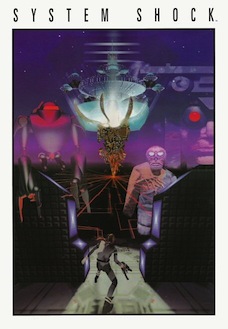
In 1994, while the FPS world was still dominated by Doom and preparing for the release of its sequel, Doom II: Hell on Earth, System Shock was released for PC. Initially well-received by the press of the time and quickly labeled as an "intelligent FPS," the game nevertheless remained a commercial semi-failure upon its release. System Shock's decision to significantly deviate from the formula that made Doom a success made it far less accessible than ID Software's flagship title.
System Shock puts the player in control of a hacker caught in the act of infiltrating the network of a space station, Citadel, who accepts a confidential deal with the station's director: remove all ethical constraints from the artificial intelligence governing the station, SHODAN, in exchange for cutting-edge neural implants. Once the task is completed, the adventure begins with the hacker waking up aboard Citadel after six months of cryogenic sleep, on November 6, 2072. Quickly, the hacker discovers that SHODAN, out of control, has become the sole master of Citadel, with the station's machines and robots under her command, and the crew either transformed into wandering mutants or simply decimated. Rapidly in contact via email with Rebecca Lansing, a representative on Earth of TriOptimum, the consortium owning Citadel, the hacker learns that SHODAN is preparing to aim Citadel's laser cannon at Earth, and that they are now their only hope to stop SHODAN's actions.
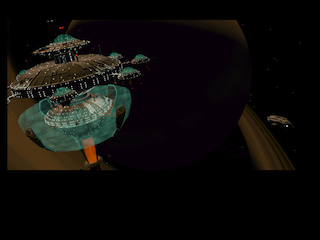
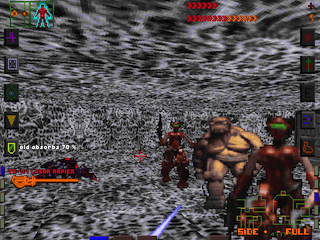
Left to his own devices, the hacker must explore the massive space station to try and break through SHODAN's defenses. The oppressive atmosphere throughout the hacker's wanderings on Citadel is one of the game's strongest points. Failing lights, messages written in blood on the walls, corpses, endless corridors, wandering robots and mutants, limited ammunition...
The atmosphere is more than oppressive, especially since the characters involved in the story are quite ambiguous at the beginning of the game and are only gradually revealed throughout the adventure. The story unfolds through the emails the player receives and especially through the numerous logs they pick up, which recount past events that occurred on Citadel. Written by former crew members, these logs describe their desperate attempts to fight against SHODAN and provide valuable information essential for progression.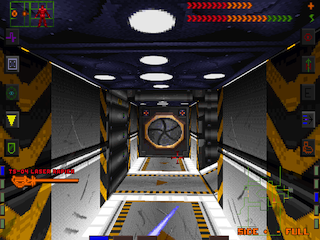
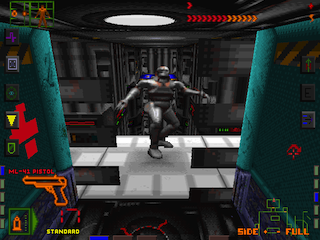
Citadel is a real maze made up of 10 floors connected by elevators. Each floor has a specific function, such as the Research level, the Security level, or the Hospital level where the adventure begins. It is very easy to get lost at the beginning in the station, fortunately, a map is available in the interface, which fills in as exploration progresses and can be annotated. Moreover, to navigate more easily, each level has been divided into 4 districts (alpha, beta, gamma, delta). Some areas of Citadel are protected by doors and are inaccessible without the corresponding security code or specific access card; others require opening and rewiring the electrical circuit controlling their closure.
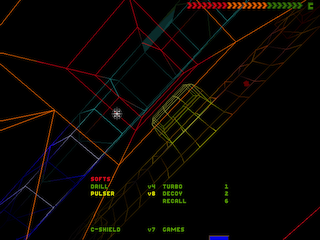
At certain points in the station, the hacker can connect to terminals that will send them into cyberspace. Cyberspace is an important component of System Shock, a parallel 3D wireframe virtual world, in which the hacker "floats" and can gather data and gain access to certain areas of the real world.
The cyberspace being controlled by SHODAN, the hacker must beware of the virtual minions stationed there, risking a brutal return to reality.
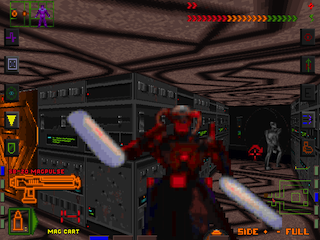
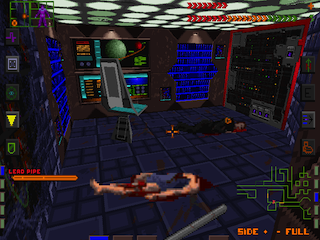
Far from being just a clone of the best FPS of the time, System Shock succeeds in blending action, adventure, survival, and a touch of RPG to create a completely original gameplay. Although combat isn't as dynamic as in the models of the era, System Shock compensates by offering many uncommon possibilities at the time. The 3D engine allows crouching, crawling, leaning to the sides, jumping, and aiming with the mouse. Additionally, the equipment provided in the game is extensive and varied. There are in fact two types of weapons in System Shock: conventional ammunition-based weapons (with multiple ammunition options for some weapons) and weapons that draw energy from the player. This also includes various types of grenades and mines. These weapons and ammunition deal more or less damage depending on the target, with certain enemy types being more or less resistant to certain weapons. With the inventory only allowing the carrying of 8 weapons at a time, the player will also have to make choices during the adventure.
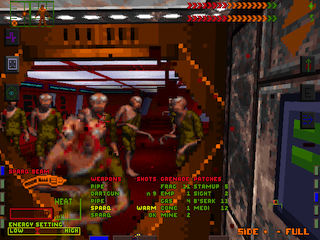
To enhance his abilities, the hacker has several patches at his disposal that he can apply to increase, for example, his vision, strength, resistance, etc., often with some side effects when the effect wears off. The hacker will also pick up various equipment that he can activate and upgrade, such as a light, infrared goggles, a radiation suit, etc. This mix of genres and abundance of possibilities comes at a cost, as System Shock is quite difficult to master at first glance. The interface is indeed quite austere and overwhelming (though it is possible to hide most of it), but above all, the ability to move the character entirely with the mouse is quite disorienting and ultimately impractical to use. Keyboard control remains far more precise and enjoyable, despite the number of keys required to fully control the character (16 keys for all actions, with the mouse then used only to target enemies, objects, and the interface).
Nevertheless, once mastered, the immersion in the cyberpunk world of System Shock is complete, and the experience offered is unique. SHODAN’s charisma plays a major role in this, even though she is an invisible enemy throughout the adventure. She remains dangerous, regularly attempting to intimidate the hacker during email exchanges and taking revenge whenever her actions are thwarted. The game’s playtime is extensive, with several tens of hours of tension in the corridors of Citadel to be expected before reaching the end. It is also interesting to note that, unlike many other modern productions, the player is never interrupted during the adventure, as System Shock contains only two cinematics—one for the introduction and one for the finale—while boasting a well-crafted story, world, and atmosphere.
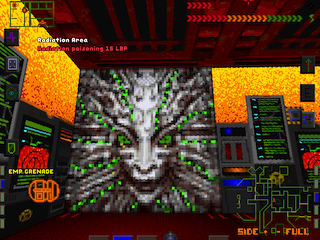
Developed by Looking Glass Studios (Ultima Underworld I & II, Thief: The Dark Project), and produced by Warren Spector (who later gained fame as the director of Deus Ex), System Shock was released in two versions: floppy disk and CD-ROM, with a few months separating their releases. The CD version improves upon the floppy disk edition by allowing higher resolutions (up to 640x480) and, most notably, providing a highly convincing voice acting for all logs and emails. SHODAN, in particular, becomes even more menacing with her distinctive cold, metallic female voice. System Shock was also adapted for Mac in its CD version.
Despite its relative failure, System Shock would see a highly successful sequel in 1999, System Shock 2, with a more pronounced RPG aspect, which marked the return of SHODAN, but which, like its predecessor, would not achieve the expected success. It would take until 2007 for the System Shock formula to meet unanimous success, both with critics and players, with the release of BioShock, the spiritual successor to System Shock.
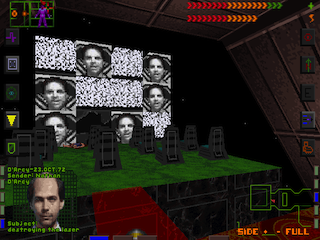
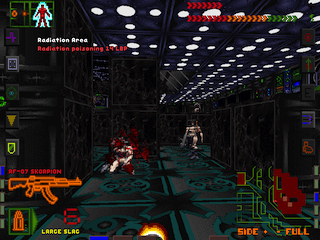
Demanding and disorienting before it can be tamed, System Shock remains extremely rewarding and unforgettable once completed. By placing the player in a state of constant tension and making them experience the struggle of a man fighting for survival against the madness of the machine, it perfectly captures the feeling of solitude and fear in a hostile space environment. Fans of stressful atmospheres, a unique experience awaits you: "Welcome to Citadel station"...
Where it fits in time
The whole timelineWhat came out and what happened around 1994.
-
Amstrad NC
Computer · Amstrad
-
Executor, the Mac on a PC
ARDI releases Executor 1.0: a 68k emulator that reimplements the Macintosh Toolbox rather than the hardware.
-
CPS Changer
Console de salon · Capcom
-
Basilisk II opens up the 68k Mac
Christian Bauer’s free emulator brings 68000 Macintoshes back to life on other machines, ROMs and System 7 included.
Play it on a Mac
2 Platform emulator
Show the 29 other emulators
An emulator being listed does not mean the game runs: every project keeps its own compatibility list.
Reply on the forum
A question or a hands-on report? Open the discussion on the forum.