Shadow Of The Ninja
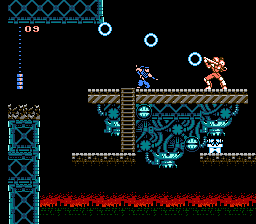
In 1990, Shadow of the Ninja delivered a tense action-platformer on the NES, featuring two agile ninjas with acrobatic movements and the ability to cling to ceilings.
Developer Natsume Publisher Natsume, Taïto (Europe)
Natsume, even though it is no longer today but a shadow of itself, was one of the very good NES developers of its time (and the quality of its Super NES games, with Wild Guns leading the way, is also not to be ashamed of). Yet most of its titles have gone more or less unnoticed. Certainly its size did not allow it to compete with the giants like Capcom, Konami, and Nintendo, but Natsume never managed to achieve the fame of Sunsoft or Tecmo, to name just a few. And it is all the more surprising when you see the quality of the action-platform games that are Shadow Of The Ninja, Shatterhand, and Power Blade, released within less than two years of each other on the sturdy NES.
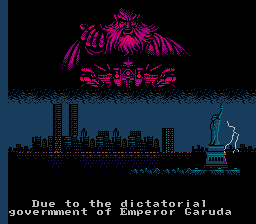
The first game of this trio to be released in 1990, Shadow Of The Ninja (Kage in Japan and Blue Shadow in Europe) is a game that, at first glance, may remind one of Ninja Gaiden, released two years earlier. However, the game is ultimately quite different from its predecessor, and the specific features of Natsume's title quickly become apparent. The setting is more futuristic, as the story is set in 2029 in a New York controlled by Emperor Garuda. To put an end to his deadly grip, two ninjas are dispatched...
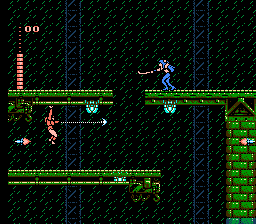

At the start of the game, the player can choose between two protagonists of opposite sexes: Hayate, the blue ninja, and Kaede, the red ninja. Just like in Ninja Gaiden, the gameplay is fast-paced and the character responds perfectly. The ninja can of course run, attack, jump, climb ladders, but can also hang from ceilings and various platforms and move underneath them or climb up.
It is this movement that truly defines the identity of Shadow Of The Ninja compared to other action-platformer titles, as it must be constantly used in the game, to reach impossible heights with just a jump and to move below. Less notably, the player can also summon lightning that will damage all enemies on screen and will cost half of their health bar.
The weaponry also stands out since the ninjas have two weapons at their disposal: the katana, or the chain (more precisely the kusarigama), each with their own specificities. The katana is thus faster but limited to melee combat, while the chain is slower but has a greater reach and can attack upwards and diagonally. Only one weapon can be equipped at a time, but they can be upgraded, each having 3 levels that make them progressively more powerful. However, after every 4 hits landed on the ninja, the weapons will revert to a lower level. In addition to weapons, the levels also contain limited ammunition items, such as shurikens and bombs.
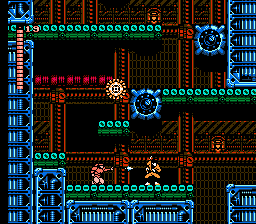
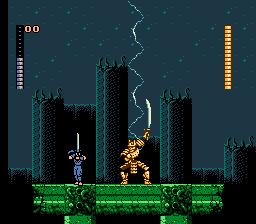
From the start of the game, the player is greeted by a very beautiful rain effect, which foreshadows the quality of the graphics in this title. The animation is smooth, the backgrounds are rich, the enemies are varied (around twenty different types, excluding bosses), and the staging knows how to be inspired, like this duel with the golden samurai on the rooftops of the city. The music is also up to the game’s standards, very successful, with rock and rhythm-heavy tracks that perfectly fit the universe of Shadow Of The Ninja and its gameplay.
Natsume has also incorporated a 2-player mode in Shadow Of The Ninja, where continues are shared between players.
This mode is fully playable, very fun, and quite rare given the few action games (apart from Contra) that offer the possibility of playing co-op on NES, and it helps compensate for the slightly short lifespan of the single-player mode.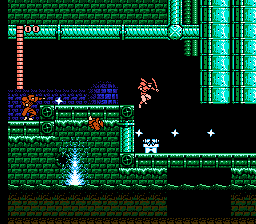
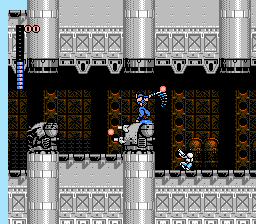
Indeed, Shadow Of The Ninja is unfortunately relatively short, spanning only 5 levels (each divided into several sections). While this criticism can also be directed at some of the biggest NES platformer hits—such as Batman, which is ultimately not much longer—it feels even more pronounced in Shadow Of The Ninja due to its more accessible difficulty level, making the end more easily reachable. Nevertheless, the game is not just a piece of cake, and the challenge remains high, in the old-school style: enemies are numerous and fast, the game features several pure platforming phases with traps that require good mastery of the character and their abilities to overcome, and the player only has one life per continue, with only 5 continues available. More accessible, but far from easy!
The comparisons that can be drawn with Ninja Gaiden are amusing in more than one way, since while Ninja Gaiden's success undoubtedly inspired Shadow Of The Ninja, the latter was not overlooked either. Indeed, the third installment in Tecmo's series borrows several moves from Natsume's title.
Even better, the very charming Game Boy version of the series, Ninja Gaiden Shadow, closely resembles Shadow Of The Ninja, as the title was originally developed by Natsume as a Game Boy adaptation of Shadow Of The Ninja before being acquired and quickly adapted by Tecmo for their franchise.
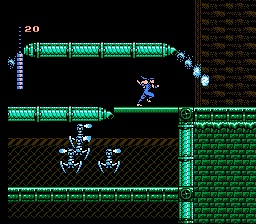
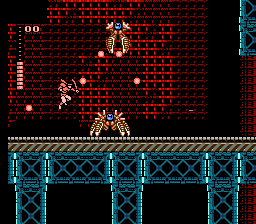
While Shadow Of The Ninja could have been nothing more than a flavorless clone of Ninja Gaiden, it turns out to be one of those forgotten NES gems that manages to stand up to its predecessor (which is no small feat given Tecmo’s title quality) and still brings the same level of enjoyment. In a way, it’s a true stepping stone to showcase Natsume’s expertise in the field—a developer who simply had the misfortune of shining a bit too late on the NES to leave their mark alongside the greats...
Where it fits in time
The whole timelineWhat came out and what happened around 1990.
-
SoftPC runs the PC on the Macintosh
Insignia Solutions brings its x86 emulator to the Mac: DOS and Windows reach Apple machines through software emulation.
-
NeXTcube
Computer · NeXT
-
Mega-Tech
Arcade · Sega
-
System 7 modernises the Mac
Virtual memory, file sharing, AppleScript: System 7 is the first major overhaul of the Macintosh system.
Play it on a Mac
1 Platform emulator
Show the 30 other emulators
An emulator being listed does not mean the game runs: every project keeps its own compatibility list.
Reply on the forum
A question or a hands-on report? Open the discussion on the forum.