Gran Turismo 2
Gran Turismo 2 (1999) expands Polyphony Digital’s automotive simulation with over 600 car models, technical tracks, licensed venues, and dealerships spread across countries on PlayStation.
Developer Polyphony Digital Publisher Sony Computer Entertainment
With Gran Turismo, Polyphony Digital had revolutionized racing games. A realistic behavior, technical circuits, and cars available both in real dealerships and virtual ones. Everything was there to make it a video game masterpiece. What more could one ask for in this second installment?
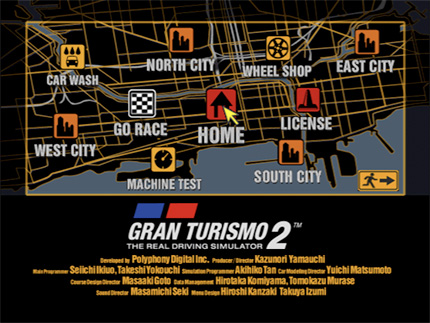
Like in the first game, the game is presented on a city map, including racing and mechanical test events, license acquisition, and dealerships. They are no longer directly accessible; now too numerous, they are grouped by country under four sections. Japanese and American brands each have their own dedicated district, while European manufacturers are grouped together, with Italy and France in one section and England and Germany in another. With more numerous dealerships, even more cars are available, totaling over 600 models. Polyphony Digital delighted automotive sports fans with some of the most powerful or prestigious cars.
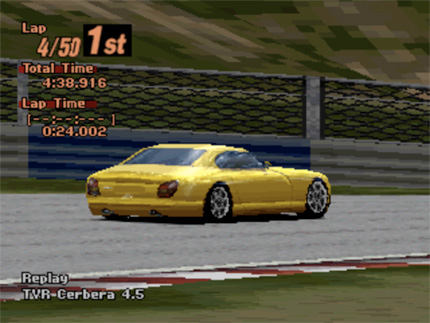
You'll find the Japanese models (Honda NSX, Nissan Skyline, Toyota Supra, Mitsubishi Lancer, Subaru Imprezza…) and American ones (Viper GTS, Chevrolet Corvette…) that you already knew, each brand featuring new models, often marked by a prestigious racing pedigree. Thus, several of them from the legendary 24 Hours of Le Mans race are now accessible. The Toyota GT-One and Nissan R390 GT1 competed for victory in the years preceding the game's release.
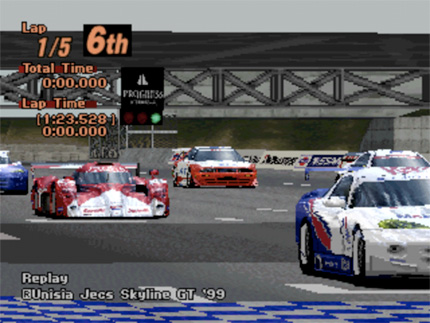
You enjoy discovering other forgotten brands. Venturi, a prestigious French brand whose sportiness is on par with the global elite, is featured alongside Renault, Peugeot, and Citroën.
The Clio 16v, Clio V6, Laguna, 106, 206, 306, 406, Saxo, and Xantia—there are many models, and we certainly enjoy driving cars we frequently see on our streets. It’s a genuine pleasure.
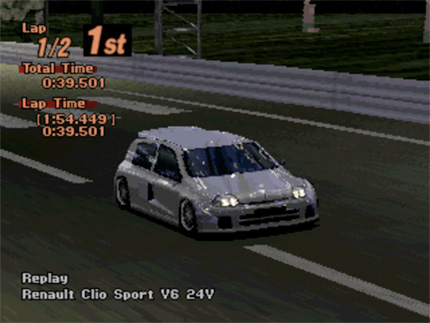
Each manufacturer showcases its flagship cars (from 1998) as well as rare racing models that have made France renowned in the world of motorsport. Peugeot and Citroën offer rally cars that anyone would dream of driving during a special stage. Other prototypes are also included, and once again, one of the most phenomenal is French—the Espace F1. This family model, the Espace, is equipped with a World Champion F1 engine. The single built example is available in this GT2.
Though not known for its sports reputation, Fiat is represented with some historical yet less performant models. The Fiat 500, with its 22 horsepower, can also take part in races. To find Italian sports cars, you’ll have to look toward Alfa Romeo and Lancia. The Stratos and Delta, formidable rally cars, will face off against current models without any issues.
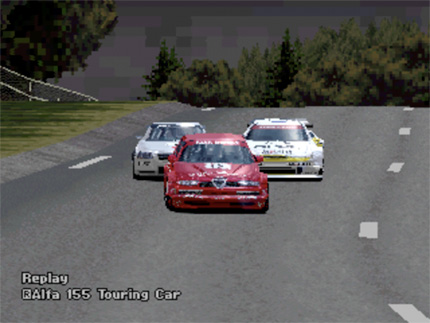
On the British and German side, the same pleasure is found in driving past or current most renowned models. Audi offers its classics—S3 and S4—alongside the TT, more exuberant models. Mercedes-Benz, meanwhile, highlights its past models in the hands of the official tuner AMG. BMW’s Series 3, 5, and 7 are also available.
Jaguar finally offers us its XJ220, designed for the 24 Hours of Le Mans and still as powerful despite the years.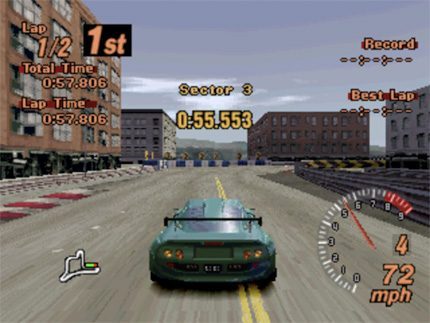
You get the idea, the number of vehicles has exploded, everyone will find their pleasure. However, we strongly regret the absence of certain models or manufacturers. The BMW cars tagged M are unfortunately not available. Ferrari, Maserati, or even Lamborghini—none of these prestigious Italian brands are present. The tuner RUF, specializing in the German Porsche brand, somewhat compensates for its absence. And of course, the wonderful McLaren F1, which could have rivaled the Toyota GT-One and Nissan R390 we mentioned earlier, is also missing. Some of these models will be available in future versions of Gran Turismo, on PS2 or even PS3.
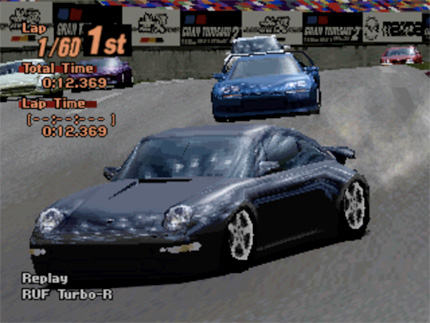
Polyphony Digital didn’t hold back, as the tracks have also undergone a major overhaul. The circuits that made GT a success are kept. Others come to complete the list, some of them even being real tracks. We now have the possibility to test all these cars on the fabulous Laguna Seca. Other fictional circuits have emerged straight from the game’s designers’ minds. They are well thought out and will be retained in future installments. Among them, two particularly stood out. Midfield, a Japanese circuit featuring long straightaways and tight turns, is an excellent track for testing a car’s balance. Apricot Hill, on the other hand, is a long succession of turns of varying sharpness, forcing the driver to push their vehicle to its limits. With a slightly boosted production car and a handling style that thrives on drift, mastering the slide becomes a delight.
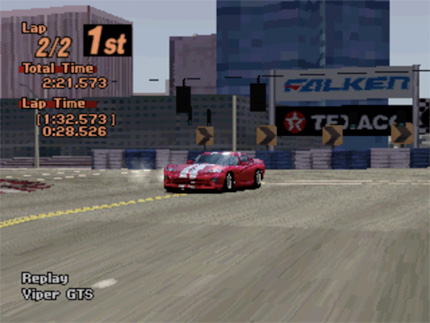
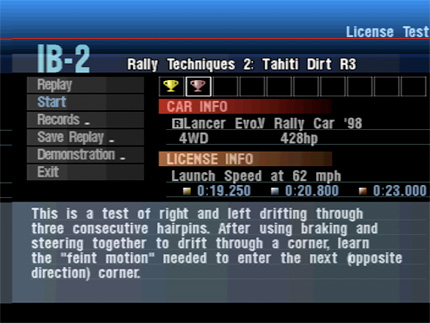
The expansion of tracks and cars allows developers to create more challenges, each with distinct variations. These challenges also depend on the maximum power of the car. Now, five licenses must be obtained to compete in all the races offered. They are relatively easy to earn. However, if you aim to win every event in gold, you will need to rely on all your piloting skills. High-level performances will be rewarded with exceptional models depending on the challenge completed. The final one, the super-license, grants access to no races but allows you to win a Toyota GT-One '99, one of the most powerful cars in the game.
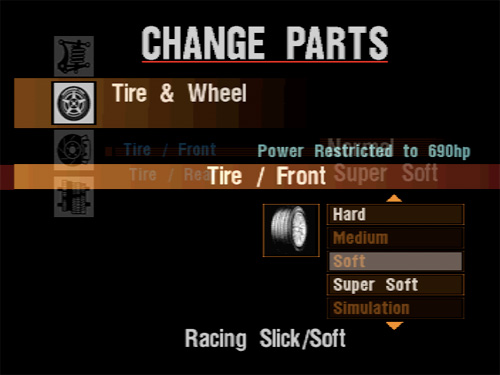
You must start by purchasing your first car, an investment that should not be taken lightly. Lightweight and powerful for less than ten thousand credits, only a few used Japanese models meet these criteria. Once the car is bought, if there are remaining credits, a sport exhaust or an electronic chip are welcome additions to boost performance at minimal cost. The possibilities to improve your vehicle are nearly identical to those in Gran Turismo 1.
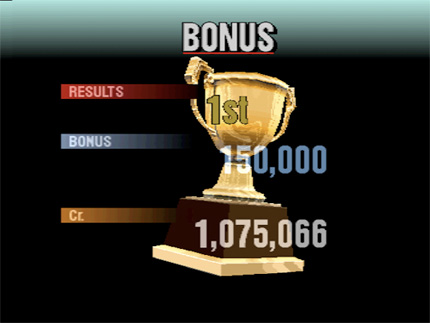
On to the races; special events are where your performances will be best rewarded at the start of the game. While the first races, such as the Sunday Cup or the Clubman Cup, only yield a few thousand credits, subsequent races allow you to win cars. Each small cup will require a specific type of vehicle. Very quickly, your garage fills up with increasingly interesting models.
The cars obtained will be quickly resold to increase your bank account and buy other vehicles directly from the dealership. Don’t hesitate to repeat the most profitable shopping trips; some won’t vehicles can be sold for up to 250,000 credits. The GT All-Stars 3 event even allows you to win a TVR Speed 12, which sells for 500,000 credits.
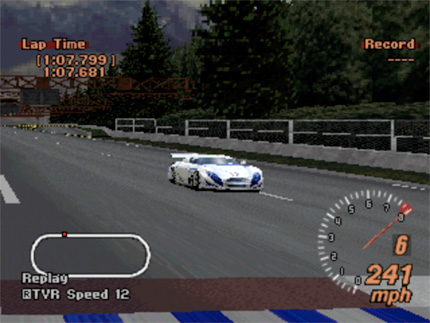
Once the special events are well underway, your account and garage should be well-stocked enough to start the GT League. Here, the country of origin matters; in the first section, you’ll need to adapt one or more cars per country and know that they will yield little credit. This can take quite a while. The second section only includes two cups: European and Pacific. Due to the required power to participate, these races with non-race adapted cars are very interesting and enjoyable to play. Especially since the prizes start to become quite appealing.
All that remains is to finish the special events, the GT League World Cup, and the endurance races.
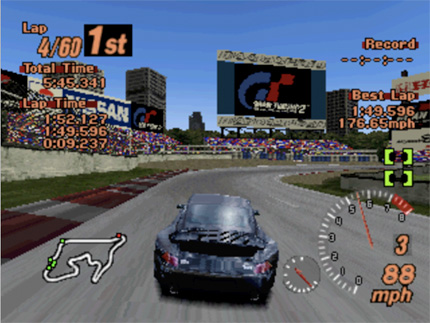
The major new feature of GT2 is the introduction of a Rally mode. The goal for each race is to beat the ghost time. While the idea could be appealing, the execution is far less so: driving on dirt feels heavy, when you’d rather slide the car, it stays glued to the road. Especially since the available tracks could be really enjoyable.
The game ends quickly; the victory percentage can easily remain at 100% if you take the time to watch the previews of each race to prepare them as best as possible.
However, we are not immune to a fatal driving mistake.
The choice of colors for civilian or racing car models allows for colorful races among friends and to have classy slow-motion replays. On the most powerful models, you will need to win cars from different teams to have distinct colors for identical models.
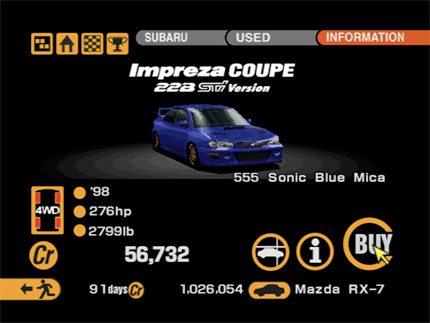
Gran Turismo 2 is one of those video games that play much better with a controller, and if possible with mini-joysticks to control acceleration power and cornering. The one available for PlayStation fulfills this role very well. If you plan to play with a keyboard, prioritize vehicles with good road handling. Four-wheel-drive vehicles are generally a good choice, such as the Imprezza 22B STi, which is rarely found used by Subaru.
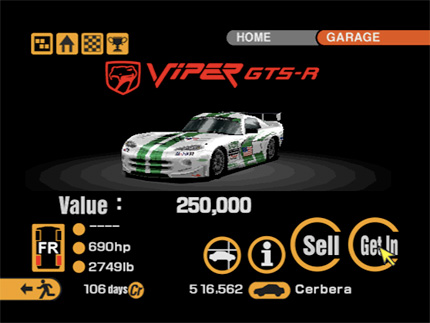
At a higher level, you will find several models of the Skyline GT-R, it's up to you to choose your colors. It is powerful and stable, with easy-to-manage drift despite the lack of acceleration. Avoid large Vipers or other TVR Speed 12s, though they may be dreamy, they are also very tricky with the rear end.
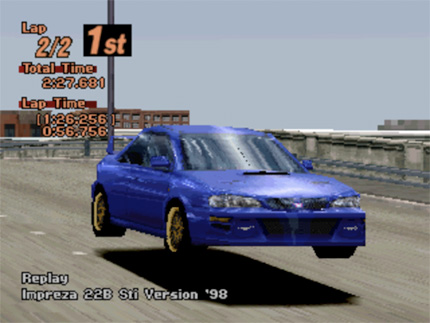
In the end, Gran Turismo 2 is the perfect sequel to the first episode released two years earlier; our wishes for car and track choices have been largely fulfilled despite some shortcomings. Only the rally mode can disappoint, but once those races are over, there's no need to linger on them. After 10 years, the models offered may seem outdated, but the game remains unfortunately relevant on Mac since no other native game has done better yet.
Where it fits in time
The whole timelineWhat came out and what happened around 1999.
-
Virtual Game Station runs the PlayStation on Mac
Connectix releases VGS: PlayStation games run on a Power Mac without a modchip or a console. Steve Jobs presents it at Macworld.
-
Sony sues Connectix
Sony claims VGS infringes its rights in the PlayStation BIOS. The case will set the boundaries of legal emulation.
-
Naomi 2
Arcade · Sega
Play it on a Mac
2 Platform emulator
Show the 12 other emulators
An emulator being listed does not mean the game runs: every project keeps its own compatibility list.
Reply on the forum
A question or a hands-on report? Open the discussion on the forum.