
CP/M for OS X
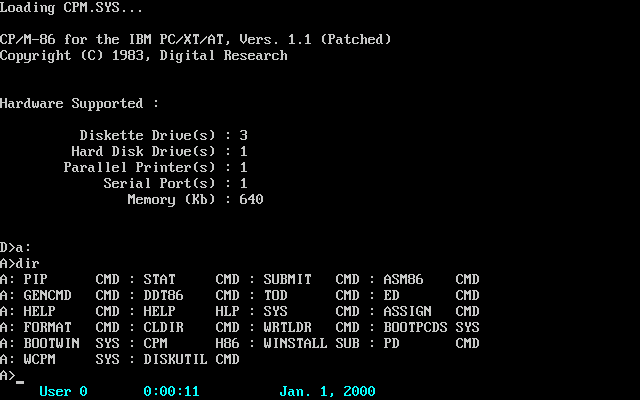
CP/M for OS X emulates a Z80 processor and the CP/M-80 environment to run programs designed for this historical platform on macOS.
CP/M for OS X is an emulator dedicated to running software designed for CP/M-80, a historical operating system for microcomputers based on the Z80 processor. Developed in Objective-C, it allows running vintage applications (such as SuperCalc, Turbo Pascal, or Zork) on macOS, accurately reproducing the CP/M environment.
The tool supports practical features: drag-and-drop device mounting, native copy-paste, and a flexible graphical interface. Although initially designed for classic macOS architectures, it remains compatible with recent versions of the operating system, provided the compilation instructions are followed. Its minimalist approach and focus on hardware emulation make it a suitable choice for retro computing enthusiasts.
Last updated:
Platforms
Architecture
 Mac OS X - macOS
 Intel x86
 Apple Silicon
 64-bit
Download and links
- Download CP/M for OS X
- Official website
- Source code 240 GitHub stars
- License : MIT
Version history
0.7.2
- Ajout du support officiel pour les processeurs Apple Silicon (M1).
- Activation du hardened runtime pour permettre la signature de l'application.
- Mises à jour mineures pour assurer la compatibilité avec macOS.
Minor updates to keep track with macOS; this build:
- adds M1 support; and
- enables the hardened runtime, permitting this to become a signed app.
0.7.1
- Correction d’un bug majeur bloquant le lancement d’un grand nombre d’applications depuis la version précédente.
- Réalignement de l’adresse de démarrage du BIOS sur 256 octets pour éviter les conflits.
- Modification du BIOS fictif avec des instructions .addr JMP addr pour éviter les réécritures dynamiques par des apps comme MBASIC.
- Correction d’un débordement d’adressage dans la boucle d’installation des JMP, qui écrasait l’instruction principale à l’adresse 0.
Corrects a bug introduced by 0.7.0 that caused a very high number of applications not to launch.
Specifically:
- the BIOS start address is now 256-byte aligned;
- the (fake) BIOS itself starts with just a bunch of
.addr JMP addrstatements because applications like MBASIC steal the target addresses from those JMPs and dynamically reprogram themselves; - but the loop that installs those JMP statements was inadvertently overflowing its addressing range and overwriting the main from-here-to-BIOS JMP at address 0. The latent error that caused this became apparent with 0.7.0 because the start address for the BIOS is no longer picked as a function the number of
JMPstatements that need to be stored.
0.7.0
- Correction de l'alignement du point d'entrée BIOS sur une frontière de 256 octets pour résoudre des problèmes avec WordStar 4 et d'autres logiciels.
Aligns the BIOS entry point to a 256-byte boundary, resolving issues with WordStar 4 and various other pieces of software.
0.6.3
- Correction des erreurs d’arrondi dans l’affichage du texte pour éviter la disparition de la dernière colonne et ligne.
- Ajout d’un léger espace supplémentaire pour compenser ces imprécisions graphiques.
Permits a little extra room for rounding errors in text output, solving potential disappearance of the final column and row of text.
0.6.2
- Ajout d’un gestionnaire de disques par défaut optimisé pour le système d’exploitation.
- Utilisation de la couleur de surbrillance de texte native sous macOS pour une meilleure intégration visuelle.
Improved default drive handling; now using the proper OS X text highlight colour.
0.6.1
- Correction d’une erreur dans le traitement des blocs de contrôle de fichiers bloquant l’accès à certains fichiers pour certains logiciels.
- Amélioration de la compatibilité avec des applications nécessitant un accès fiable aux ressources fichiers.
This release corrects an error in file control block handling that could prevent some software from locating its files.
0.6
- Ajout de la sélection de texte pour faciliter les opérations de copie et améliorer l’intégration avec le presse-papiers.
- Correction des problèmes liés à la gestion des fichiers et dossiers dans certains environnements CP/M.
Added text selection for copy operations, improving clipboard integration.
0.5.1
- Correction d’une régression bloquante lors de la création de fichiers dans le système.
- Pas d’ajout de fonctionnalités majeures, de systèmes émulés ou de nouveautés techniques.
A very hasty release; this fixes a regression in file creation.
0.5
- Correction d’une erreur empêchant les applications de détecter correctement les arguments invalides lors du lancement.
- Amélioration de la détection des erreurs lors de l’exécution des programmes CP/M.
This release fixes a mistake that caused applications to think the user had specified valid arguments when launching an application.
0.4
- Ajout d’un accès en écriture limité vers le système de fichiers hôte (avec précautions et sans garantie).
- Correction de problèmes liés à la gestion des permissions et des accès en lecture/écriture.
- Mise à jour des bibliothèques et outils pour améliorer la stabilité des sessions CP/M.
- Amélioration des logs pour faciliter le débogage des erreurs système.
This release includes an attempt at enabling write access to your filesystem. So be careful. No guaranties.
0.3
- Ajout d’un icône pour l’application et prise en charge des disques multiples via glisser-déposer.
- Passage au texte ambre pour activer le rendu sous-pixel.
- Correction d’un problème de chargement des fichiers non multiples de 128 octets.
Added an application icon, added support for multiple drives via drag and drop, switched to amber text to enable subpixel rendering, fixed an issue with loading files that aren't a multiple of 128 bytes in size.
0.2
- Ajout du support pour l'appel BDOS 10 (entrée tamponnée du clavier en console).
- Correction du problème nécessitant de quitter et relancer l'émulateur pour rouvrir un programme CP/M spécifique.
Added support for BDOS call 10 — buffered console input — and resolved an issue whereby you'd have fully to quit and reopen CP/M for OS X to reopen a specific CP/M program.
0.1
- Première version expérimentale permettant l’exécution en lecture seule de programmes CP/M.
- Fonctionnalités BDOS et BIOS partiellement implémentées, mais non conformes.
- Pas de support pour l’écriture ou la modification de fichiers sous CP/M.
- Lancement direct depuis macOS via double-clic sur un fichier CP/M.
An extremely early build; this attempts read-only execution of CP/M applications. Even those BDOS and BIOS functions that are implemented probably remain far from conformant.
To use, just put this app anywhere on your system then find a CP/M program and double click to launch it.
Reply on the forum
A question or a hands-on report? Open the discussion on the forum.