Emulation: Explanation of ROM Naming Conventions
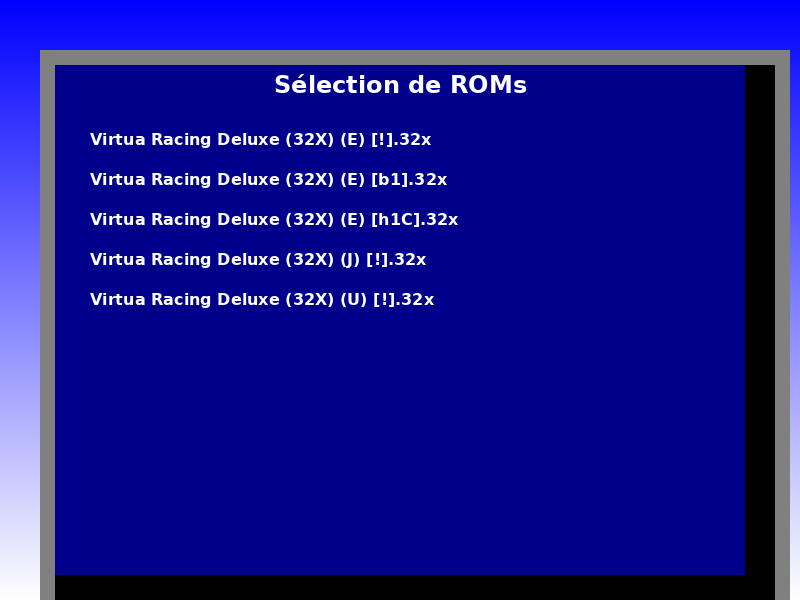

While searching for ROMs online (which you obviously owned the original of), you may have come across several versions of the same game without knowing which one to choose, each having a quite cryptic name like
- Virtua Racing Deluxe (32X) (E) [!].32x
- Virtua Racing Deluxe (32X) (E) [b1].32x
- Virtua Racing Deluxe (32X) (E) [h1C].32x
- Virtua Racing Deluxe (32X) (J) [!].32x
- Virtua Racing Deluxe (32X) (U) [!].32x
for Virtua Racing on 32X, a game we recently discussed in these pages. This mainly happens with games from the 1990s, corresponding to the 16-bit generation where numerous dumps (extraction of a cartridge into a ROM) were made for each game.
Here is a small guide to help you choose among all the versions the one that suits you best.
Let's start with the region or country information. They are often in parentheses and the first piece of information given after the game name:
- (W) : No specific region, or rather "World" region
- (E) : Europe
- (U) : United States
- (J) : Japan
- (F) : France
- (G) : Germany
- (I) : Italy
- (S) : Spain
- (UK) : United Kingdoms
- (H) : Netherlands
- (NL) : Netherlands
- (SW) : Sweden
- (FN) : Finland
- (GR) : Greece
- (FC) : Quebec (Canadian French)
- (C) : China
- (HK) : Hong Kong
- (K) : Korea
- (A) : Australia
- (B) : Brazil
It happens that the main regions are also combined for a game released under a single version in multiple places around the globe:
- (EU) : Europe & United States
- (JU) : Japan & United States
- (JE) : Japan & Europe
- (JUE) : Japan, United States & Europe
The region may also include the video system format of the region:
- PAL-E : Europe, PAL format
- NTSC-U : United States, NTSC format
- NTSC-J : Japan, NTSC format
Finally, there are a few additional codes for special cases:
- (PD) : Public Domain
- (Unk) : Unknown
- (Unl) : Unlicensed
- (M*) : Where * is a number, indicates the number of languages available in the game, for example, (M5) often represents Central Europe with English, French, German, Italian, and Spanish.
- (VC) : Virtual Console. This is often a ready-to-use dump for a virtual console, such as that of the Wii for example.
Now let’s move on to the information related to dumps, with values in brackets:
- [!] : Verified and functional dump, these are the ones to prioritize!
- [a] : Alternative version.
- [p] : Pirate version.
- [b*] : Bad dump, will not work, there may exist multiple versions b1, b2, ...
- [h*] : Hacks, there may exist multiple versions h1, h2, ...
- A country code is sometimes added for country-specific versions, most often China
- [f*] : Fixed dump to run better on an emulator, there may be multiple versions like f1, f2, ...
- [t] : Improved version including, for example, access to cheat codes.
- [T] : Translated version by someone outside the game publisher, the T is often associated with the final language and the translator [T-FR by xxxx].
- [o] : Overdump, the dump size is larger than the cartridge size, this should not prevent it from working.
- [x] : Bad checksum, the game may not work.
- [c] : Cracked version.
* is a number, indicating the version number.
In the case of our example, I would take the Virtua Racing Deluxe (32X) (E) [!].32x version, which seems most suitable for a quick play.
Hopefully, all this helps. Feel free to share some codes I might have missed in the comments.
Reply on the forum
A question or a hands-on report? Open the discussion on the forum.