Bandai Pippin by Apple
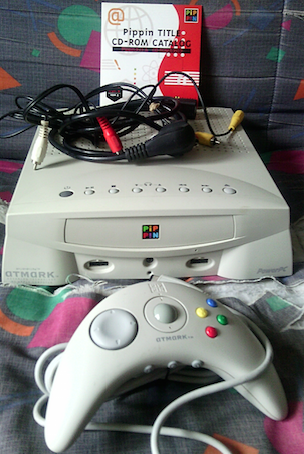

To understand the tragic fate of this console, you first need to recall the path that Apple Inc. has taken up to that point. I won’t recount here (on this site followed by a majority of users of Apple products) the details of the company’s history and will only outline the main points.
As everyone knows, the company was founded at the end of the 1970s by two Steves: Wozniak and the late Jobs. This was followed by the success of the Apple II, then the arrival of the famous Macintosh in the mid-1980s and the departure of Steve Jobs, who created NeXT.
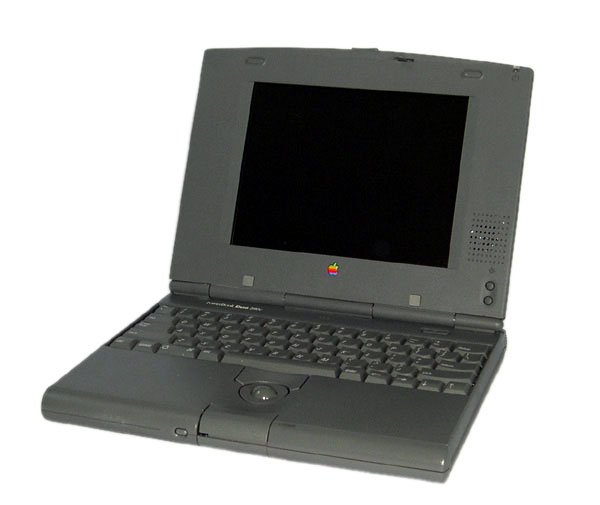
The early 1990s was a crucial period for players in the consumer and business microcomputer markets, including the arrival of laptops, whose still prohibitive prices limited the customer base mostly to professionals. Innovation was key while remaining competitive.
Apple was not immune to this commercial war and tried to stand out with the LC and Quadra series, then the PowerBook and the Newton, the latter being a commercial failure.
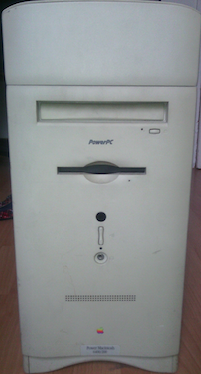
Despite all these efforts, the company saw its market share eroded by the Personal Computer standard (initiated by IBM), primarily based on Intel CPUs and using Microsoft’s Windows operating system. Meanwhile, Apple, IBM, and Motorola collaborated, and from this alliance came the PowerPC, a RISC processor, whose technology was widely used in the world of so-called "new" and "next-gen" consoles (PS3, Xbox 360, GameCube, Wii, Wii U…).
The first PowerPC Mac appeared in 1994. However, the release of the new Intel Pentium and Microsoft Windows 95 cut the ground from under Apple’s feet.
At the time, its CEO, Michael Spindler, who was criticized by colleagues for poor communication, faced the daunting task of steering the company out of troubled waters. He would attempt to revive public interest in Apple products through various means. These products would be manufactured in large quantities, as the California-based company would release devices such as a CD player, a camera, a digital camera, or even speakers, going as far as producing DOS-compatible Macs.
Nothing worked, and a major decision was made. Following Microsoft’s example, which had freely copied Apple’s system (and since this is a pro-Mac site, let’s not shy away from saying it), Apple would do the same with the PC economic model by opening its architecture to third-party manufacturers. Thus, the Macintosh was no longer an exclusive product bearing the multicolored apple logo, as anyone could create their own Macintosh by purchasing a license. This period, known as the "clone" era, would give birth to the famous "Pippin" (a type of apple, not the nickname of a small imaginary being). Indeed, as part of the massive project to open its technology to the world and flood the market, Apple launched the Pippin project in parallel. This was essentially a set of specifications for a lightweight platform based on the Macintosh PPC "multimedia" architecture—a pompous and catch-all term coined by the marketing of the time (much like the words "digital" and "digital" as I write these lines).
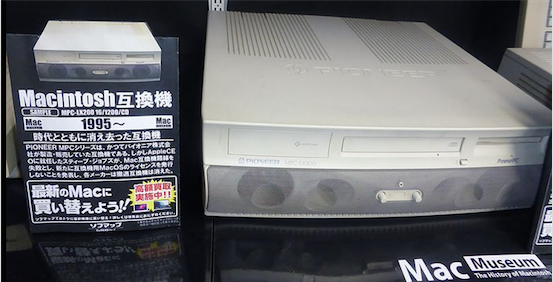
Technically, the Pippin was based on a 66 MHz PowerPC 603e processor, chosen for its low production cost and minimal energy consumption, paired with System 7.5.2, which would be included on every CD and adapted to the product. This system was revised for the occasion, dropping all unnecessary extensions, with the firmware contained in a 4 MB ROM. For RAM, the base version included 6 MB, along with an expansion port allowing up to 16 MB to be added, and a 128 KB flash memory.
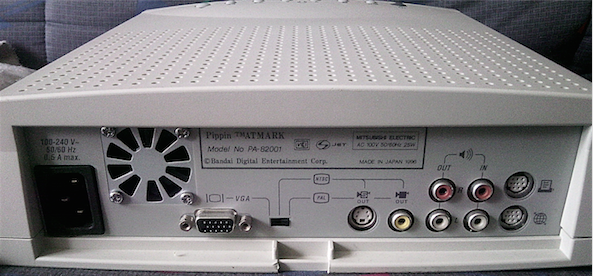
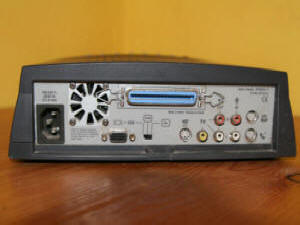
With a quadruple-speed CD reader and a power supply handling both 110V and 220V, the Pippin features composite RCA audio input and output supporting stereo mode, but most importantly allows selecting the video output which handles 640x480 resolution in 8 or 16 bits (either 256 or thousands of colors). Indeed, while a VGA output is offered, a composite RCA output as well as an S-Video output are available, and a simple switch allows switching the stream from NTSC to PAL standard. All this is accompanied by two ADB serial ports for connecting peripherals such as a printer or a modem more powerful than the built-in 14kb/s one (Internet gradually entering households), as well as two additional ports on the front for connecting game controllers. The architecture being open, additional ports can be added, which will be the case for SCSI during the console's end-of-life.
The license is therefore available for purchase, just like that of the clones. Apple hopes to sell it through arguments such as it being a hybrid mini-computer that is cheaper to produce, and for developers, that their creation will be compatible and portable at minimal cost on a standard or dedicated System 7 system.
But this machine might never have seen the light of day since the company lacks the financial strength to produce this hybrid, and it is the support of the Japanese toy giant, Bandai, that will allow Apple to embark on the adventure of digital entertainment.

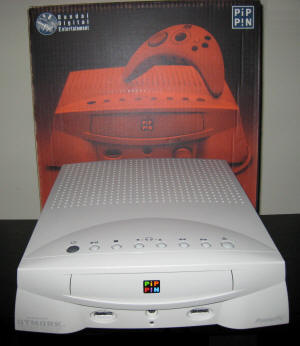
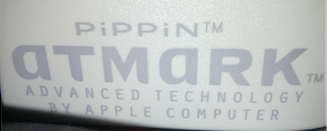
This is the result of everyone's will, that Bandai and Apple will join forces to market the first Pippin console, named "atmark", on March 28, 1995 in Japan (via phone order before finding them in stores), then on September 1, 1995 in North America, renaming it "@world" and changing its white color to black.
The terms of the contract will be as follows: the company from the Land of the Rising Sun ensures production and distribution, while the California firm takes charge of research and development costs and secures a percentage of machine sales while retaining the right to sell the license to other companies.
The price is rather high, around $600, where the Saturn costs $400 or the PlayStation $300, then the Nintendo 64, launched in 1996, at only $200. Not to mention that the 3DO, another licensed architecture, had already entered the fray in 1993 for $700 per unit, alongside other 32-bit systems like the Amiga CD32 and the Atari Jaguar. The console war is about to become fierce.
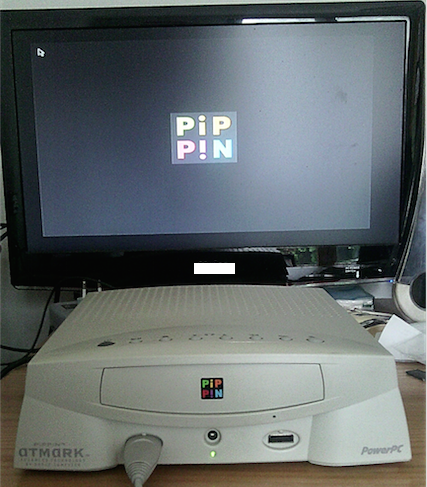
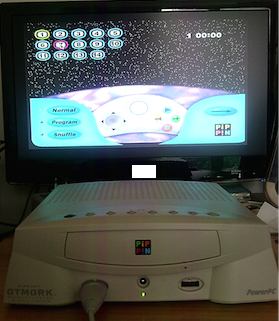
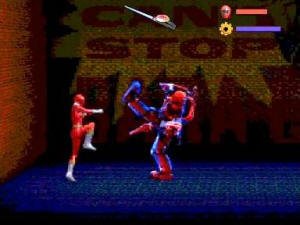
Every console launch must be accompanied by major titles or at least announcements of flagship releases. Bandai will therefore take on the task of producing games, obviously under license, such as Power Rangers Zeo vs. the Machine Empire (by developer CiberFlix) and others that will follow, like successful Gundam titles, unfortunately never translated. But to appeal to the inhabitants of the new world, Apple, with Bandai's support, will commission developers to port their creations, originally intended for Macintosh exclusivity, to the young console.
Alex Seropian, founder of the Bungie Software studio (the one acquired by Microsoft to develop Halo for its Xbox), recalls the request from both giants to create their groundbreaking FPS of the time, Marathon, which PC players envied at the time compared to Mac users: "I remember we were quite excited... I think we were somewhat skeptical but supportive of the project at the same time. It seemed that Apple and Bandai really wanted it done [the Marathon port for Pippin] and we had very good relations with them." That’s how Super Marathon (a compilation of the first two installments), Racing Days, or earlier, Shockwave Assault, came to appear.
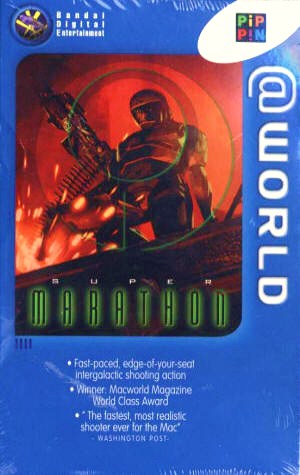
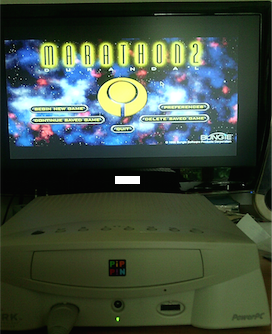
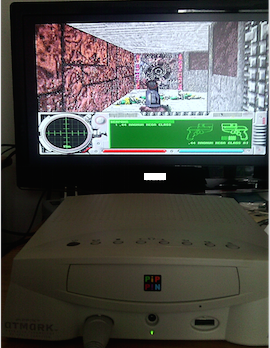
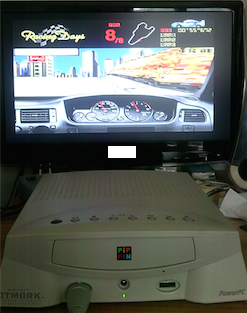
While Bandai tried to highlight its licenses on the PPC console, some highly anticipated titles benefited more from the machine’s computer side to create programs like the highly praised Dragon Ball Z Anime Designer. However, few third-party developers attempted to release their products on Pippin (and consequently on Macintosh).
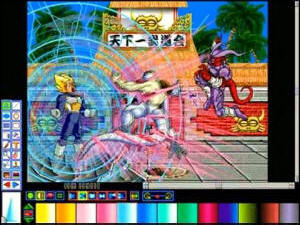
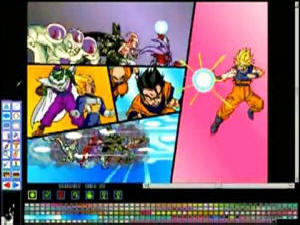

The hybrid nature of the Pippin, which was meant to be a strong point and an additional selling argument compared to others, turned out to be the machine's main flaw. A powerful console, with its Dual Frame Buffer allowing one image to be displayed while another is being calculated, and its possible Internet connection (Netscape was indeed involved in releasing a browser specifically for the console), it remains a budget computer, lacking a hard drive to store data or a keyboard for comfortable web browsing. This is reflected in the poorly ergonomic controllers, which, in addition to having typical gaming buttons, feature a trackball in the center, replacing the traditional mouse (or "mulot" for the familiar).
We will then see peripherals to enhance the interface with the machine, including the incredible 230 MB three-and-a-quarter-inch floppy disk drive by Olympus at an exorbitant price, but especially the graphics tablet with a real computer keyboard.
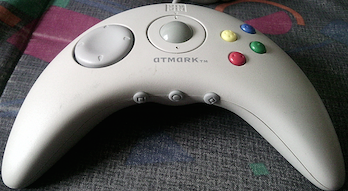
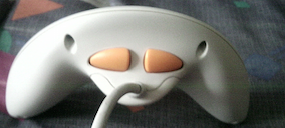
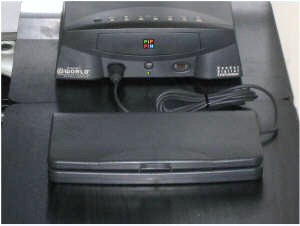
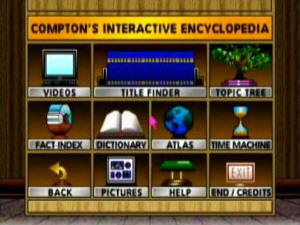
It becomes clear that this architecture will see some games appear, but especially educational programs, software suites, encyclopedias, and more. Indeed, for European production, it was the Norwegian company Katz Media that attempted this. The company seemed to see more potential in a low-cost computer rather than its gaming aspect, adding a SCSI port at the back and attempting to sell the product in hospitals or as an internet kiosk in hotels, but without more success.
The financial balance sheet is not glorious; it was even a considerable loss for both partners. Bandai, which hoped to sell around 200,000 units in the first year, sold only a little over 40,000 in total, according to estimates.
Forgotten without a clear and strong marketing image, the Pippin faded quickly into obscurity, and the adventure that began at the end of March 1995 came to a sad end in June 1997 when Bandai decided to halt production and sales of its console (official support continuing until 2002).
For Apple, the Pippin project ended earlier, with the dismissal of Splinder in February 1996. By the way, he was later replaced by Gil Amelio, who, with the acquisition of NeXT, brought a certain Steve Jobs back into the company. But the Pippin wouldn’t be the only project buried. The entire licensing system and its clones would also fail to help Apple gain market share as hoped, instead causing it to lose ground and pushing the company to the brink of collapse.

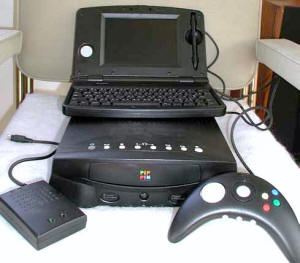
In the end, the Pippin was an oddity in the entertainment world, a hybrid of console and computer, with over eighty programs available for the Japanese market and a small dozen for the North American market, featuring eclectic titles of varying quality. To conclude the Pippin adventure, the words of Julian Wilson seem the most fitting: "I learned a lot at Apple, but one thing I remember is the importance of vision. Vision gives context to every decision. The Pippin was a distraction at that time; Apple had other priorities, they probably had good reason not to spend too much time on the Pippin."
References:
In addition to the essential Wikipedia, these lines were written using the excellent English article by Adam Volk on the now-defunct site gameological, as well as the dedicated console article on the video game console library site, from which some images were taken (the rest coming from my personal collection).
Reply on the forum
A question or a hands-on report? Open the discussion on the forum.