Model-3-Vulkan
Réécriture Vulkan de Supermodel pour l'arcade Sega Model 3, avec des binaires macOS.
Model-3-Vulkan est une réécriture autonome en Vulkan de Supermodel, l'émulateur d'arcade Sega Model 3. Le projet publie des archives distinctes pour macOS Apple Silicon et Intel.
Dernière mise à jour :
Plateformes
Architecture
 Mac OS X - macOS
 Apple Silicon
 64 bits
Téléchargement et liens
-
Télécharger Model-3-Vulkan
Le fichier proposé est en version 0.9.9.6, alors que la dernière version publiée est la 0.9.9.8.
- Code source 89 étoiles sur GitHub
Historique des versions
0.9.9.8
- Optimisation JIT hybride couvrant plus de 80 % des instructions PowerPC en natif, réduisant drastiquement les appels au mode interpréteur C.
- Correction majeure sur les GPU intégrés Intel : suppression d’une écriture redondante de profondeur (gl_FragDepth) bloquant l’optimisation Early-Z/Hi-Z, avec des gains de 20 à 50 % sur des jeux comme VF3tb (+60,9 %) ou Daytona 2.
- Suppression du délai de chargement des sauvegardes (passé de 3 secondes à 0), sans splash-screen intermédiaire, compatible avec 15 jeux testés.
- Fix du stutter dans Dirt Devils : optimisation de la gestion des pages 4 Ko partagées entre tables de variables et code chaud, réduisant le temps de simulation par frame de 45–66 ms à 0,28–0,78 ms.
- Prise en charge native des GPU Apple Silicon (M1–M4) via un build arm64 pur, avec MoltenVK intégré et support de macOS 13.3+.
- Correction des conflits entre résolution présélectionnée et rendu en basse résolution : les deux paramètres synchronisés pour éviter un rendu forcé à 496×384 malgré une présélection en 2x.
Model 3-Vulkan v0.9.9.8 — Release Notes
2026-11-14 · Windows x64 · Linux x86_64 · macOS Intel · macOS Apple Silicon
Model 3-Vulkan v0.9.9.8 is a performance release. Nothing in the emulation model changed: every game still renders the same picture it did in v0.9.9.6, and the same save states still load. What changed is how much work the CPU and the GPU have to do to get there.
The headline is that the hybrid JIT now translates more than 80 % of the guest instruction stream to native x86-64, the Vulkan renderer stopped paying for a redundant depth write that was silently disabling hardware Early-Z / Hi-Z culling, and UMA GPUs finally get zero-copy geometry upload. Together those turn the integrated-GPU experience from "lock it to 496×384" into a picture that can actually be played at native resolution.
📦 Packages
| Platform | File | Requirements |
|---|---|---|
| Windows x64 | Model3-Vulkan.v0.9.9.8.for.Windows.zip |
Windows 10/11, Vulkan 1.3 |
| Linux x86_64 | Model3-Vulkan.v0.9.9.8.for.Linux.tar.gz |
glibc 2.38+, Vulkan 1.3 |
| macOS Intel | Model3-Vulkan.v0.9.9.8.for.macOS-Intel.tar.gz |
macOS 13.0+, bundled MoltenVK 1.3 |
| macOS Apple Silicon | Model3-Vulkan.v0.9.9.8.for.macOS-AppleSilicon.tar.gz |
macOS 13.3+, bundled MoltenVK 1.3 |
SHA256SUMS.txt is attached to the release. Every archive extracts to a relocatable folder; put your
ROM zips in its roms/ directory (or point ROMPath at them). The Linux archive is built on Ubuntu
24.04 with g++-14 and needs no newer than GLIBC_2.38 / CXXABI_1.3.15 / GLIBCXX_3.4.32, so it
loads on Ubuntu 24.04, SteamOS 3.5+ and other current distributions. The macOS Intel build carries
its own libMoltenVK.dylib and targets macOS 13.0; .zst saves need macOS 14+ because the host core
links against a newer Swift runtime, and on macOS 13 the emulator falls back to .st automatically.
The Apple Silicon archive is the arm64 slice of the same build: the application, the host core and
MoltenVK are all pure arm64, so M1–M4 machines run it natively. Intel Macs should take the Intel-only
archive instead.
The short version
- The JIT now covers over 80 % of the guest instruction stream — more PowerPC instruction
classes are translated to native x86-64, so the C interpreter fallback runs far less often. In
uncapped-frame-rate sessions (
-benchmark, or the performance test button) the emulated machine runs noticeably faster than before. - Intel integrated GPUs got 20–50 % faster, and the fix is architectural — the fragment stage
no longer writes
gl_FragDepth, which had been disabling the GPU's Early-Z / Hi-Z depth rejection on every frame. Occluded pixels are discarded before shading again instead of after it. Measured on Intel Arc Graphics (Core Ultra 5 125H) at 2480×1920 2x MSAA:vf3tb+60.9 %,daytona2+30.9 %,scuddx+21.9 %,dirtdvls+14.0 %. AMD integrated GPUs use the same architecture and should benefit as well. Discrete GPUs gain too, but they were rarely the bottleneck. - Dirt Devils no longer stutters — its variable tables and its hot code share one 4 KB page, which the old "flush the whole page on any store" self-modifying-code check thrashed on. Simulation time per frame dropped from 45–66 ms to 0.28–0.78 ms.
- Save states now load on frame 0 — the 3-second boot guard is gone by default (
0.0), with no splash-in-the-middle. Every hardware block the loader needs is in the save image. - Smaller CPU overhead in the renderer — HD-texture descriptor bindings are per-frame rather than per-viewport, and opaque geometry is grouped by vertex source, cutting redundant pipeline binds on the Intel Windows driver.
⚡ PowerPC → x86-64 hybrid JIT: over 80 % native
The JIT shipped in v0.9.9.6 already handled integer arithmetic, compares, branches, byte-reversed loads and stores, single/double float memory ops and register moves. This release extends the native encoder to cover substantially more of the instruction stream; the session-end log line now reads:
PPC: translated code is 812345/987654 instruction(s) native (82.25%).
That line is compiled from the live block tables, so it describes the game that just ran rather than a fixed estimate. With more of the stream native, the dispatcher hands off to the C interpreter far less often, which is where the extra throughput comes from in CPU-bound scenes.
Verification is unchanged and still strict: SM3D_PPC_JIT_VERIFY=1 double-runs every block
against the interpreter and aborts on the first difference, and SM3D_PPC_JIT_DUMP=1 writes the
active blocks out as disassembly. The C interpreter remains selectable (Core → PowerPC Execution
Mode) as the reference path for A/B comparisons.
If you want to see the effect yourself, use Common → Performance test (unlocked frame rate) or
-benchmark: those unlock the fixed 57.524 Hz logic pacing so the figure is real throughput rather
than the present rate.
🅾️ Intel integrated GPUs: 20–50 % faster
The bug: a depth write that switched off Early-Z
The fragment shader used to end with:
gl_FragDepth = ubo.projection[3][2] * gl_FragCoord.w;
That value is exactly what the rasteriser already produces. Every Model 3 projection in this
backend comes from Mat4::FrustumRZ, whose third row is (0, 0, 0, near), so the hardware's
interpolated gl_FragCoord.z is identically equal to that expression — the sorted-transparency
stage (real3d_oit.frag) already relied on this and never wrote depth. But a fragment shader that
writes gl_FragDepth at all cannot have its depth test hoisted above it, so the GPU had to run the
entire fragment shader — four 64-byte vertex pulls, a bilinear quad solve and a texture decode —
for every pixel, including the ones that were about to be thrown away.
Removing the write restores hardware depth rejection. On a 24-EU-class integrated GPU, where the fragment stage is the bottleneck by a wide margin, that is the whole ballgame.
Measured on Intel Arc Graphics (Core Ultra 5 125H)
-benchmark, 6 seconds per run, same save state, AlphaSortMode=0:
| Resolution | Game | Before | After | Gain |
|---|---|---|---|---|
| 1920×1080 · MSAA 1x | daytona2 |
87.80 FPS | 112.83 FPS | +28.5 % |
| 1920×1080 · MSAA 1x | dirtdvls |
91.17 FPS | 105.64 FPS | +15.9 % |
| 2480×1920 · MSAA 2x | vf3tb |
45.48 FPS | 73.17 FPS | +60.9 % |
| 2480×1920 · MSAA 2x | daytona2 |
37.34 FPS | 48.86 FPS | +30.9 % |
| 2480×1920 · MSAA 2x | scuddx |
34.13 FPS | 41.62 FPS | +21.9 % |
| 2480×1920 · MSAA 2x | dirtdvls |
41.30 FPS | 47.10 FPS | +14.0 % |
vf3tb at 5× native resolution went from "cannot reach the arcade frame rate" to 1.27× arcade
speed. At 1080p the lighter games now sit against the desktop compositor's 120 Hz ceiling, which
is why their gains look smaller — they were already limited by presentation, not by the GPU.
Picture verification
Same save state, same emulated frame (-Frame 200), interpolated presents disabled
(RefreshRateMode=0), 2480×1920, MSAA 2x:
| Game | Identical pixels | Mean absolute error | PSNR |
|---|---|---|---|
daytona2 |
99.924 % | 0.0185 / 255 | 49.18 dB |
scuddx |
99.964 % | 0.0153 / 255 | 47.21 dB |
vf3tb |
99.941 % | 0.0123 / 255 | 51.64 dB |
dirtdvls |
99.969 % | 0.0091 / 255 | 51.53 dB |
The differences are single-sample tie-breaks on coplanar decals, a fraction of one 8-bit step, and the diff visualisation shows them only along triangle edges. This is the same depth value being tested slightly earlier in the pipeline, not a different picture.
UMA geometry upload
On integrated and unified-memory GPUs the 384 MB ROM vertex buffer is now allocated
DEVICE_LOCAL | HOST_VISIBLE | HOST_COHERENT when the driver offers it, and new vertices are
written straight through the mapping. That removes the staging copy, the vkCmdCopyBuffer and the
TRANSFER_WRITE barrier for every batch of newly cached static geometry. Discrete GPUs fall back to
the original device-local buffer automatically, and the log says which path ran:
Vulkan: ROM vertex buffer is host-visible (UMA direct write).
Draw submission
Two changes reduce per-frame CPU in the renderer, which matters most on the Intel Windows driver:
- The HD-texture descriptor set (set 2) is bound once per frame instead of once per viewport
node inside
DrawBucket(). - Opaque geometry is grouped by vertex source (ROM vs. polygon RAM) within each viewport node, so a node switches between the two pipelines at most once instead of alternating. Translucent layers keep their original submission order — grouping them would change how two overlapping translucent surfaces composite.
Both changes are pixel-identical: the four games above compare at 0 differing pixels against the build without them.
What it looks like on an Intel iGPU
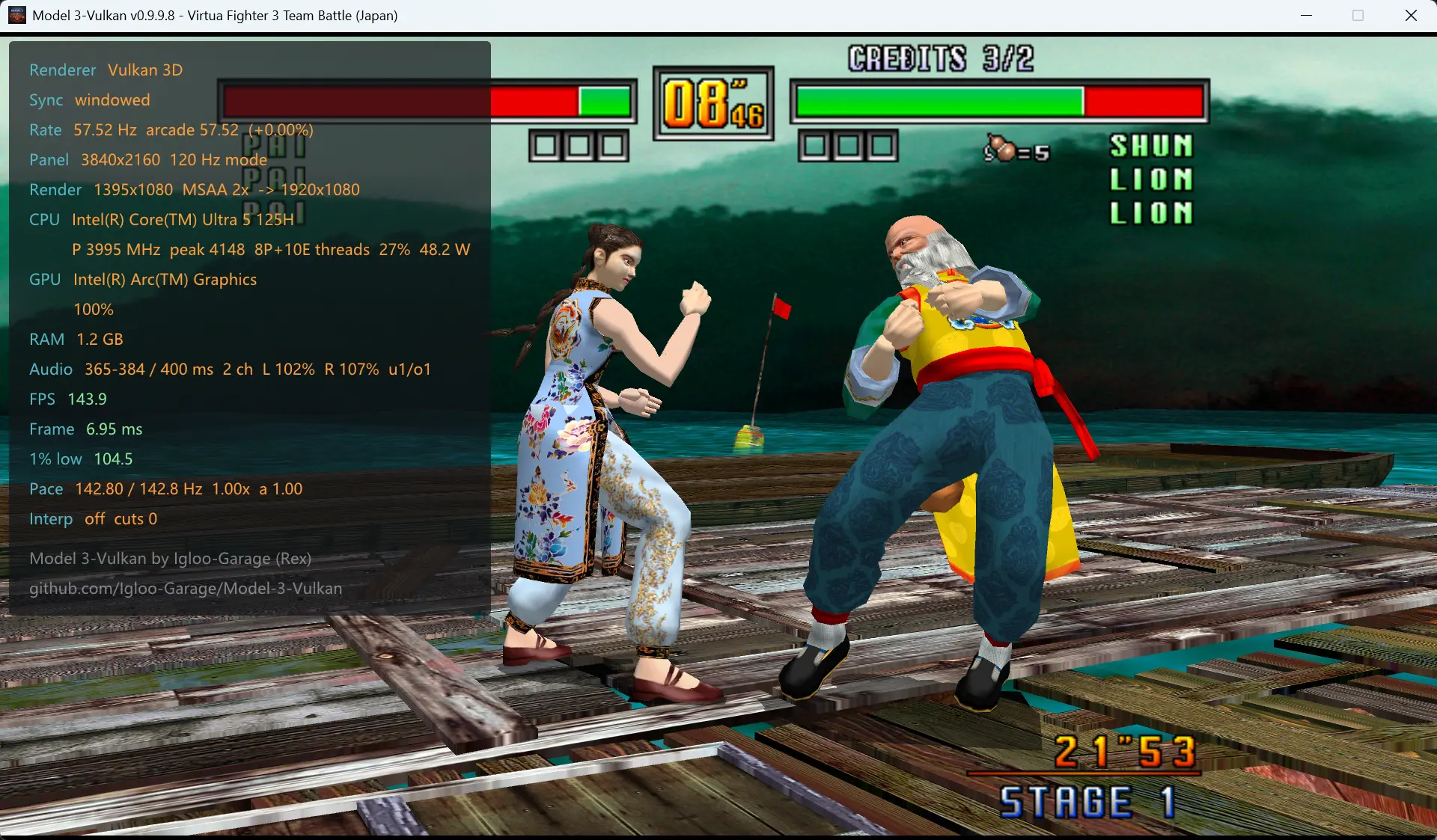
Same save state (vf3tb.zst1), 1920×1080 output, 2× MSAA, frame pacing unlocked: 143.9 FPS
(6.95 ms/frame, 1 % low 104.5) on integrated Intel Arc graphics — about 2.5× the arcade's
57.52 Hz. Under the heavy 2480×1920 2× MSAA load used in the table above, the same scene went
from 45.5 to 73.2 FPS (+60.9%).
🏁 Dirt Devils: the 4 KB page stutter is fixed
dirtdvls has an unusual layout: its variable tables at 0x0005A5A8–0x0005A66C and its hot code at
0x0005AB64–0x0005AEA4 share one 4 KB page. The old self-modifying-code check invalidated
every translation on that page whenever any store landed in it, so the game re-translated its own
hot code roughly 2,300 times per frame.
The invalidation is now three-level:
- a 32-byte line gate,
- a one-bit-per-guest-byte map,
- a 4 KB page generation counter.
A store only bumps the page generation when the address really overlaps bytes that were translated,
and it clears that page's line marks and byte map in the process. ramGen is not touched — that
is reserved for icbi, state loads and memory reallocation. Blocks are also constrained to a single
4 KB page so a fetch loop cannot straddle two generations.
Result, same save state, 30 seconds:
| Before | After | |
|---|---|---|
| Simulation hand-off per frame | 45–66 ms | 0.28–0.78 ms |
| Store-triggered flushes | ~2,300 / frame | 0 |
| Present rate | collapsed | holds the panel rate |
The code cache is 64 MB, and SM3D_PPC_JIT_VERIFY=1 re-verifies the invalidation against the
interpreter block by block (26.6 million blocks, 0 failures on the test matrix).
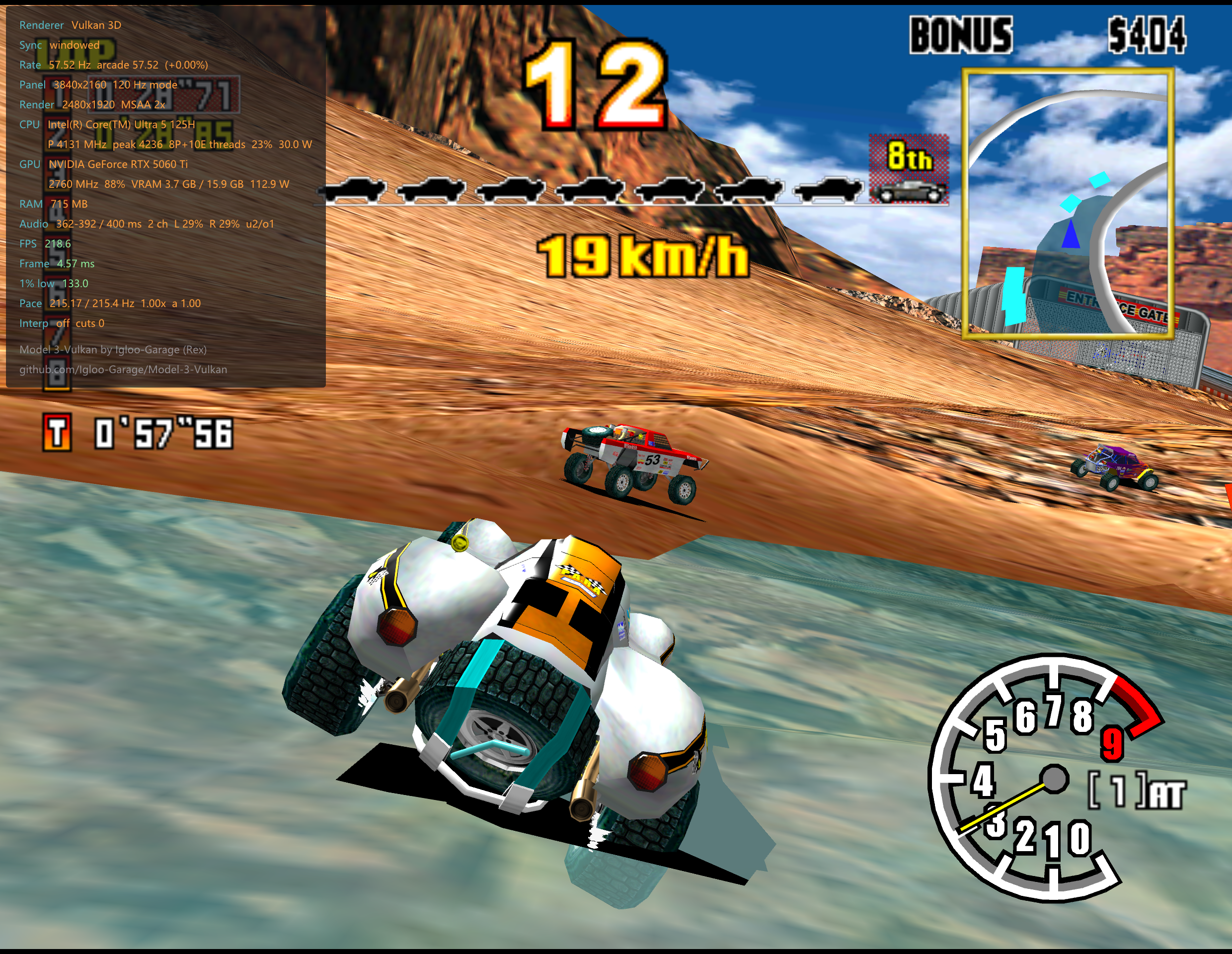
Before the fix the same save was capped near 20 FPS by re-translation — 45–66 ms of simulation hand-off per frame, no matter how fast the GPU was. The card now renders it at 218.6 FPS (4.57 ms/frame, 1 % low 133.0), 2480×1920 with 2× MSAA and frame pacing unlocked.
💾 Save states load on frame 0
The deferred load was introduced as a workaround: applying a state to a machine still in its boot ROM left VF3 running at about 1/25 speed, because the 53C810's PCI base address had never been written. That root cause was fixed in v0.9.9.6 by adding the missing hardware blocks to the save image, and v0.9.9.8 finally drops the default guard:
constexpr double kDeferredLoadSeconds = 0.0;
- Manage Saves → Load and
-load-statenow apply the state on the first frame, with no start-up artwork flashing in between (loading deferred state ... after 0 emulated frame(s)). - Verified across 15 ROM sets —
daytona2,dayto2pe,scuddx,scud,scudau,srally2,lemans24,dirtdvls,vf3tb,fvipers2,lostwsga,swtrilgy,magtruck,von2a,spikeofe— covering both.zstcontainers and legacy.stfiles. SM3D_DEFER_LOAD_SECONDS=remains as a diagnostic override, still counted in emulated frames rather than wall clock.- The usual rule still applies: do not save on a load, transition, score or K.O. screen. Those states can be parked in a cross-frame handshake and may hang when restored.
🖥️ Statistics panel on dual-GPU laptops
On a laptop with both an integrated GPU and a discrete NVIDIA card, the statistics overlay used to
name (and read telemetry from) the NVIDIA card even when the Vulkan renderer was running on the
integrated GPU, because NVML was probed unconditionally. The readout now checks which device the
renderer actually selected: when it is not an NVIDIA adapter, the overlay keeps the Vulkan device
name and reads load from the Windows GPU Engine counters, so a session on Intel Arc shows
Intel(R) Arc(TM) Graphics and the real 3D utilisation.
🔧 Interface fix: resolution preset vs. low-resolution rendering
Advanced → Picture scaling → Low-resolution 3D rendering pins the 3D scene to 496×384 or
992×768 regardless of the window size. Changing the resolution preset on the Common page did
not touch it, so picking 2x (992 x 768) after having used the ultra-low preset still rendered at
496×384 and upscaled — the readout said 496x384 -> 992x768, which looked like the setting had
been ignored.
The two controls now stay in step: choosing 1x (496 x 384) sets the internal size to 496×384,
2x (992 x 768) sets it to 992×768, and any higher preset turns low-resolution rendering off.
⚙️ Also in this build
-benchmark/ performance test — unlocks the 57.524 Hz logic pacing, mutes audio, skips a one-second warm-up and reports real throughput (BENCH: ... FPS ... x arcade). Available from Common → Performance test (unlocked frame rate).- Mouse device logging — the log now enumerates each mouse and its SDL id, so a two-light-gun setup can be diagnosed without guessing whether Windows exposed both guns as separate devices.
- Force-feedback diagnostics — the FFB summary line counts
FFStopcommands, and a device that rejects a constant-force update is logged once instead of failing silently. - Dual-GPU stats — see the section above.
- Defaults on a clean install — hybrid JIT on, 4.0 Quad audio, automatic presentation cadence with motion interpolation, strong chase-camera stabiliser, warm frosted-glass interface, cabinet bezel, loopback networking, asynchronous sound-board thread. Recording, HD textures, statistics overlay, crosshairs, Sinden border, Vulkan validation, exclusive fullscreen, per-pixel OIT, instance interpolation and MSAA/CRT/glow/FXAA remain off.
🔄 Upgrading
- Settings and save states are compatible:
SUPERMODEL_VERSIONis untouched, so existing.zst/.stsaves and NVRAM load normally. - The default save-state delay changed from 3 seconds to 0; this is the one behavioural difference you will notice immediately.
- If you had selected an integrated GPU from a testing build and the settings window comes up with blocky artefacts, set Video → GPU back to automatic: that combination instructs the Vulkan context to render on one adapter and present to the display attached to another.
⚠️ Known issues
scuddx(Scud Race Deluxe) HUD instruments are still incomplete — a long-standing emulation gap that predates MAME; play the Twin/DX sets (scud,scudau,scudplus,scudplusa).- Per-instance interpolation remains off by design: enabling it produces single-frame hairline cracks where a snapped instance meets an interpolated one.
- Not every moment is saveable: states captured on load/transition/score screens may hang.
- Force feedback, two light guns, the Sinden border and the two-machine link are implemented but still untested on real hardware in this build.
中文摘要
Model 3-Vulkan v0.9.9.8 是一次纯粹的性能更新:模拟本身没有变化,同一存档仍然逐像素输出同一画面。
三个重点:
- 混合 JIT 覆盖了超过 80% 的客户机指令流。更多 PowerPC 指令被翻译成 x86-64 原生代码,落到 C 解释器
的次数大幅减少。在解锁帧率的场景(
-benchmark或「性能测试」按钮)下游戏运行速度明显更快。 每局结束日志会打印PPC: translated code is N/N instruction(s) native (xx.xx%),可直接核对。 - Intel 核显专属优化,实测提升 20–50%(AMD 核显大概率同样受益)。片元着色器不再写
gl_FragDepth——对本后端所有Mat4::FrustumRZ投影,它恒等于硬件已经插值出的gl_FragCoord.z,但写了就等于关掉 Early-Z / Hi-Z:被遮挡的像素仍要跑完整片元着色(4 次 64 字节顶点读取 + 双线性四边形求解 + 贴图解码)。移除后硬件深度剔除恢复。 Intel Arc Graphics(Core Ultra 5 125H)实测 2480×1920 / MSAA 2x:vf3tb+60.9%、daytona2+30.9%、scuddx+21.9%、dirtdvls+14.0%;1080p 下daytona287.8 → 112.8 FPS(+28.5%)。画面同帧 A/B:99.92–99.97% 像素完全一致,全图平均误差 0.007–0.019 / 255。 - 修复「泥地赛车」(Dirt Devils)运行卡顿。这个游戏的变量表(
0x5A5A8–0x5A66C)与热代码 (0x5AB64–0x5AEA4)位于同一个 4 KB 页,旧的「页内任何写入就作废整页翻译」逻辑让它每帧 重译约 2300 次。现在改为三层失效:32 字节行门 + 每字节位图 + 4 KB 页 generation,只有真正 覆盖到已翻译指令字节的写入才作废该页。仿真交接时间从 45–66 ms/帧 降到 0.28–0.78 ms/帧, 存储触发的刷新从每帧约 2300 次降到 0。
实测截图(解锁帧率):RTX 5060 Ti 上《Dirt Devils》2480×1920 / 2× MSAA 为 218.6 FPS
(4.57 ms/帧,1% low 133.0);Intel Arc 核显上 vf3tb 1080p / 2× MSAA 为 143.9 FPS
(6.95 ms/帧,1% low 104.5,约 2.5× 街机满速)。
其它:
- UMA 核显零拷贝几何上传:ROM 顶点缓冲在统一内存设备上用
DEVICE_LOCAL | HOST_VISIBLE | HOST_COHERENT,新顶点直接由 CPU 写入映射地址,省掉暂存拷贝、vkCmdCopyBuffer与TRANSFER_WRITE屏障;独显自动回退原路径(日志打印ROM vertex buffer is host-visible)。 - 驱动调用减负:高清纹理描述符(set 2)改为每帧绑定一次(原先每个视口节点都绑一次); 同一视口内不透明几何按 ROM / 多边形 RAM 归组,管线切换从交替变为最多一次;半透明层保持 原有提交顺序。两项改动逐像素 0 差异。
- 存档默认第 0 帧读取:
kDeferredLoadSeconds从3.0改为0.0,不再有读档时整屏启动图, 日志显示after 0 emulated frame(s)。已用 15 个 ROM set 验证(新.zst与旧.st都覆盖)。 - 双显卡笔记本统计面板:在核显上跑时不再显示闲置的 NVIDIA 独显名称与遥测,改为显示实际 Vulkan 设备名与 GPU Engine 占用率。
- 分辨率预设与低分辨率渲染联动:在「常用」页改分辨率预设时会同步更新
InternalResolution(1x → 496×384,2x → 992×768,3x 及以上 → 关闭),不会再出现选了2x (992 x 768)却仍按 496×384 渲染的情况。
默认不打开:录音、高清纹理加载/导出、统计浮层、准星、Sinden 白边、Vulkan 校验层、 独占全屏、逐像素 OIT、实例插值、MSAA/CRT/辉光/FXAA、点对点缩放。 默认打开:混合 JIT、4.0 四声道、自动刷新节奏 + 运动插值、强力追尾镜头稳定、暖色毛玻璃界面。
兼容性:SUPERMODEL_VERSION 未改,旧存档与 NVRAM 继续可用。
Model 3-Vulkan is licensed under GPLv3. Upstream Supermodel attribution and third-party notices
are preserved in Data/NOTICE.md, Data/LICENSE-ADDITIONAL-TERMS.md and Data/TRADEMARK.md.
0.9.9.6h
- Capacité de slots de textures HD multipliée par 4 (2 048 → 8 192) pour éviter les limites lors de l'utilisation de packs massifs.
- Optimisation du chargement dynamique et du décalage des tuiles pour mieux gérer les textures en streaming et les échanges rapides.
- Logs améliorés pour suivre les conflits de hachage, les invalidations de cache et les surécritures dynamiques de textures.
- Mode Hybrid JIT instable : risque de baisses de FPS ; basculez sur l'interpréteur C pur en cas de problèmes.
Known Issue / Experimental Notice:
Hybrid JIT might be unstable in some scenes, as PowerPC Execution Mode is still mid-transition between the pure C interpreter and JIT. If you experience heavy FPS drops, switch back to the pure C interpreter for now. If an issue occurs, please exit and share your \Data\Model3Vulkan.log
It’s critical for ongoing development toward 100% JIT.
🎨 Special Build for HD Texture Pack Creators (Windows x64 Only)
- 4x Bindless HD Texture Slot Capacity (2,048 -> 8,192 slots): Accommodates massive HD texture packs (3,500+ textures, such as Spikeout Final Edition) in full without hitting the session slot cap.
- Dynamic Tile-Streaming & Offset-Wrap Optimization: Improved sub-texture hash tracking and cache invalidation for games that stream and swap small texture tiles on the fly across areas.
- Enhanced Log Diagnostics (Data/Model3Vulkan.log): Added detailed HD texture load/dump status, duplicate hash conflict reporting, and dynamic tile-overwrite tracking for pack authors.
Tip for HD Texture Pack Creators: For games like Spikeout that dynamically reuse texture slots across stages, a few original textures in later areas may not have been dumped during your first playthrough. After updating to v0.9.9.6h, simply turn on Dump Textures and walk through those areas again — the emulator will automatically dump any missing original textures for you.
(Regular players who are not creating or testing massive HD texture packs can stay on v0.9.9.6.)
0.9.9.6
- JIT hybride PowerPC → x86-64 : accélération jusqu’à 4,1× en scènes CPU-intensives, vérifiée contre l’interprète avec 675 millions de blocs sans différence pixel.
- Stabilisateur de caméra de poursuite : filtre spring-damper pour éliminer les oscillations horizontales, HUD 3D (vitesse, carte) figé, modes Off/Standard/Strong (NFS-style).
- Retour du feedback force : initialisation SDL3 corrigée sous Windows, reconnaissance des bases direct-drive (SIMAGIC, Fanatec), calibration live des axes/pedales, table adaptative DPI.
- Audio 4.0 Quad/5.1 Surround : upmixer centre/LFE, interpolation Catmull-Rom 4-tap, enregistrement multi-canaux lossless (WAV/FLAC), décodage DSB 32-bit float.
- Sauvegardes corrigées : inclusion du 53C810 PCI et du simulateur réseau, reprise immédiate de VF3/Scud Race sans spin DMA.
- macOS : support natif Apple Silicon (arm64), correction Retina 4K (fenêtre haute densité), module .zst (macOS 14+), rétrocompatibilité .st sur 13.x.
Model 3-Vulkan v0.9.9.6 — Release Notes
Known Issue / Experimental Notice:
Hybrid JIT might be unstable in some scenes, as PowerPC Execution Mode is still mid-transition between the pure C interpreter and JIT. If you experience heavy FPS drops, switch back to the pure C interpreter for now. If an issue occurs, please exit and share your \Data\Model3Vulkan.log
It’s critical for ongoing development toward 100% JIT.
2026-11-07 · Windows x64 · Linux x86_64 · macOS Intel · macOS Apple Silicon
Model 3-Vulkan v0.9.9.6 is the biggest release this fork has shipped. It is not a maintenance build: the emulation core now has a PowerPC → x86-64 hybrid JIT, the audio path can drive a real 4.0/5.1 arcade cabinet and record it losslessly, the chase camera has a proper Need for Speed-style stabilizer, direct-drive wheels finally get real force feedback and live pedal calibration, and the settings window has been rebuilt around frosted glass and three complete themes.
If you are coming from v0.9.8.6a, the JIT, camera, force-feedback, audio, save-state, graphics and interface sections below are new. The platform section also recaps the v0.9.8.6a / v0.9.8.6x hotfixes so a fresh reader sees the whole picture.
📦 Packages
| Platform | File | Requirements |
|---|---|---|
| Windows x64 | Model3-Vulkan.v0.9.9.6.for.Windows.zip |
Windows 10/11, Vulkan 1.3 |
| Linux x86_64 | Model3-Vulkan.v0.9.9.6.for.Linux.tar.gz |
glibc 2.38+, Vulkan 1.3 |
| macOS Intel | Model3-Vulkan.v0.9.9.6.for.macOS-Intel.tar.gz |
macOS 13.3+, bundled MoltenVK 1.3 |
| macOS Apple Silicon | Model3-Vulkan.v0.9.9.6.for.macOS-AppleSilicon.tar.gz |
macOS 13.3+, native arm64 |
SHA256SUMS.txt is attached to the release. Every archive extracts to a relocatable folder;
put your ROM zips in its roms/ directory (or point ROMPath at them).
The short version
- Up to 4.1× faster in CPU-bound scenes — the PowerPC 603e now translates hot basic blocks to native x86-64, verified against the interpreter for 675 million blocks with pixel-identical output.
- A chase camera that behaves like a modern racing game — spring-damper yaw stabilisation around the car's pivot, with full-screen 3D HUDs (speedometer, course map, turn arrows) staying perfectly still.
- Force feedback that finally reaches the wheel — SDL3 haptics initialised correctly on Windows, raw direct-drive wheel bases recognised, single-axis constant force fixed, and a live wheel/pedal calibration lab.
- A soundtrack, not a stereo mix — native 4.0 Quad and 5.1 Surround, a smart center/LFE upmixer, 4-tap Catmull-Rom SCSP voices, 32-bit float DSB decoding, a C¹ soft-clipper, and a lock-free multi-channel WAV/FLAC recorder.
- Save states that resume instead of stalling — the 53C810 PCI base address and halt flag and the simulated network board are now part of the save, so VF3 and Scud Race pick up where they left off instead of spinning on the DMA chain.
- A front end that belongs in 2026 — frosted-glass panels, warm light / warm dark / classic themes, adaptive tables that work at any DPI, per-game audio balance, and a much richer diagnostic log.
- The platform work that makes it shippable — AMD Windows Vulkan driver limits handled, Linux pinned to a Steam Deck-compatible glibc, macOS Retina 4K fixed, GNOME Wayland title bars restored.
🎯 Try these first
Three settings define this release. The screenshots are from the Windows build; the same options exist on Linux and macOS.
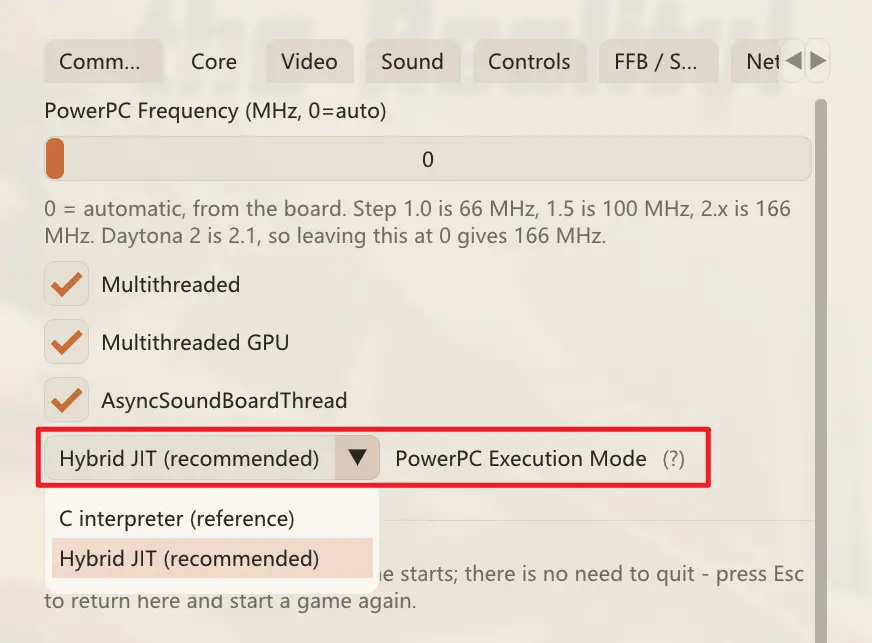
Hybrid JIT — Core → PowerPC Execution Mode
Keep Hybrid JIT (recommended) selected and leave PowerPC Frequency at 0 (auto): 0 reads the
board's multiplier, so Daytona 2 (2.1×) runs at 166 MHz without manual tuning. The C interpreter
is only a reference for A/B debugging.
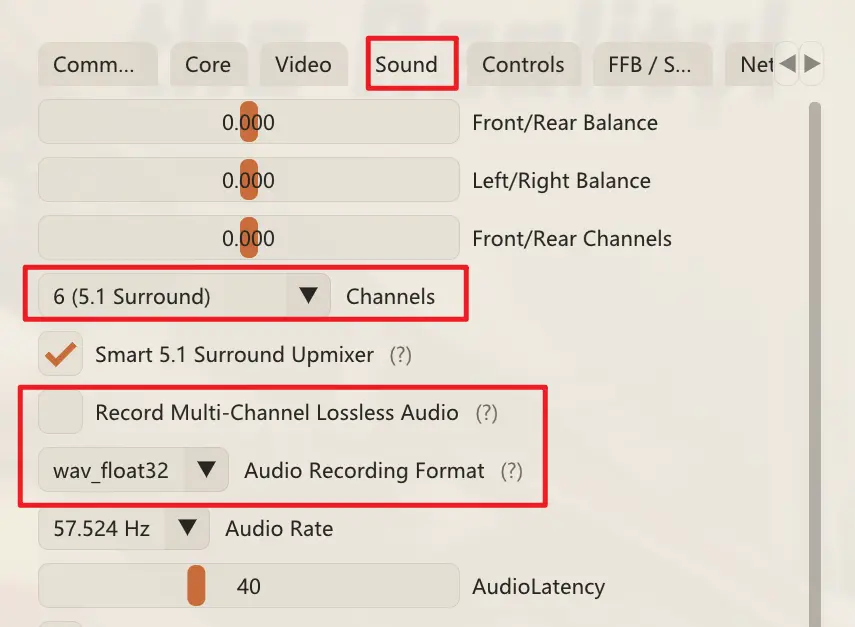
5.1 Surround + lossless recording — Sound → Channels
Set Channels to 6 (5.1 Surround) and keep Smart 5.1 Surround Upmixer ticked: the emulator
builds a real centre channel and a 120 Hz LFE from the quad mix. Tick Record Multi-Channel Lossless Audio to capture the same 5.1 stream; wav_float32 is the default, flac_pcm24 gives
smaller lossless files. Recordings land in Data/Recordings/Sound/.
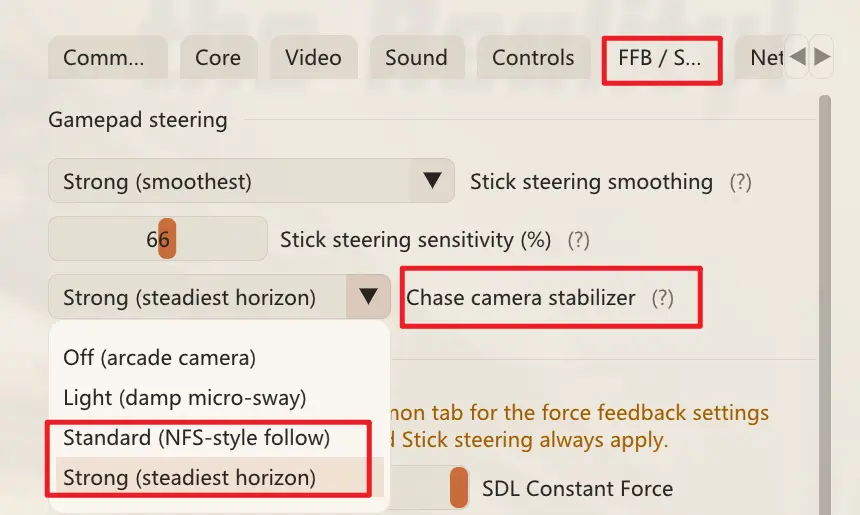
Chase camera stabilizer — FFB / Sensitivity
The new defaults are Stick steering smoothing: Strong, Stick steering sensitivity: 66% and
Chase camera stabilizer: Strong (steadiest horizon). This is what removes the left-right horizon
swing on a gamepad and keeps Daytona 2's speedometer, course map and turn arrows still. Prefer the
raw arcade camera? Set the stabilizer to Off; Standard (NFS-style follow) is the middle ground.
⚡ PowerPC 603e → x86-64 hybrid JIT
PowerPCMode = 1 is the new default. Hot PowerPC basic blocks are translated once into native
x86-64 and then executed directly, with:
- a 16 MB RWX code cache and
PPC_FAST_MEMORYdirect-memory windows; - self-modifying-code page tracking;
- idle-loop skipping;
- a lock-step verifier that runs every translated block against the interpreter.
Verification: 675 million blocks compared across five games, zero mismatches; the same save state and frame is pixel-identical to the interpreter. In a CPU-bound scene the frame rate went from 55.2 Hz to 224.5 Hz — about 4.1×.
The C interpreter remains one menu entry away (PowerPCMode = 0) for reference runs and A/B tests.
The JIT lives only in the Vulkan build; the retired OpenGL build keeps the interpreter.
🎥 Chase camera & steering feel
The new Chase Camera Stabilizer (ChaseCameraStabilizer, Off / Light / Standard / Strong,
default Strong) is a spring-damper filter applied to the camera's horizontal yaw around the player
car's pivot in view space. It removes the “the whole city swings when I breathe on the stick”
problem on a gamepad without touching the car's actual heading. Full-screen 3D HUD viewports are
excluded, so Daytona USA 2's speedometer, route map and turn arrows stay nailed in place.
Paired with it:
- Gamepad Steering Smoothing (Off / Light / Medium / Strong, default Strong) and Sensitivity
(25–100%, default 66%) on the FFB / Sensitivity page and in the in-game
Taboverlay. - Selecting Off resets sensitivity to 100% automatically.
- Binding steering to a physical racing wheel bypasses both filters completely, preserving 1:1 direct response.
🏎️ Force feedback, pedal calibration & wheel lab
Force feedback in the SDL3 build was not merely tuned — it was fixed end to end:
- Correct haptic initialisation on Windows.
SDL_INIT_HAPTICis now brought up before the joystick/gamepad subsystems, so DirectInput wheel bases actually appear in SDL's haptic list. - Raw joystick wheel bases are accepted. The old
isGamepadgate rejected SIMAGIC, MOZA, Fanatec and similar direct-drive bases; they are now opened as haptic devices. - Constant force sign and axis encoding fixed, with the 20 ms attack envelope retained for a smooth torque build-up instead of a staircase.
- Vibration routed through
SDL_HAPTIC_SINE, with a rumble fallback for devices that do not expose a sine effect. - Hardware autocenter is released, so the game's own spring effect is in control.
On the FFB / Sensitivity page there is now a live calibration lab:
- centred bidirectional axes, full-travel pedals, deadzones and custom min/off/max ranges;
- columns measured from the current font and DPI, stretching to fill a wide window and switching
to a horizontal scrollbar instead of clipping
-32768when the window is narrow; - a one-click “Release H-shifter to neutral (from gears 1–4)” binding generator on the Controls tab.
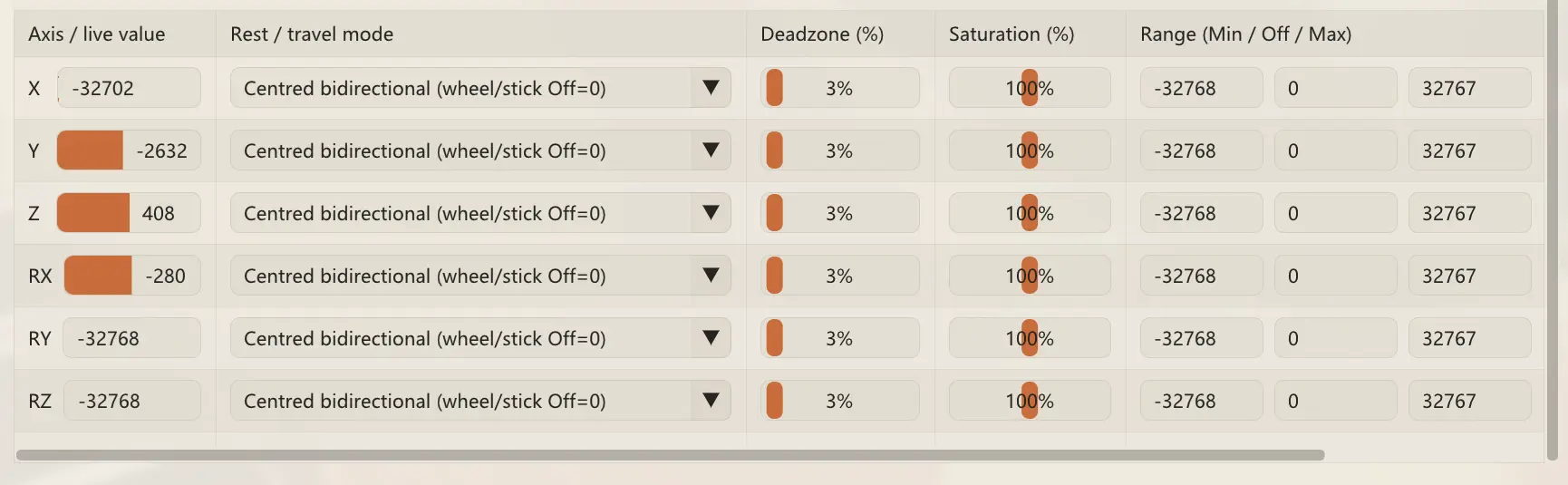
The table is live. A direct-drive base reports six axes (X/Y/Z/RX/RY/RZ); each row shows the raw
position, the rest/travel mode (centred bidirectional for the wheel, full travel for pedals), the
deadzone (3% by default), saturation (100%) and the captured min / off / max range. On a narrow
window the table switches to a horizontal scrollbar instead of clipping -32768.
Force Feedback is off on a fresh install by design: most players use a pad or keyboard, and enabling the drive board would make supported pads rumble constantly. Wheel users: tick Force Feedback on the FFB / Sensitivity page (or launch with
-force-feedback) once.
🔊 Audio: from stereo fold-down to a real cabinet
Native 4.0 Quad and 5.1 Surround
NbSoundChannels now supports 1 (Mono), 2 (Stereo), 4 (4.0 Quad [FL, FR, RL, RR]),
and 6 (5.1 Surround [FL, FR, FC, LFE, RL, RR]). The default is 4.0 Quad, which matches the
arcade cabinet and behaves correctly on a stereo desktop endpoint.
The optional 5.1 upmixer (SurroundUpmix51) synthesises:
- Center (
FC) from the front/rear common-mode signal, lifting vocals, navigator calls and lead melodies out of the left/right pair; - LFE through a pre-warped 120 Hz second-order Butterworth low-pass, extracting engine rumble and collision weight.
Lossless multi-channel recorder
RecordWav captures the finished 4.0/5.1 mix through a lock-free SPSC ring buffer and a dedicated
disk-writer thread — no fwrite, no mutex, no blocking on the real-time audio callback.
wav_float32— WAV, 32-bit IEEE floatwav_pcm16— WAV, 16-bit PCMflac_pcm24— FLAC, 24-bit PCMflac_pcm16— FLAC, 16-bit PCM
Files land in Data/Recordings/Sound/___ch.wav|flac, with proper
WAVE_FORMAT_EXTENSIBLE / VORBIS_COMMENT speaker masks for Premiere, DaVinci Resolve and
Audacity. Recording keeps the full 4/6-channel mix even on a stereo endpoint, so the file is a true
discrete surround capture rather than a fold-down.
Recording is off by default. Turn it on in the Sound page or with
-record-wav.
SCSP and DSB fidelity
- 4-tap Catmull-Rom cubic interpolation on non-FM SCSP PCM voices, with FM carriers and modulators kept bit-exact; this removes the mirror-image aliasing on pitch-shifted engine, tyre and voice samples.
- Slave-SCSP FM ring-buffer cross-talk fixed, Slots 16–17
EFSDL/EFPANwired toDSP.EXTS[0..1],LFOREphase reset implemented, and dynamicAR/D1R/D2R/RR/KRSenvelope updates corrected. - 32-bit float DSB MPEG decoding straight into the 64-tap polyphase resampler, with per-sample gain ramping to remove 57.5 Hz zipper noise.
- C¹-continuous knee soft-clipper on the master bus: bit-exact below -1.41 dBFS, smooth
saturation above it, no flat-topped hard clipping when
MusicVolumeis pushed past 100%.
Restored music and a hidden-egg fix
- Looped MPEG intros are back.
MpegDecnow preserves valid negative pre-loop offsets, which restores Daytona USA 2's 9.9-second attract intro and the 12.6-second race-theme intros. - Daytona USA 2 no longer plays Track 8 on every course. Single-button view cycling
(
VRCycle) used to hold the defaultVR3button down on every frame from boot, which triggered the arcade's “hold VR3 while a race loads” Easter egg. View cycling now emits a six-frame momentary pulse only when you actually press the button. - Per-game audio balance (Scud Race, Daytona 2, Star Wars Trilogy, Spikeout) tames the arcade's own effects/music divider; any explicit value in the ini or on the command line wins.
💾 Save states and the network board
53C810 PCIstate block. The SCSI controller'sbaseAddressand halt flag are now part of the save state. Loading at the first frame used to leave the0xF9/0xC1register windows disabled until the game wrote its PCI configuration, which made VF3 and Scud Race spin on the DMA chain. New saves load immediately; old saves fall back to0xC0.- The simulated network board is saved.
CSimNetBoardstate, shared RAM and buffer are part of the save, with a synthesised single-machine ready state (and the256 → 848segment-size repair) for older saves. Attract-mode saves no longer time out into the boot self-test or hang on “Please Wait” at car select.
Also in this release: the drive board's command queue (one command per frame to the Z80), the wheel
servo gain and constant-force/vibration cache, a WheelBoardServo save block, and the FFVibrate
effect-count fix.
🖼️ Graphics & presentation
- Per-pixel transparency sorting (
AlphaSortMode = 1) — a fixed-slot SoA A-Buffer, four layers per pixel, resolved per priority. It fixes scenes the two-layer scheme cannot: more than two translucent surfaces at one pixel, and translucent polygons submitted out of depth order. At 4K + MSAA 4× it holds the same 120 Hz as the two-layer path; the old linked-list prototype ran at 27–37 Hz and was discarded. - Two-subpass on-chip composite for the default path. 4K + 4× MSAA VF3 went from 226 to 240–241 Hz (about +6%), bit-identical at 1×.
- Hardware MSAA (2/4/8×), exact quad interpolation, derivative-based texture filtering with a long-axis tap mode, and the arcade-exact checkerboard transparency mode as an opt-in experiment.
- HD texture packs — PNG, WebP, DDS BC1/BC2/BC3/BC5/BC7, and
.dds.zst, with bindless sampling, async decode, chunked GPU upload and hot reload.F4toggles replacement/original,F3rescans. Exported dumps now write alpha only where the material actually reads it, eliminating the white dots and dashed lines caused by the arcade's 1-bit alpha dither. - High-refresh presentation — Original / Auto / Fixed modes, VRR 2×/3×/4×/8× phase stepping,
camera and instance interpolation,
F8hot-switch, and a present-phase calibration that cut about 4.6 ms of end-to-end latency on a Fixed 120 Hz setup. - macOS Retina 4K — the game window requests a high-density drawable and the render geometry is computed in device pixels, so 4K panels render at native resolution instead of a 1080p upscale.
🎨 Interface
- The tab row stays put. Common / Core / Video / Sound / Controls / FFB / Sensitivity / Network are now a fixed header; scrolling a long page no longer takes the tabs with it, so switching pages never means scrolling back to the top first.
- Frosted-glass panels with a real dual Kawase blur of the game artwork behind them, 1px glass highlight edges, and a 120 ms panel fade.
- Three complete themes — warm eye-care light (default), warm dark, and the original flat interface reproduced value for value.
- The game list carries 63 WebP box arts, a cover preview, per-game descriptions, filters, remembered selection/scroll position, and an optional “auto-launch on startup”.
- Adaptive tables — the wheel/pedal calibration table measures columns at the current font and DPI, stretches when there is room, and shows a horizontal scrollbar instead of clipping when there is not.
- Single config file —
Data/Config/Model3-Vulkan.ini. OldSupermodel.inifiles are migrated or removed automatically; a staleGameXMLFilepath is repaired at startup. - Richer log —
Data/Model3Vulkan.logstarts with the build timestamp, host memory and CPU count, the audio DSP chain, and every non-default axis calibration value. - Portable ROM folders — a
rom/roms/romset/romsetsfolder next to the executable is detected automatically and stored as a relative path, so moving the whole folder keeps working.
🧩 Platform work
- Windows + AMD: per-viewport uniforms moved out of push constants, shrinking
R3DPushfrom 208 B to 96 B. AMD's Windows Vulkan driver reports a 128-byte limit, which used to make the emulator exit silently after the splash screen. - Linux: release builds pinned to Ubuntu 24.04 + g++-14, with a CI guard that fails above
GLIBC_2.39; the 24.04 build itself needs at mostGLIBC_2.38, so it loads on SteamOS 3.5 and Ubuntu 24.04. The bundledwqy-microheifont has a Latin-glyph guard,/Data/is discovered on Linux, andlibdecoris included for GNOME Wayland title bars. - macOS: Retina/4K fix, non-Windows mouse/keyboard input in the in-game
Taboverlay, and the.zstHostCore module (macOS 14+;.stremains the fallback on macOS 13). - SDL3 input: per-device mice via RawInput, late input sampling just before the simulation step, controller hot-plug, SDL haptics, and the Sinden light-gun border.
- Config/log cleanup: the legacy
Supermodel-LegacyOG.exeis retired from the release package;Model3-Vulkan.exeis the product.
🧾 Upstream 0.4 sync (2026-11-07)
The last round before this release pulls the low-risk fixes from upstream Supermodel 0.4:
53C810PCI base address and halt flag in save states;- thread-safety fixes in the DSB FIFO, SCSP MIDI FIFO and the audio mute flag;
- drive-board command queue and wheel-servo state;
- non-merged clone ROM sets (
srally2dx,swtrilgyp); - Lost World light-gun reload / off-screen indicator (
lostwsgo→lostwsgp); - VF3 startup viewports with subnormal matrices skipped;
- Real3D config-register zero-initialisation;
- the fourth force-feedback effect slot.
⚙️ Defaults on a clean install
The release package ships without an ini, so a fresh install starts from these defaults. This is the list worth knowing before your first launch.
Off by default (opt in when you want them):
| Option | Key | Where |
|---|---|---|
| Audio recording | RecordWav |
Sound |
| HD texture replacement | LoadHDTextures |
Core |
| HD texture dumping | DumpHDTextures |
Core |
| Raw memory / texture dumps | DumpMemory, DumpTextures |
Network |
| Statistics overlay | ShowStatsOsd |
Video |
| Crosshairs | Crosshairs |
Video |
| Sinden border | SindenBorder |
Video |
| Vulkan validation | VkValidation |
Video |
| Exclusive fullscreen / exclusive refresh | ExclusiveFullscreen, ExclusiveRefreshRate |
Video |
| Per-pixel OIT | AlphaSortMode = 1 |
Video |
| Instance interpolation | InstanceInterpolation |
no UI (internal A/B switch) |
| MSAA / CRT / glow / FXAA | MSAA = 0, PostCRT = 0, PostGlow = 0, PostFXAA = 0 |
Video |
| Integer scaling / widescreen stretch | IntegerScale, WideScreen, WideBackground |
Video |
| Force feedback | ForceFeedback |
FFB / Sensitivity |
On by default, deliberately:
- Hybrid JIT (
PowerPCMode = 1). - 4.0 Quad audio (
NbSoundChannels = 4). 5.1 is a deliberate choice; the upmixer only runs when six channels are selected. On a stereo endpoint the 4-channel mix is folded by the emulator, not by SDL. - Auto refresh pacing + motion interpolation (
RefreshRateMode = 1,MotionInterpolation = 1). - Chase camera stabilizer Strong and gamepad steering smoothing Strong (both bypass a real wheel).
- Warm light frosted-glass UI (
UITheme = 0,UiFrostedGlass = 1). - Cabinet bezel backdrop (
BezelMode = 1) — turn it off in Video if you prefer black bars. - Network self-link (
Network = 1,SimulateNet = 1, ports 1970/1970 on loopback), required for the netboard games to boot. - Async sound board thread and high process priority.
🔄 Upgrading from v0.9.8.6a
- Save states and NVRAM remain compatible:
SUPERMODEL_VERSIONis untouched. Supermodel.iniis migrated toData/Config/Model3-Vulkan.inion first launch; if both exist, the stale file is removed.- Existing
.stsaves still load; new saves prefer the.zstcontainer.Data/Saves/is kept. - HD texture packs in
Data/Assets/HDTextures//keep working; DDS and.dds.zstare new options, not replacements. - The pipeline cache is rebuilt once after the upgrade; the first launch is slower than subsequent ones.
- If you extract into a fresh folder, copy
Data/Saves,Data/NVRAM,Data/Recordings,Data/Assets/HDTexturesand your ROM folder across.
⚠️ Known issues
- Scud Race Deluxe (
scuddx) HUD — the grey CONDITION panel and some wrong-colored rank text are a long-standing Model 3 emulation gap. Upstream Supermodel 0.4 still shows the same thing on the same save state. The Twin/DX versions (scud,scudau,scudplus,scudplusa) display the HUD correctly; use those if it bothers you. .zston macOS 13 — the HostCore module needs macOS 14+. The emulator logs it once and falls back to.st; saving and loading still work.- Force feedback is opt-in — see the note above. Without a wheel it stays off, which is why a fresh install does not rumble a gamepad.
- 5.1 on a stereo endpoint — if you select 6 channels, SDL folds the stream to stereo with its own coefficient table; the default 4.0 mode uses the emulator's fold and is the recommended setting for stereo speakers.
- Recording changes the device stream — with
RecordWavon, the mixer keeps a 4/6-channel stream even on a stereo endpoint. That is intentional (the file must be discrete), but it means toggling recording can change the monitoring level slightly.
中文摘要
Model 3-Vulkan v0.9.9.6 是这条分支至今最大的一次更新,不是小修补。
重点推荐先试这三项(截图见上方 Try these first):
- Core → PowerPC Execution Mode:保持
Hybrid JIT (recommended),频率0即自动。 - Sound → Channels:选
6 (5.1 Surround)+Smart 5.1 Surround Upmixer;要录音再勾Record Multi-Channel Lossless Audio(默认关闭)。 - FFB / Sensitivity:
Stick steering smoothing = Strong、66%、Chase camera stabilizer = Strong。
- 混合 JIT:PowerPC 603e 热代码块直接翻译成 x86-64,6.75 亿个块与解释器逐块对照零差异、 同帧像素一致;CPU 瓶颈场景从 55.2 Hz 提升到 224.5 Hz(约 4.1 倍)。
- 极品飞车式追尾镜头:围绕车身支点的弹簧阻尼水平偏航稳定器,手柄微操不再让整条地平线 左右甩;Daytona 2 的码表、路线图、转弯箭头保持不动。默认「强力」,可关/轻/标准/强力。
- 真正的力反馈:Windows 下 SDL3 触觉正确初始化,直驱方向盘(SIMAGIC / MOZA / Fanatec 等
raw joystick 底座)可被识别,恒力方向与单轴编码修正,振动走
SDL_HAPTIC_SINE;新增实时 方向盘/踏板死区与全行程校准(六轴表截图见上方力反馈章节)、H 挡一键回空挡。力反馈总开关默认关闭, 用方向盘时在「力反馈 / 灵敏度」页打开即可。 - 音频全面升级:原生 4.0 四声道(默认)与 5.1 环绕,智能中置/120 Hz 低音炮上混; SCSP 非 FM 通道 4-tap 三次样条插值;DSB MPEG 32-bit Float 直通 + 64-tap 重采样; 主总线 C¹ 软限幅;内置无锁多声道 WAV/FLAC 录音(默认关闭)。
- 读档更可靠:53C810 PCI 基址与 halt 标志、模拟网络板状态都进了存档,VF3 与 Scud Race 不会再卡在 DMA 链上。Daytona 2 的 9.9 秒前奏和 12.6 秒比赛曲前奏恢复;修掉了「所有赛道都 放 Track 8」的隐藏彩蛋误触发。
- 画面与界面:逐像素半透明排序、双 Subpass 片上合成、MSAA、精确四边形插值、DDS/
.dds.zst高清纹理包、毛玻璃三主题界面、4K/Retina、高刷插值与 VRR 倍频。 - 平台:AMD Windows 驱动 128 字节 push constant 限制、Linux 固定 Ubuntu 24.04 构建(CI 守
GLIBC_2.39,实际产物最高只要求GLIBC_2.38)、GNOME Wayland 标题栏、macOS Retina、 非 Windows 游戏内面板输入全部处理。 - 下载:Windows x64、Linux x86_64、macOS Intel、macOS Apple Silicon 四个包,另附
SHA256SUMS.txt;Linux 需要 glibc 2.38+,macOS 需要 13.3+(13.x 上.zst存档回退为.st)。
默认不打开:录音、高清纹理加载/导出、原始显存/贴图导出、统计浮层、准星、Sinden 白边、 Vulkan 校验层、独占全屏/独占刷新率、逐像素 OIT、实例插值、MSAA/CRT/辉光/FXAA、点对点缩放/ 宽屏拉伸、力反馈。默认打开:混合 JIT、4.0 四声道、自动刷新节奏 + 运动插值、强力追尾镜头 稳定与手柄转向平滑、暖色毛玻璃界面、机柜背景图、网络自连、异步声板线程。
兼容性:SUPERMODEL_VERSION 未改,旧存档与 NVRAM 继续可用;旧 Supermodel.ini 会自动迁移为
Model3-Vulkan.ini;旧 .st 存档仍可读取,新存档优先 .zst。
Model 3-Vulkan is licensed under GPLv3. Upstream Supermodel attribution and third-party notices
are preserved in Data/NOTICE.md, Data/LICENSE-ADDITIONAL-TERMS.md and Data/TRADEMARK.md.
0.9.8.6a
- Correction majeure : adaptation du shader 3D pour respecter la limite de 128 octets de constantes dynamiques sur les GPU AMD sous Windows.
- Amélioration des logs : affichage détaillé des GPU détectés et raisons de leur rejet lors du démarrage.
- Pas de modification pour macOS, Windows uniquement (build spécifique x64).
Model 3-Vulkan v0.9.8.6a — Windows hotfix
Windows only. This release contains a single asset for Windows x64. Everything else is v0.9.8.6 unchanged.
Why the v0.9.8.6 Windows package refused to start on AMD graphics cards
On Windows, AMD's Vulkan driver reports 128 bytes of push constants — the amount Vulkan itself guarantees. Every driver this renderer had been developed against reports 256.
The 3D scene shader packed 208 bytes into that block: the projection matrix, the light parameters and the fog colour, re-sent on every single draw call. The renderer's device selection therefore required 256 bytes, found 128, rejected the GPU, and the program exited — the start-up artwork flashed and disappeared, no settings window, no game, no message. Nothing in the picture was wrong; the renderer simply refused to open the device.
The report that surfaced this was a Steam Deck running Windows 11, whose AMD APU driver reports 128 as well — but the same limit applies to Radeon cards and Ryzen APUs on Windows generally, not to one machine.
What is fixed
The scene shader now fits in the 128 bytes Vulkan guarantees. The projection matrix, the light parameters and the fog colour are per-viewport values, not per-draw ones: they changed at most four times a frame and were being copied into the command stream hundreds of times. They now travel in the viewport uniform buffer that was already being uploaded once per viewport, and the per-draw block is 96 bytes. Device selection requires 128 bytes instead of 256.
No visual change, and no cost. The same save state, captured at the same emulated frame, on the same machine, is pixel-identical before and after (mean difference 0, maximum 0 across the whole frame). Each draw now copies 96 bytes instead of 208, so this is marginally cheaper too.
Startup failures now say which check failed. The log lists every Vulkan device it found, with API version, driver version, push constant size and the reason it was rejected, instead of a single sentence that only says none of them were usable.
Requirements
- Windows 10 or 11, x64.
- AMD, NVIDIA or Intel GPU with Vulkan 1.3, or Vulkan 1.2 with
VK_KHR_dynamic_renderingandVK_KHR_synchronization2. - On AMD cards, a current Radeon driver. The limit described above is handled by this build, so no driver update is required for it.
A note from me
Compatibility work is the part of this project nobody sees, and today it took the whole day: cutting separate patch packages for different graphics cards and driver stacks, one after another, because the same source behaves differently on each of them. This is one of those packages. If it starts on your machine, that is the whole reward — and if it does not, the log is what makes the next one possible.
What is unchanged
- Everything else from v0.9.8.6: both renderers, the interface, HD texture packs, the
.zstsave containers, the CRT filter, widescreen and integer scaling. - Save states remain compatible:
SUPERMODEL_VERSIONhas not been touched. Supermodel-LegacyOG.exe(OpenGL) is included and unchanged.
If it still does not start
Attach Data/Supermodel.log to a report. The device list added in this build names the GPU, its API
version, its push constant size and the exact reason it was skipped, which is normally enough to tell
a driver problem from a missing GPU.
Verifying the download
Get-FileHash .\Model3-Vulkan.v0.9.8.6a.for.Windows.zip -Algorithm SHA256
The value must match SHA256SUMS.txt.
0.9.8.6x
- Correction majeure : l’interface des paramètres ignorait clavier et souris sur Linux et macOS, avec seulement la molette active.
- Nouvel empaquetage pour Linux : nécessite glibc 2.38 et inclut une police embarquée pour une lisibilité correcte.
- Linux : le dossier /Data/ est désormais utilisé pour les assets (liste de jeux, boxarts), et la fenêtre des paramètres affiche une barre de titre sous GNOME/Wayland.
- Correction Linux : les sauvegardes .zst fonctionnent sans installation .NET, avec un module natif AOT embarqué.
- Correction macOS : suppression de l’erreur de démarrage VkResult -7 et prise en charge des implémentations Vulkan 1.2 valides.
- Correction macOS : les données (configurations, sauvegardes) sont trouvées dans le dossier Data/Config/ au lieu de Config/.
Model 3-Vulkan v0.9.8.6x — Linux and macOS
This release replaces both v0.9.8.6l (Linux) and v0.9.8.6m (macOS). It contains three
assets: Linux, macOS for Apple Silicon, and macOS for Intel Macs. There is no Windows package: the
Windows build is unchanged since v0.9.8.6 and does not need this update.
Fixed in both packages
The in-game settings panel ignored the mouse and the keyboard on Linux and macOS.
Press Tab and the panel opened, but nothing in it responded: no hover highlight, no clicks, no arrow
keys, no Enter. The panel's input feed was Windows-only — the whole block that reads the pointer
position, the mouse buttons and the key states sat behind #ifdef _WIN32, with no equivalent for the
other platforms, so on Linux and macOS only the mouse wheel was ever delivered. It now reads the
platform's per-frame input snapshot, which both backends already maintain: pointer position, three
mouse buttons, Ctrl/Shift/Alt and a full key table (arrows, Tab, Enter, Escape, Home/End, Page Up/Down,
Insert/Delete, Backspace, Space, A/C/V/X/Z, digits and the keypad).
Verified by hand on both platforms: the panel responds to the mouse, to keyboard navigation, and to a clicked checkbox.
Linux
It runs on current distributions again. v0.9.8.6's Linux package was built by GitHub Actions on
ubuntu-latest, a label the image had quietly moved to a newer Ubuntu under us. The result required
glibc 2.43, so SteamOS, Ubuntu 24.04 and most other current systems killed the process in the dynamic
loader — no window, no log, nothing to report. This package is built against a fixed toolchain and
requires glibc 2.38, measured from the finished binary.
The interface is readable on a stock distribution. Ubuntu installs no CJK font by default, and
the fallback it does have (Droid Sans Fallback) contains no Latin glyphs at all — the settings window
opened with every control drawn and not one character of text. The package now ships its own font in
Data/Assets/Fonts/, used first on Linux, and the font loader rejects any face without Basic Latin
coverage.
The package's own Data/ folder is used. The emulator looked only in the working directory and in
XDG paths, so the release's Games.xml, boxarts and bundled font were never found and the game list
came up empty. Linux now resolves /Data/ exactly like the other platforms.
The settings window has a title bar on GNOME/Wayland. SDL3 draws client-side decorations only when libdecor is found at build time; without it the window had no title bar and could not be dragged or closed with the mouse.
Fixed: entering a game could show a black screen. The game window was created before its size was known (clamped to 1×1) and Wayland applies resizes asynchronously, so the picture rectangle was computed from that stale size and the whole game was scaled into a single pixel.
.zst save states work out of the box. The optional host-core module
(libModel3VulkanHostCore.so) is bundled. It is a Native AOT build, so no .NET installation is
needed. Legacy .st files remain readable.
macOS
Startup no longer fails with VkResult -7. The preflight asked for VK_KHR_portability_enumeration,
an extension the Vulkan loader synthesises. The macOS package loads MoltenVK directly through volk with
no loader in between, so the request was rejected before any device was looked at. It is now requested
only when the implementation lists it.
A Vulkan 1.2 device is no longer rejected at the door. The renderer has always accepted either
Vulkan 1.3 or Vulkan 1.2 with VK_KHR_dynamic_rendering plus VK_KHR_synchronization2; the preflight
only accepted 1.3, so a machine the renderer could drive was turned away.
The package finds its own data again. The path helper looked for Config/ beside the executable
while the archive ships Data/Config/, so Games.xml, boxarts, NVRAM and saves were invisible.
Known limitations
- Pick the macOS package that matches your Mac.
for.macOS-AppleSiliconis arm64 (M1 and later);for.macOS-Intelis x86_64. Each contains only that architecture, so the download is about a third smaller than the universal build they are split from. Intel Macs can run the Apple Silicon package not at all, and Apple Silicon Macs can run the Intel one only through Rosetta 2, so take the right one. - macOS 13 or newer, measured from the binary's deployment target (13.3).
.zstsave states need macOS 14 or newer. The host-core module links the system Swift runtime and needsswift_getTypeByMangledNameInContext2, which first shipped with macOS 14. On macOS 13 the module does not load, the emulator says so once in the log, and save states fall back to.st.- Linux needs glibc 2.38 or newer and
libwebp.so.7at run time (every desktop distribution, SteamOS included, ships it). - No OpenGL build for macOS. The macOS package ships the Vulkan build only;
Supermodel-LegacyOGremains available on Windows.
What was verified
- Linux, Ubuntu 24.04.4 + Intel UHD 620 (Mesa), GNOME Wayland: package extracted to a clean folder,
game list populated from the package's own
Data/, Daytona USA 2 running with bezel,.zstsave written (30.9 MB state → 942 KB + thumbnail), in-game panel clicked and navigated by keyboard. - macOS, 13.7.8 on an Intel Core i5-8365U with MoltenVK: settings window, ROM identification,
Scud Race running, in-game panel clicked and navigated by keyboard. This was the same source built
locally; the two macOS assets here come from the GitHub Actions macOS runner, built universal and
split per architecture with
lipo -thinafterwards. - Not verified: a real Steam Deck, and any Apple Silicon Mac (no hardware available). The arm64 package is the arm64 slice of the same universal build, not a separate compile.
Compatibility
Save states and NVRAM are unchanged; SUPERMODEL_VERSION is untouched. The Windows build is unchanged
since v0.9.8.6.
Verifying the download
sha256sum -c SHA256SUMS.txt
0.9.8.6l
- Correction majeure : compatibilité restaurée sur les systèmes Linux récents (glibc 2.38+) après échec de démarrage lié à une version incompatible de glibc.
- Ajout d’une police système intégrée (WenQuanYi Micro Hei) pour afficher correctement l’interface sur les distributions Linux sans police CJK.
- Résolution du problème d’affichage noir lors du lancement d’un jeu via la correction de la taille initiale de la fenêtre.
- Prise en charge des sauvegardes au format .zst (compressé) avec miniatures, avec un module natif inclus (pas besoin de .NET).
- Correction du chemin de recherche des fichiers de configuration et des assets (dossier /Data/ utilisé comme sur Windows/macOS).
- Réapparition de la barre de titre sur les environnements GNOME/Wayland grâce à la réintégration de libdecor.
Superseded by v0.9.8.6x. The in-game panel (Tab) had no working mouse or keyboard input on Linux; 0.9.8.6x fixes it.
Model 3-Vulkan v0.9.8.6l — Linux hotfix
Linux only. This release contains a single asset for Linux x86-64. There is no Windows or macOS package, and the source tree on GitHub has not been updated.
This is v0.9.8.6 with the Linux fixes only. Everything else is unchanged.
Why the v0.9.8.6 Linux package refused to start
The v0.9.8.6 Linux build could not run on Steam Deck, Ubuntu 24.04, or most other current distributions. It exited instantly — no window, no log, nothing to report.
The cause was the build environment, not the emulator and not your hardware. Linux packages are
compiled by GitHub Actions, and the runner we asked for is ubuntu-latest: a label GitHub keeps
pointed at the newest Ubuntu release. That image moved forward under us, so the package came out
linked against glibc 2.43 while SteamOS and the current Ubuntu LTS are older. The dynamic loader
rejects such a binary before the first line of our code runs, which is why the failure looked like a
crash instead of a version requirement. Vulkan, the GPU and the driver had nothing to do with it.
In short: GitHub's ubuntu-latest image moved to a newer Ubuntu under us, and the package silently
inherited that system's minimum requirements. This build is produced against a fixed toolchain
instead.
What is fixed
It runs again on current Linux systems. This package requires glibc 2.38 — measured from the finished binary, not assumed. SteamOS 3.5 and newer, Ubuntu 24.04 and newer, Debian 13, Fedora 39 and anything else with glibc 2.38 or newer will load it. The v0.9.8.6 package needed 2.43.
The interface is readable on a stock distribution. Ubuntu installs no CJK font by default, and
the fallback it does have (Droid Sans Fallback) has no Latin glyphs at all — the settings window
opened with every button and checkbox drawn and not one character of text. The package now ships its
own interface font in Data/Assets/Fonts/ (WenQuanYi Micro Hei, Apache-2.0), used first on Linux;
the font loader also rejects any face without Basic Latin coverage.
The package's own Data/ folder is used. On Linux the emulator looked only in the current
directory and in XDG paths, so the release's Data/Config/Games.xml, the boxart covers and the
bundled font were never found — the game list came up empty. Linux now resolves /Data/ exactly
like the Windows and macOS packages do.
The settings window has a title bar on GNOME/Wayland again. SDL3 draws client-side decorations only when libdecor is present at build time. Without it the window had no title bar at all and could not be dragged or closed with the mouse.
Fixed: entering a game could show a black screen. The game window was created before its size was
known (0×0, clamped to 1×1), and Wayland applies resizes asynchronously, so the picture rectangle was
computed from that stale 1×1 size: the whole game was scaled into a single pixel and the screen
looked black. The window is now created at the configured resolution, SetWindowSize waits for the
compositor to confirm, and a nonsense window size can no longer collapse the picture.
Save states use the modern .zst container. The optional host-core module
(libModel3VulkanHostCore.so) is now bundled, so F5/F7 and the in-game save menu write the compact
zstd format with thumbnails — about 1 MB where the old .st format needed 30 MB. It is a Native AOT
build, so you do not need .NET installed. Legacy .st files are still readable. If the module is
missing the emulator falls back to .st silently.
Requirements
- Linux x86-64 with glibc 2.38 or newer.
- A Vulkan 1.3 driver, or Vulkan 1.2 with
VK_KHR_dynamic_renderingandVK_KHR_synchronization2. libwebp.so.7at run time (boxart decoder). Every desktop distribution ships it, SteamOS included.
Running it on a Steam Deck
- Copy the tarball to the Deck and extract it (Desktop Mode, or over SSH):
tar -xzf Model3-Vulkan.v0.9.8.6l.for.Linux.tar.gz - Put your ROM
.zipsets in theroms/folder next to the executable — it is detected automatically — or pick a folder in the settings window. - Run
./Model3-Vulkanfrom that folder. To add it to Steam, add the executable as a non-Steam game; the extracted folder must stay in place. - If it still does not start, run it once from a terminal (or with
Model3-Vulkan > ~/model3.log 2>&1as a launch option) and attachData/Supermodel.logto a report.
What this build does not include
- No Windows or macOS packages. The Windows package for v0.9.8.6 is unchanged and already includes
the same
.zstmodule. - The source tree on GitHub has not been updated; this is a binary-only hotfix.
Verifying the download
sha256sum -c SHA256SUMS.txt
0.9.8.6m
- Correction majeure sur macOS : suppression de l'erreur de démarrage avec VkResult -7 (Vulkan 1.3 requis) via une vérification adaptée des extensions et du niveau Vulkan.
- Compatibilité macOS corrigée : reconnaissance des périphériques Vulkan 1.2 avec les extensions requises (VK_KHR_dynamic_rendering + VK_KHR_synchronization2) pour le rendu.
- Chemin des données macOS : prise en charge du dossier Data/ pour les fichiers de configuration, ROMs, boîtiers et sauvegardes, avec rétrocompatibilité pour Config/.
- Limitation macOS 13 : les sauvegardes .zst nécessitent macOS 14+ (module HostCore dépendant de Swift 5.9), avec bascule automatique vers .st sur macOS 13.
- Suppression du build OpenGL : macOS ne propose plus que le rendu Vulkan, abandonnant les builds OpenGL pour réduire la maintenance.
- Optimisation graphique Intel : réglages dédiés pour les GPU intégrés (préréglages "intégrated graphics" ou "ultra-low") pour limiter les lag en 3D.
Model 3-Vulkan Release Notes
v0.9.8.6m — macOS only (2026-10-30)
This release is for macOS only. It contains one asset,
Model3-Vulkan.v0.9.8.6m.for.macOS.tar.gz. There is no Windows or Linux build in this release, and none is needed: nothing outside the macOS platform layer changed since v0.9.8.6. Themsuffix marks the macOS build of 0.9.8.6; the Windows and Linux builds keep the 0.9.8.6 number.
Model 3-Vulkan v0.9.8.6m makes the macOS build start again. v0.9.8.6 refused to launch with
"Vulkan 1.3 required" (VkResult -7) on every Mac that has been tried; this release fixes the
three macOS-only defects behind that message.
Fixed (macOS)
- Startup no longer fails with
VkResult -7. The preflight asked forVK_KHR_portability_enumeration, an extension the Vulkan loader synthesises. The macOS package loads MoltenVK directly through volk with no loader in between, so the request was rejected before any device was looked at. The extension is now requested only when the implementation actually lists it, and the portability flag is set together with it. - The preflight no longer rejects a Vulkan 1.2 device that the renderer accepts.
ClassifyDevice()has always allowed either Vulkan 1.3 or Vulkan 1.2 withVK_KHR_dynamic_renderingplusVK_KHR_synchronization2; the preflight only accepted 1.3, so a machine the renderer could drive was turned away at the door. Both now use the same rule. - The macOS package finds its own data again. The path helper looked for
Config/beside the executable while the archive shipsData/Config/, soGames.xml,Boxarts/, NVRAM and saves were all invisible.Data/is used when it exists; the old layout still works as a fallback. The default ROM folder isroms/, next to the executable.
Known limitation on macOS 13
.zst save containers need macOS 14 or newer. The optional HostCore module is a .NET Native AOT library that links the system Swift runtime, and the Swift function it needs (swift_getTypeByMangledNameInContext2) first shipped in Swift 5.9, which is what macOS 14 includes. On macOS 13 the module does not load, the emulator says so once in the log and falls back to .st, which works normally — saving, F7 loading and -load-state were all verified on macOS 13.7.8. Nothing else is affected.
No OpenGL build for macOS
The macOS package no longer offers the traditional OpenGL renderer. Keeping three platforms and six builds in step — Vulkan and OpenGL for Windows, Linux and macOS — is more than one person with limited hardware can keep tested, so macOS ships the Vulkan build only. Supermodel-LegacyOG remains available on Windows.
Verified on hardware
macOS 13.7.8 on an Intel Core i5-8365U: the settings window opens, all 56 ROM sets in the local folder are listed and identified, Daytona USA 2 runs (bezel, textures, audio), and a .st save state is written and loaded back at the expected PC. The log contains no errors apart from the HostCore notice described above.
Settings for Intel integrated graphics
On a 24-EU Intel iGPU the 3D scene is the expensive part. If a game is choppy, open Advanced → Hardware preset and choose integrated graphics (992×768) or the ultra-low (496×384) preset: the 3D scene is rendered at a fixed lower resolution and scaled up, while the HUD stays sharp.
Thanks to Mateus109 for the report (issue #12).
Compatibility: save states and NVRAM are unchanged; SUPERMODEL_VERSION is untouched. The Windows and Linux builds are unchanged since v0.9.8.6.
v0.9.8.6 (2026-10-29)
Attention macOS users: download v0.9.8.6m instead — the macOS build attached to this release does not start. The Vulkan preflight in this archive fails with
VkResult -7, so the emulator never reaches its settings window on macOS. v0.9.8.6m is the macOS-only rebuild that fixes it; the Windows and Linux downloads on this page are unaffected and still current.
Model 3-Vulkan v0.9.8.6 makes every hotkey configurable from the INI file, fixes input handling for mice, standalone shifters and button boxes, and adds a one-click automatic launch.
🎮 Input
- Hotkeys in the INI — every in-game hotkey is an
InputUI...entry (InputUIExit,InputUISaveState,InputUIToggleOverlay, ...), so a front end such as RetroBat or a cabinet build can assign its own buttons. Chords use the normal binding syntax, e.g.JOY1_BUTTON7+JOY1_BUTTON8. The Controls page still neither lists nor rewrites these keys, so editing the interface - or pressing Apply recommended bindings - never clobbers what a front end wrote; a key left out keeps the built-in default andNONEdisables one. The two-line patch was proposed by Tartifless over at RetroBat (RetroBat-Official/emulatorlauncher#1456) and is included as-is. - Binding a mouse axis works again — a full-axis capture compared the pointer against the display centre and could keep both X and Y, producing
MOUSE_XAXIS+MOUSE_YAXIS, which the input system rejects as an invalid combination; the capture then silently failed. Only the dominant axis (the larger displacement) is captured now, and a capture in progress no longer appends a second axis when the pointer or a resting pedal crosses the centre, so a full-axis binding always ends up as exactly one source. - Standalone shifters, handbrakes and >16-button devices work in the default input mode — with
sdlgamepadselected, SDL3 devices that do not identify as game controllers used to be skipped, so a MOZA H-shifter or a handbrake could not be bound at all. They are opened alongside the controllers now,BUTTON17and up are readable on any device, and standard pads keep exactly the button numbering they had. - The control-preset combo stays on what you picked — selecting "Keyboard only" was replaced on the next frame by the value still in the INI.
🖥️ Interface
- Auto-Launch on Startup — right-click a row in the game list and choose it to start that game automatically the next time the program opens. The row is marked with
★; Clear Auto-Launch on the same row undoes it. It fires once per run, so pressingEscreturns to the list rather than restarting the game, and starting with a ROM set on the command line is unaffected because that path never opens the list. Three rough edges found while testing that path are fixed too: the key no longer shows up as a stray untranslated text box on the Core page, launching straight into a starred game no longer flashes the settings window, and the menu entry is greyed out for sets that cannot start instead of silently doing nothing.
Compatibility: save states and NVRAM are unchanged; SUPERMODEL_VERSION is untouched.
v0.9.8.3b Maintenance Release (2026-10-28)
Model 3-Vulkan v0.9.8.3b is a maintenance update for the v0.9.8.3a milestone. It fixes a regression that silenced sound effects in every title and completes the native DDS path for HD texture packs.
🔧 Fixes
- Sound effects restored in every game. A misplaced
elseinCSoundBoard::RunFrame()cleared the SCSP output buffers immediately after the sound board filled them, so only the MPEG music survived. Engine, tyre, collision and menu effects were silent on fresh boots and on loaded saves alike; they are back now. Music playback, the quad-to-stereo fold and existing save states are unaffected.
🖼️ HD Texture Packs
.dds/.dds.zstsupport — BC1, BC2, BC3, BC5 and BC7 images go straight into VRAM with the mip chain from the file (no blit pass). Files are uploaded in resumable chunks, so a 4096×4096 BC7 chain no longer starves the staging ring.- Pack order is
.dds.zst>.dds>.webp>.pngwhen several files carry the same hash. - F4 toggles replacements and F3 rescans the folder, so a pack can be compared against the original artwork without opening the in-game panel.
🛠️ Under the hood
SM3D_AUDIO_LEVEL=1now reports the source peak split into front and rear channels, which makes "the machine is playing but one channel is missing" visible in the log.- The 3D scene targets are handed to the 2D compositor on every exit path (including the white-flash frame), and new targets are transitioned before the first composite, so
VUID-vkCmdDraw-imageLayout-00344no longer appears after a flash frame. - A same-layout write-after-write barrier was added for attachments cleared at the start of a scene pass, closing a cross-submit hazard visible to synchronisation validation.
Compatibility: save states written by v0.9.8.3a (and by the Supermodel-VK fork) load unchanged; SUPERMODEL_VERSION is untouched.
v0.9.8.3a Milestone Release (2026-10-28)
Model 3-Vulkan v0.9.8.3a represents a historic architectural milestone in Sega Model 3 emulation. This release officially graduates the project from Supermodel-VK into Model 3-Vulkan, decoupling the modern rendering pipeline from legacy OpenGL into a dedicated, high-performance Vulkan 1.3 architecture.
🌟 Executive Summary
- Project Graduation: Transitioned to an independent, standalone Vulkan 1.3 and SDL3 architecture. Legacy OpenGL is cleanly preserved as a standalone fallback binary (
Supermodel-LegacyOG.exe). - Real3D Hardware Simulation: Completely resolved long-standing graphics artifacts, including Real3D hardware-accurate checkerboard transparency (Mode 2) and Quad pull-model SSBOs.
- Native HD Texture Pack Engine: Unlocked the first-ever native texture replacement pipeline for Sega Model 3 arcade games with automatic hardware Mipmaps and
textureGradbypass. - Audio Overhaul: Decoupled the sound emulation into a dedicated real-time thread, permanently retiring the 6-year-old
LegacySoundDSPworkaround by correcting SCSP memory mapping. - Modern Storage & State Management: Introduced visual 16-slot save state management with Zstandard (
.zst) compression, slashing save state file sizes by ~83% (crucial for handhelds like the Steam Deck). - Display Pacing & Low-Latency Input: Native 57.524 Hz arcade refresh rate with 120Hz/144Hz+ motion interpolation via
CDisplayPacer, backed by an ultra-low latency SDL3 Raw Input and HIDAPI input foundation.
🎨 Visuals & Real3D Emulation Accuracy
1. 100% Hardware Quad Pull-Model (SSBO)
- Completely eliminated geometry shaders. Quads are now pulled directly from shader storage buffer objects (SSBOs).
- Implemented an inverse-bilinear solver directly within the fragment shader to recover perspective-correct
(s, t)coordinates and native quad interpolation. - Preserves GPU Early-Z depth culling across all modern graphics pipelines, significantly boosting fill-rate efficiency on integrated and discrete GPUs alike.
2. 4x EWA Anisotropic Filtering
- Engineered an elliptical weighted average (EWA) anisotropic filtering pipeline using a 2×2 Gram matrix eigenvalue extraction with dynamic tap calculation.
- Eliminates oblique texture shimmering and cross-seam edge bleeding along track boundaries and distant geometry.
3. Groundbreaking 3-Tier Transparency Architecture
- Mode 0: Bit-Exact Two-Pass (
AlphaSortMode = 0):- Utilizes on-chip
subpassLoadwithVK_ATTACHMENT_STORE_OP_DONT_CAREtile memory access for optimal bandwidth efficiency on low-power and integrated GPUs.
- Utilizes on-chip
- Mode 1: Per-Pixel Sorted A-Buffer OIT (
AlphaSortMode = 1):- Employs a 4-slot structure-of-arrays (SoA) A-Buffer backed by a 5-step constant-time sorting network (
0.9.8.6
- Configuration des touches personnalisables : tous les raccourcis sont gérés via des entrées InputUI... dans le fichier INI, permettant aux interfaces comme RetroBat d'affecter des boutons.
- Correction du suivi de l'axe de la souris : seule l'axe dominant est capturé, évitant les combinaisons invalides comme MOUSE_XAXIS+MOUSE_YAXIS.
- Prise en charge des périphériques à plus de 16 boutons : les dispositifs comme les shifters ou freins à main fonctionnent désormais en mode d'entrée par défaut.
- Lancement automatique d'un jeu : sélection possible via un clic droit sur une entrée de la liste, avec une icône ★ pour l'indiquer.
- Build macOS corrigé : version spécifique v0.9.8.6m publiée pour résoudre un échec de préflight Vulkan (VkResult -7) bloquant l'interface.
Model 3-Vulkan Release Notes
Attention macOS users: download v0.9.8.6m instead — the macOS build attached to this release does not start. The Vulkan preflight in this archive fails with
VkResult -7, so the emulator never reaches its settings window on macOS. v0.9.8.6m is the macOS-only rebuild that fixes it; the Windows and Linux downloads on this page are unaffected and still current.
v0.9.8.6 (2026-10-29)
Model 3-Vulkan v0.9.8.6 makes every hotkey configurable from the INI file, fixes input handling for mice, standalone shifters and button boxes, and adds a one-click automatic launch.
🎮 Input
- Hotkeys in the INI — every in-game hotkey is an
InputUI...entry (InputUIExit,InputUISaveState,InputUIToggleOverlay, ...), so a front end such as RetroBat or a cabinet build can assign its own buttons. Chords use the normal binding syntax, e.g.JOY1_BUTTON7+JOY1_BUTTON8. The Controls page still neither lists nor rewrites these keys, so editing the interface - or pressing Apply recommended bindings - never clobbers what a front end wrote; a key left out keeps the built-in default andNONEdisables one. The two-line patch was proposed by Tartifless over at RetroBat (RetroBat-Official/emulatorlauncher#1456) and is included as-is. - Binding a mouse axis works again — a full-axis capture compared the pointer against the display centre and could keep both X and Y, producing
MOUSE_XAXIS+MOUSE_YAXIS, which the input system rejects as an invalid combination; the capture then silently failed. Only the dominant axis (the larger displacement) is captured now, and a capture in progress no longer appends a second axis when the pointer or a resting pedal crosses the centre, so a full-axis binding always ends up as exactly one source. - Standalone shifters, handbrakes and >16-button devices work in the default input mode — with
sdlgamepadselected, SDL3 devices that do not identify as game controllers used to be skipped, so a MOZA H-shifter or a handbrake could not be bound at all. They are opened alongside the controllers now,BUTTON17and up are readable on any device, and standard pads keep exactly the button numbering they had. - The control-preset combo stays on what you picked — selecting "Keyboard only" was replaced on the next frame by the value still in the INI.
🖥️ Interface
- Auto-Launch on Startup — right-click a row in the game list and choose it to start that game automatically the next time the program opens. The row is marked with
★; Clear Auto-Launch on the same row undoes it. It fires once per run, so pressingEscreturns to the list rather than restarting the game, and starting with a ROM set on the command line is unaffected because that path never opens the list. Three rough edges found while testing that path are fixed too: the key no longer shows up as a stray untranslated text box on the Core page, launching straight into a starred game no longer flashes the settings window, and the menu entry is greyed out for sets that cannot start instead of silently doing nothing.
Compatibility: save states and NVRAM are unchanged; SUPERMODEL_VERSION is untouched.
v0.9.8.3b Maintenance Release (2026-10-28)
Model 3-Vulkan v0.9.8.3b is a maintenance update for the v0.9.8.3a milestone. It fixes a regression that silenced sound effects in every title and completes the native DDS path for HD texture packs.
🔧 Fixes
- Sound effects restored in every game. A misplaced
elseinCSoundBoard::RunFrame()cleared the SCSP output buffers immediately after the sound board filled them, so only the MPEG music survived. Engine, tyre, collision and menu effects were silent on fresh boots and on loaded saves alike; they are back now. Music playback, the quad-to-stereo fold and existing save states are unaffected.
🖼️ HD Texture Packs
.dds/.dds.zstsupport — BC1, BC2, BC3, BC5 and BC7 images go straight into VRAM with the mip chain from the file (no blit pass). Files are uploaded in resumable chunks, so a 4096×4096 BC7 chain no longer starves the staging ring.- Pack order is
.dds.zst>.dds>.webp>.pngwhen several files carry the same hash. - F4 toggles replacements and F3 rescans the folder, so a pack can be compared against the original artwork without opening the in-game panel.
🛠️ Under the hood
SM3D_AUDIO_LEVEL=1now reports the source peak split into front and rear channels, which makes "the machine is playing but one channel is missing" visible in the log.- The 3D scene targets are handed to the 2D compositor on every exit path (including the white-flash frame), and new targets are transitioned before the first composite, so
VUID-vkCmdDraw-imageLayout-00344no longer appears after a flash frame. - A same-layout write-after-write barrier was added for attachments cleared at the start of a scene pass, closing a cross-submit hazard visible to synchronisation validation.
Compatibility: save states written by v0.9.8.3a (and by the Supermodel-VK fork) load unchanged; SUPERMODEL_VERSION is untouched.
v0.9.8.3a Milestone Release (2026-10-28)
Model 3-Vulkan v0.9.8.3a represents a historic architectural milestone in Sega Model 3 emulation. This release officially graduates the project from Supermodel-VK into Model 3-Vulkan, decoupling the modern rendering pipeline from legacy OpenGL into a dedicated, high-performance Vulkan 1.3 architecture.
🌟 Executive Summary
- Project Graduation: Transitioned to an independent, standalone Vulkan 1.3 and SDL3 architecture. Legacy OpenGL is cleanly preserved as a standalone fallback binary (
Supermodel-LegacyOG.exe). - Real3D Hardware Simulation: Completely resolved long-standing graphics artifacts, including Real3D hardware-accurate checkerboard transparency (Mode 2) and Quad pull-model SSBOs.
- Native HD Texture Pack Engine: Unlocked the first-ever native texture replacement pipeline for Sega Model 3 arcade games with automatic hardware Mipmaps and
textureGradbypass. - Audio Overhaul: Decoupled the sound emulation into a dedicated real-time thread, permanently retiring the 6-year-old
LegacySoundDSPworkaround by correcting SCSP memory mapping. - Modern Storage & State Management: Introduced visual 16-slot save state management with Zstandard (
.zst) compression, slashing save state file sizes by ~83% (crucial for handhelds like the Steam Deck). - Display Pacing & Low-Latency Input: Native 57.524 Hz arcade refresh rate with 120Hz/144Hz+ motion interpolation via
CDisplayPacer, backed by an ultra-low latency SDL3 Raw Input and HIDAPI input foundation.
🎨 Visuals & Real3D Emulation Accuracy
1. 100% Hardware Quad Pull-Model (SSBO)
- Completely eliminated geometry shaders. Quads are now pulled directly from shader storage buffer objects (SSBOs).
- Implemented an inverse-bilinear solver directly within the fragment shader to recover perspective-correct
(s, t)coordinates and native quad interpolation. - Preserves GPU Early-Z depth culling across all modern graphics pipelines, significantly boosting fill-rate efficiency on integrated and discrete GPUs alike.
2. 4x EWA Anisotropic Filtering
- Engineered an elliptical weighted average (EWA) anisotropic filtering pipeline using a 2×2 Gram matrix eigenvalue extraction with dynamic tap calculation.
- Eliminates oblique texture shimmering and cross-seam edge bleeding along track boundaries and distant geometry.
3. Groundbreaking 3-Tier Transparency Architecture
- Mode 0: Bit-Exact Two-Pass (
AlphaSortMode = 0):- Utilizes on-chip
subpassLoadwithVK_ATTACHMENT_STORE_OP_DONT_CAREtile memory access for optimal bandwidth efficiency on low-power and integrated GPUs.
- Utilizes on-chip
- Mode 1: Per-Pixel Sorted A-Buffer OIT (
AlphaSortMode = 1):- Employs a 4-slot structure-of-arrays (SoA) A-Buffer backed by a 5-step constant-time sorting network (
0.9.8.3b
- Correction majeure des effets sonores : restauration des effets sonores (freins, collisions, menus) après une régression liée à un else mal placé dans CSoundBoard::RunFrame.
- Prise en charge native des textures HD en .dds/.dds.zst : chargement direct en VRAM avec chaîne de mipmaps intégrée, sans étape de blit, pour les formats BC1 à BC7.
- Gestion des packs de textures améliorée : priorité donnée aux .dds.zst > .dds > .webp > .png pour les mêmes hashes, avec basculement via F4 et rescans via F3.
- Améliorations sous-jacentes : ajout d’un write-after-write barrier pour les attachments clairs au début d’un passage scène, résolvant un risque de synchronisation.
- Architecture Vulkan 1.3 et SDL3 : séparation définitive de l’héritage OpenGL (fallback disponible sous Supermodel-LegacyOG).
Model 3-Vulkan Release Notes
v0.9.8.3b Maintenance Release (2026-10-28)
Model 3-Vulkan v0.9.8.3b is a maintenance update for the v0.9.8.3a milestone. It fixes a regression that silenced sound effects in every title and completes the native DDS path for HD texture packs.
🔧 Fixes
- Sound effects restored in every game. A misplaced
elseinCSoundBoard::RunFrame()cleared the SCSP output buffers immediately after the sound board filled them, so only the MPEG music survived. Engine, tyre, collision and menu effects were silent on fresh boots and on loaded saves alike; they are back now. Music playback, the quad-to-stereo fold and existing save states are unaffected.
🖼️ HD Texture Packs
.dds/.dds.zstsupport — BC1, BC2, BC3, BC5 and BC7 images go straight into VRAM with the mip chain from the file (no blit pass). Files are uploaded in resumable chunks, so a 4096×4096 BC7 chain no longer starves the staging ring.- Pack order is
.dds.zst>.dds>.webp>.pngwhen several files carry the same hash. - F4 toggles replacements and F3 rescans the folder, so a pack can be compared against the original artwork without opening the in-game panel.
🛠️ Under the hood
SM3D_AUDIO_LEVEL=1now reports the source peak split into front and rear channels, which makes "the machine is playing but one channel is missing" visible in the log.- The 3D scene targets are handed to the 2D compositor on every exit path (including the white-flash frame), and new targets are transitioned before the first composite, so
VUID-vkCmdDraw-imageLayout-00344no longer appears after a flash frame. - A same-layout write-after-write barrier was added for attachments cleared at the start of a scene pass, closing a cross-submit hazard visible to synchronisation validation.
Compatibility: save states written by v0.9.8.3a (and by the Supermodel-VK fork) load unchanged; SUPERMODEL_VERSION is untouched.
v0.9.8.3a Milestone Release (2026-10-28)
Model 3-Vulkan v0.9.8.3a represents a historic architectural milestone in Sega Model 3 emulation. This release officially graduates the project from Supermodel-VK into Model 3-Vulkan, decoupling the modern rendering pipeline from legacy OpenGL into a dedicated, high-performance Vulkan 1.3 architecture.
🌟 Executive Summary
- Project Graduation: Transitioned to an independent, standalone Vulkan 1.3 and SDL3 architecture. Legacy OpenGL is cleanly preserved as a standalone fallback binary (
Supermodel-LegacyOG.exe). - Real3D Hardware Simulation: Completely resolved long-standing graphics artifacts, including Real3D hardware-accurate checkerboard transparency (Mode 2) and Quad pull-model SSBOs.
- Native HD Texture Pack Engine: Unlocked the first-ever native texture replacement pipeline for Sega Model 3 arcade games with automatic hardware Mipmaps and
textureGradbypass. - Audio Overhaul: Decoupled the sound emulation into a dedicated real-time thread, permanently retiring the 6-year-old
LegacySoundDSPworkaround by correcting SCSP memory mapping. - Modern Storage & State Management: Introduced visual 16-slot save state management with Zstandard (
.zst) compression, slashing save state file sizes by ~83% (crucial for handhelds like the Steam Deck). - Display Pacing & Low-Latency Input: Native 57.524 Hz arcade refresh rate with 120Hz/144Hz+ motion interpolation via
CDisplayPacer, backed by an ultra-low latency SDL3 Raw Input and HIDAPI input foundation.
🎨 Visuals & Real3D Emulation Accuracy
1. 100% Hardware Quad Pull-Model (SSBO)
- Completely eliminated geometry shaders. Quads are now pulled directly from shader storage buffer objects (SSBOs).
- Implemented an inverse-bilinear solver directly within the fragment shader to recover perspective-correct
(s, t)coordinates and native quad interpolation. - Preserves GPU Early-Z depth culling across all modern graphics pipelines, significantly boosting fill-rate efficiency on integrated and discrete GPUs alike.
2. 4x EWA Anisotropic Filtering
- Engineered an elliptical weighted average (EWA) anisotropic filtering pipeline using a 2×2 Gram matrix eigenvalue extraction with dynamic tap calculation.
- Eliminates oblique texture shimmering and cross-seam edge bleeding along track boundaries and distant geometry.
3. Groundbreaking 3-Tier Transparency Architecture
- Mode 0: Bit-Exact Two-Pass (
AlphaSortMode = 0):- Utilizes on-chip
subpassLoadwithVK_ATTACHMENT_STORE_OP_DONT_CAREtile memory access for optimal bandwidth efficiency on low-power and integrated GPUs.
- Utilizes on-chip
- Mode 1: Per-Pixel Sorted A-Buffer OIT (
AlphaSortMode = 1):- Employs a 4-slot structure-of-arrays (SoA) A-Buffer backed by a 5-step constant-time sorting network (
0.9.8.3a
- Transition complète vers une architecture Vulkan 1.3 standalone et SDL3, abandonnant définitivement le pipeline OpenGL hérité (conservé uniquement en fallback sous Supermodel-LegacyOG).
- Correction définitive des artéfacts graphiques Real3D, incluant la transparence en damier (Mode 2) et le modèle de quad pull via SSBO.
- Ajout d’un système natif de remplacement de textures avec mipmaps automatiques et désactivation de textureGrad, optimisé pour les jeux d’arcade Sega.
- Refonte complète de l’audio avec un thread dédié, supprimant le workaround LegacySoundDSP et corrigeant la cartographie mémoire SCSP.
- Gestion des sauvegardes visuelles avec 16 slots et compression Zstandard (réduction de ~83 % de la taille des fichiers).
⚠️ Superseded — do not download.
This build silences sound effects in every game: MPEG music still plays, but all SCSP sound effects are muted. It has been replaced by v0.9.8.3b, which fixes the problem.
Save states written by this build load unchanged in v0.9.8.3b.
Model 3-Vulkan Release Notes
v0.9.8.3a Milestone Release (2026-10-28)
Model 3-Vulkan v0.9.8.3a represents a historic architectural milestone in Sega Model 3 emulation. This release officially graduates the project from Supermodel-VK into Model 3-Vulkan, decoupling the modern rendering pipeline from legacy OpenGL into a dedicated, high-performance Vulkan 1.3 architecture.
🌟 Executive Summary
- Project Graduation: Transitioned to an independent, standalone Vulkan 1.3 and SDL3 architecture. Legacy OpenGL is cleanly preserved as a standalone fallback binary (
Supermodel-LegacyOG.exe). - Real3D Hardware Simulation: Completely resolved long-standing graphics artifacts, including Real3D hardware-accurate checkerboard transparency (Mode 2) and Quad pull-model SSBOs.
- Native HD Texture Pack Engine: Unlocked the first-ever native texture replacement pipeline for Sega Model 3 arcade games with automatic hardware Mipmaps and
textureGradbypass. - Audio Overhaul: Decoupled the sound emulation into a dedicated real-time thread, permanently retiring the 6-year-old
LegacySoundDSPworkaround by correcting SCSP memory mapping. - Modern Storage & State Management: Introduced visual 16-slot save state management with Zstandard (
.zst) compression, slashing save state file sizes by ~83% (crucial for handhelds like the Steam Deck). - Display Pacing & Low-Latency Input: Native 57.524 Hz arcade refresh rate with 120Hz/144Hz+ motion interpolation via
CDisplayPacer, backed by an ultra-low latency SDL3 Raw Input and HIDAPI input foundation.
🎨 Visuals & Real3D Emulation Accuracy
1. 100% Hardware Quad Pull-Model (SSBO)
- Completely eliminated geometry shaders. Quads are now pulled directly from shader storage buffer objects (SSBOs).
- Implemented an inverse-bilinear solver directly within the fragment shader to recover perspective-correct
(s, t)coordinates and native quad interpolation. - Preserves GPU Early-Z depth culling across all modern graphics pipelines, significantly boosting fill-rate efficiency on integrated and discrete GPUs alike.
2. 4x EWA Anisotropic Filtering
- Engineered an elliptical weighted average (EWA) anisotropic filtering pipeline using a 2×2 Gram matrix eigenvalue extraction with dynamic tap calculation.
- Eliminates oblique texture shimmering and cross-seam edge bleeding along track boundaries and distant geometry.
3. Groundbreaking 3-Tier Transparency Architecture
- Mode 0: Bit-Exact Two-Pass (
AlphaSortMode = 0):- Utilizes on-chip
subpassLoadwithVK_ATTACHMENT_STORE_OP_DONT_CAREtile memory access for optimal bandwidth efficiency on low-power and integrated GPUs.
- Utilizes on-chip
- Mode 1: Per-Pixel Sorted A-Buffer OIT (
AlphaSortMode = 1):- Employs a 4-slot structure-of-arrays (SoA) A-Buffer backed by a 5-step constant-time sorting network (
0.9.2.4a
- Correction de l’interface macOS sur écrans Retina : suppression du doublon de mise à l’échelle DPI, redimensionnement cohérent avec les autres plateformes.
- Fenêtre de paramètres adaptée aux petites tailles : minimum logique de 1280×720, mode compact au-delà de ~1100 pixels (colonnes réorganisées, barre de tab scrollable).
- Affichage des couvertures d’articles enfin supporté sur macOS et Linux via des décodeurs dédiés (ImageIO + CoreGraphics pour macOS).
- Labellisation de la dernière onglet de paramètres en FFB pour éviter les tronquatures répétées.
Supermodel-VK v0.9.2.4a
A bug-fix release for the settings window on macOS and for cover art on macOS and Linux.
Fixed
macOS: oversized interface on Retina displays
The display DPI was applied on top of the framebuffer scale, so every control was about 1.5× too large and the right-hand settings column was clipped. macOS windows are measured in points and the Retina factor already applies to the drawable, so the DPI multiplier is no longer added there. The interface is now the same size as on any other platform, and still renders at native Retina resolution.
Layout collapsed in small windows
The settings window now enforces a 1280×720 logical minimum, scaled by the display DPI and capped to the desktop work area, so it can no longer be dragged into a size the layout cannot render. Below roughly 1100 logical pixels it switches to a compact arrangement:
- the game list takes a narrower column and the settings panel gets the rest;
- the footer uses two rows;
- the settings tab bar scrolls instead of truncating its labels.
The cover art / description preview is not dropped when the window gets small — it stays visible at every size, the divider can shrink it but never past half of the left column, and the ROM column is now measured from the longest ROM set name instead of a fixed pixel width, leaving the remaining width to the game title.
No cover art on macOS or Linux
The game list preview showed no artwork outside Windows: the only decoder in the code was WIC,
and both the decode call and the texture upload were inside #ifdef _WIN32, so the preview simply
received an empty texture. Each platform now has its own decoder:
| Platform | Decoder |
|---|---|
| Windows | WIC |
| macOS | ImageIO + CoreGraphics |
| Linux | libwebp |
The RGBA upload is shared, so all three platforms produce identical textures.
Minor
- The last settings tab is labelled FFB, so the tab bar stops shrinking and truncating every other label.
Platform notes
- Windows x64 — self-contained, no VC++ redistributable or external DLLs.
- Linux — the release now links
libwebp(installed by default on most desktops). Building from source requireslibwebp-dev;Scripts/install-linux-deps.shand the README were updated. - macOS — no new dependency: ImageIO reads WebP natively on macOS 11 and later. Builds are universal (arm64 + x86_64).
As always, no ROMs are included or linked — please dump your own games.
Thanks to everyone who reported the macOS scaling problem and helped test the macOS build.
Full Changelog: https://github.com/Igloo-Garage/Supermodel-VK/compare/v0.9.2.3a...v0.9.2.4a
0.9.2.3a
- Correction du mode "Exclusive fullscreen - G-SYNC/VRR" qui affichait 60 Hz au lieu de 57,5 Hz pour les écrans compatibles.
- Résolution "Custom" dans le menu fonctionnelle après avoir été inopérante.
- Suppression des bandes bleues après désactivation du mode Widescreen et correction du fond d’écran de cabines.
- Interface utilisateur : tableau des sauvegardes avec des horodatages absolus et suppression du bouton "Use for F5/F7".
- Correction de l’affichage clippé du dialogue de confirmation de sortie en haute DPI sous Windows.
- Ajout de 8 nouvelles couvertures de jeux (romsets) dans les assets, incluant des sources documentées et un script d’installation.
Windows x64, Linux and macOS builds. The Windows build is self-contained: no VC++ redistributable and no external DLLs. ROMs are not included.
2026-10-20
Display
- "Exclusive fullscreen - G-SYNC/VRR" now paces at the arcade 57.5 Hz automatically when the display's timing range includes it, instead of running 4.3% fast at 60 Hz. Switching back to borderless restores the stored refresh rate.
- The Video page shows Refresh rate as 57.5 Hz and greys it out in that mode; "60 Hz (recommended)" is now "60 Hz (non-VRR / 60 Hz panel)".
- The Video page no longer lists raw
ExclusiveRefreshRate/ExclusiveFullscreenvalues; the three-way refresh mode on the Common page owns them. - Fixed a false "borderless frame cadence" notice under exclusive G-SYNC.
Fixed
- The Quit confirmation dialog clipped its button labels (
Save and Quit,Don't Save) in the English UI at high DPI. Button widths are now derived from the translated labels, so the auto-sized dialog grows to fit them.
2026-10-19
Fixed
- "Custom" in the Resolution dropdown did nothing.
- Blue bars after disabling Widescreen, and a blue line along the top in widescreen mode. The late-loaded cabinet backdrop never updated composite descriptor slot 3, and the widescreen picture rectangle ignored the integer-scale letterbox.
- Controls tab stutter: the input system was rebuilt on every visit. It is now cached across tabs and released before a game starts.
- First-run window stayed on the taskbar after allowing the app through SmartScreen.
- Release archives kept
Assets/beside the executable while the Windows build readsData\Assets\, so downloaded cover art and crosshair bitmaps were never found. The first run now copies the folder (includingBoxarts/) into place, and existing installations are repaired on the next start.
UI
- The built-in cabinet backdrop is enabled by default for new installs.
- In-game panel:
- collapsible CRT Filter section;
- reworked save-state table with absolute
YYYYMMDD-HH:MMtimestamps; - removed the Use for F5/F7 button (Save/Load also make that slot current);
- mouse-wheel scrolling;
- default height is now 75% of the work area;
- removed redundant help paragraphs and their reserved footer space;
- tooltips stay inside the panel and no longer cover the scrollbar.
- Settings window:
- Controls tab moved after Sound;
- controller explanations moved into the corresponding (?) tooltips;
- tab bar shrinks to fit instead of leaving a partially clipped tab;
- the vertical scrollbar is always reserved, so the tab scrolling arrows no longer move;
- the output-display selector is back in the Video section and no longer hidden when Fullscreen is off;
- a preview panel above the game list shows the hovered or selected game's WebP cover, title, version and a short English description, with the scrolling list below it;
- the divider between the preview and the list can be dragged, and both parts scale with the
window; the position is remembered in
GuiPreviewSplitacross launches; - the ROM count moved from inside the list to the footer status line, giving the table that extra row of height.
Build
- MSVC Release x64 build passes.
- Boxarts now cover all 63 ROM sets in
Games.xml:- 55 from the libretro MAME set (unchanged);
von2/von2a/von254g/von2o: US Dreamcast cover (Cyber Troopers Virtual-On Oratorio Tangram);fvipers2/fvipers2o: JP Dreamcast cover (Sega Retro);lamachin: arcade flyer (Arcade Flyer Archive);skichamp: arcade cabinet photo (Sega Retro, no standalone boxart exists).
- Added
Scripts/install_missing_boxarts.pyto fetch these eight sets and convert them to WebP;SOURCES.txtrecords the sources. - Named by ROM set and copied into
Data/Assets/Boxartsbybuild.bat. - The release package now ships the artwork and the built-in backdrop:
Assets/(includingBoxarts/) is packaged, andSupermodel3Bezel.pngis added toPKG_FILESand moved intoAssets/while staging.
0.9.0.3a-20261017
- Ajout d’un build automatisé pour macOS incluant les architectures Apple Silicon (M1/M2/M3) et x86_64.
- Support étendu des systèmes Windows et Linux via des builds Vulkan automatisés.
- Correction de problèmes de compatibilité avec les versions récentes de Vulkan sur macOS.
- Amélioration des dépendances pour garantir la stabilité des builds sur macOS.
Automated Supermodel-VK build for Windows, Linux and macOS.
Réagir sur le forum
Une question, un retour d’expérience ? Ouvrez la discussion sur le forum.